
E45: Okay, but is the lyrebird a liar?
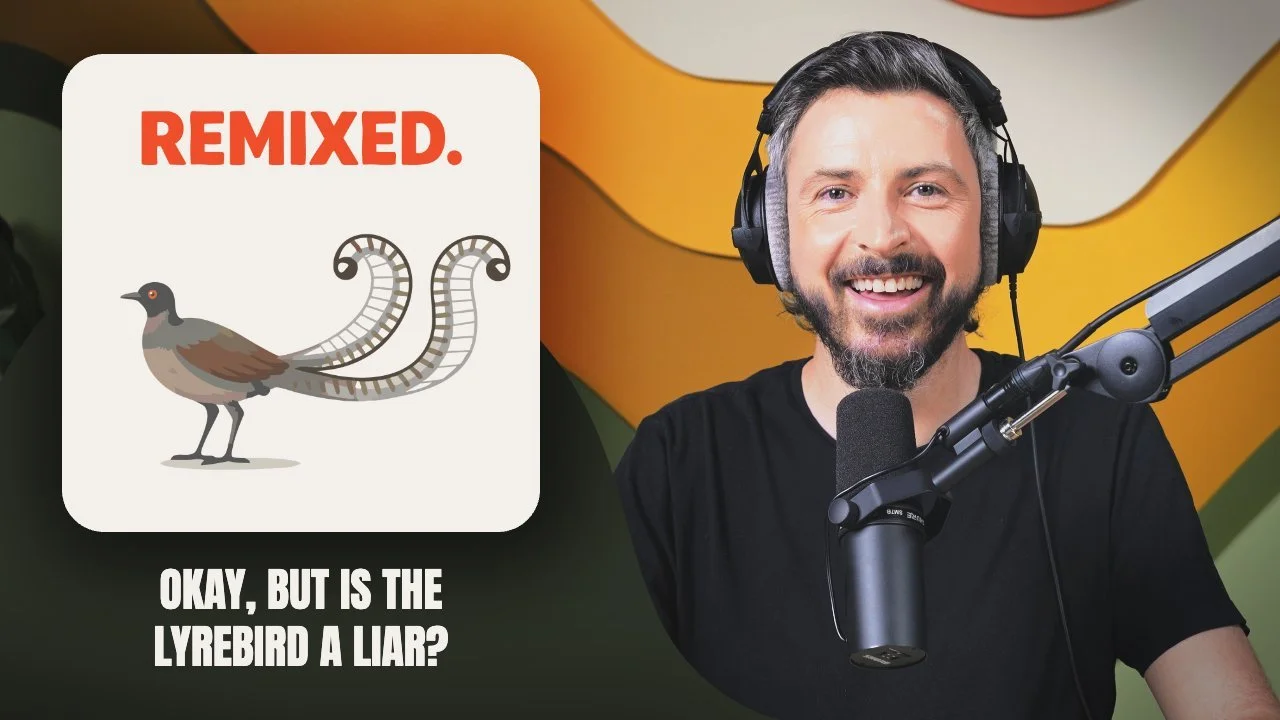
Release Date: Oct 22, 2026Lyrebirds can copy a chainsaw, a car alarm and a camera shutter, so it is easy to call them liars. Dr. Anastasia Dalziell of Western Sydney University has spent years recording them in the wild, and she explains what the famous Attenborough clip left out and why every sound a lyrebird borrows has a job to do.
Transcript
In this episode
- Why lyrebirds are named for the ancient Greek lyre, and why the stuffed museum specimens that gave them the name had the tail on wrong
- What the famous Attenborough clip of a lyrebird copying a chainsaw, a car alarm and a camera shutter shows, and what it leaves out: the birds filmed were captive
- How female lyrebirds defend a nest with the scariest sounds in the forest, and how a male mimics a whole mobbing flock to keep a female from walking away
- The Albert's lyrebird, which shakes a hooked wait-a-while vine in time to its song, and the lyrebird's own song, which is beautiful enough to stand on its own
Scott Taylor: You hear this. You scan the sky. You scan the tree line. You keep scanning and eventually you find it. A blue jay? You're certain you just heard a killdeer, except you're nowhere near a place that has killdeer, and none of it makes sense until you spot the European starling doing an almost perfect killdeer. Almost, not quite. Mimicry is everywhere once you start listening for it, and it will humble you. But today we're going to talk about what I think of as the Beyonce of mimics. This is the bird that probably comes to mind when you think about mimicry at all, and it's because of one video, David Attenborough, an Australian forest, and a bird producing the sound of a camera shutter. Then a car alarm, then a chainsaw. If you've seen it, you remember it, and you maybe even thought that some of it was faked. Lyrebirds. There are two species. The superb lyrebird, which lives across the wet forests of southeastern Australia, and now Tasmania, and is the one from the video. And the Albert's lyrebird, which has a much smaller range in a narrow band of upland subtropical rainforest and gets almost none of the attention. They are among the largest passerines on Earth. Passerines being the perching birds, the group that holds the sparrows and the finches and the warblers, most of which you could hold in one hand. A lyrebird is built more like a pheasant, long legs, long tail, spends its life walking around on the forest floor turning over leaf litter. They fly badly, they live a very long time, and they are exceptional mimics. We're talking about a bird that can mimic an entire ecological scene. More on that in a bit.
Scott Taylor: Which brings us to the topic of today's episode. Okay, but is the lyrebird a liar? To help us unpack that, I'm joined by Dr. Anastasia Dalziell, who studies avian ecology and evolution at the Hawkesbury Institute for the Environment at Western Sydney University. After the break, Ana tells us what that famous clip actually captured and what it quietly left out. We get into what a female lyrebird does when you get too close to her nest, And she walks us through the one moment in a male's life when he abandons the beautiful stuff entirely and reaches for something else. Stay tuned.
Scott Taylor: Welcome back to the podcast, everyone. I'm really excited to have Ana here today to talk all about lyrebirds. Thanks for joining us, Ana.
Anastasia Dalziell: Thanks for having me, Scott.
Scott Taylor: Of course, it's nice to reconnect after our time at Cornell together. I just thought we could start off with the name of these birds because I, for a long time, had assumed that they're called lyrebirds because they're mimics and so they're liars. But that is not correct, right?
Anastasia Dalziell: It makes perfect sense, but in fact, that's not the case. They are called lyrebirds after the ancient instrument, ancient Greek instrument, the lyre, because initially when the first specimens, stuffed specimens of lyrebirds were taken the early naturalists from Australia to Europe, they stuffed them incorrectly once they got to Europe and stuck their tails right up behind them like a peacock's display. And in that position, their tails do look a little bit like the ancient Greek lyre, which is something you kind of strum. And hold. You've probably seen them in the Odyssey lately. But that's completely wrong, and in fact when lyrebirds do stick up their tails, the males, they flip them over their head entirely so it looks like a veil. So even their name, I guess, is a lie.
Scott Taylor: Right. What an interesting place to start. Even their name is a lie. And I think most people know lyrebirds from this really viral social media clip or documentary where there was a bird that was mimicking the noises of chainsaws and car alarms and even the camera shutters. And I was wondering if you could tell us a little bit about what that video gets right and what it misses.
Anastasia Dalziell: Oh, it's a wonderful it shows really just how accurate the lyrebirds are in their mimicry and their breadth and what they can do. And it's so skillful. But the bit that's missing from the story is that the lyrebirds that were filmed for that clip, there's a couple of different ones, were actually captive birds. And they were captive-raised individual males. So they never had the chance to learn their song. And then mimicry from another male. So what they did have was all the sounds of the zoos or the wildlife parks in which they were housed, which they did mimic, and occasionally they sometimes mimicked these wild desert birds that a lyrebird would never ever meet in the wild. So it's a really good way of showing exactly how accurate they are, but it's not what they do in the wild.
Scott Taylor: Yeah. Yeah. Which brings me to like, I want to talk a bit about their mimicry because when you watch that video, you think, okay, these individuals are mimicking, you know, the sounds of chainsaws and the sound of a shutter, but it's like you're saying, these are captive birds that didn't have the opportunity to hear other singing males and natural bird sounds. So in like the natural settings, are they mostly mimicking other birds as well as singing kind of their own song? And, With all of that, what is a male lyrebird trying to accomplish?
Anastasia Dalziell: Sure. So if we start just with the male lyrebirds in the wild, they mimic most when they're breeding, which happens in the middle of the austral winter, which is very strange.
Scott Taylor: It happens in the middle of the austral winter? Huh.
Anastasia Dalziell: Yeah, these are, lyrebirds are actually strange for lots of different reasons. They're extremely big, they're really poor flyers, and they live a really long time. And part of that slow life history of living a long time is that the females will lay their eggs in the middle of the Australian winter, which, you know, it does actually snow in some parts of lyrebirds' range. It does get quite cold. And then the egg is in the nest for a very long time. And she doesn't actually have to feed the young. Until the months later. And then she has to do, she works quite hard. But so the males, of course, are singing to attract a female. And so they need to sing when the female's fertile and that just takes place in the middle of winter, which is very strange.
Scott Taylor: Yeah, that's so interesting. Mm.
Anastasia Dalziell: So if you do want to hear lyrebirds in the wild, the males, the best bet is to go out in the middle of the Australian winter when it's quite cold and hopefully quite wet because lyrebirds like a nice wet forest. And then they sing, and then they actually start off when they start mimicking, they're almost like a normal song, but they have a dawn chorus, they're starting, when they roost at the top of trees. So you actually walk into the forest when hardly anything's singing because nobody in their right mind is breeding at that time of year, except for the lyrebirds. Then the forest is just full of this mimicry coming from the top of the trees, and they're really loud, these birds. And so what they're doing with this song is they're actually mimicking mostly birds. Other birds that are in the forest but may not be very vocally active at this time of year.
Scott Taylor: Right, which is an interesting piece. Like they're mimicking birds they hear a different time of year during their breeding season. That's very cool. Yeah.
Anastasia Dalziell: Some of them, yeah. So something like the beautiful liquid melodic song of the Grey Shrike-thrush or the Golden Whistler named for their songs. Partially but they also mimic things like kookaburras which do actually vocalize laugh if you like all year round eastern yellow robins are the same and then quite a lot of parrots as well so some of the parrots in the lyrebirds forest they actually have quite beautiful song like vocalizations as well and so they're mimicking it's mainly birds but it's not everything not cuckoos, which is odd.
Scott Taylor: And so that's the males are singing, but females sing as well. Is that correct?
Anastasia Dalziell: They do. If you want to hear a female lyrebird mimic, your best bet is actually to really annoy her and find her nest and approach it. And then she will defend her nest by approaching you. They have a visual display that is quite similar to other species. It kind of makes them look bigger. They raise their crest and their wings come up and they're already big. And then they mimic things, and they mimic often very scary sounds like very large eagles, one of the few birds that's actually bigger than a lyrebird in the forest. And goshawks, which can actually eat adult lyrebirds as well as their young. And then small birds that are indicating that a predator is around. But the females, they mix it up. We've got recordings. When I say we, it's not me. Vicky Austin has recordings of lyrebirds mimicking introduced predators, like cats, for example. Meowing. It's really kind of odd. And we're a little bit suspicious, but we think we've recorded a couple of times a lyrebird, a female, mimicking the sound of two branches of a tree sort of squeaking together in high winds. And that is actually a very scary sound because we're working in a very tall forest full of hardwood trees. And when it's windy, those trees or just their branches fall down and can really injure people or kill them. A squeaky tree is actually a very scary sound.
Scott Taylor: It's so cool that the females are focused in on these scary sounds, they're defending their nest in these contexts. And the fact that they're using this interesting repertoire of scary sounds is, that's so cool to me, man. And you said they're big a couple of times, but how big are they? Like how much do they weigh?
Anastasia Dalziell: Yes, so the heaviest male that we've measured was 1.2 kilograms. And the females tend to be around 700, 800, maybe even 900 grams. These are the superb lyrebirds, which is the bigger of the two species.
Scott Taylor: Read this paper relatively recently. I don't remember what year it came out, I read it with my ornithology class and it was this paper where you found that males stopped doing these broader kind of melodic song mimicry bouts and start actually mimicking like the sound of a mobbing flock or an angry flock of birds in the forest. Can you talk us through the context within which these male lyrebirds switched to basically mimicking a mobbing flock? Because it's so fascinating.
Anastasia Dalziell: Certainly so while most of the time the males during the breeding season the males are mimicking this sort of song like a string of a different species of bird at key moments in their life like really crucial moments they actually switch to imitation of an ecological scene of a mobbing flock a flock of birds producing mobbing alarm calls. You can even hear the lyrebird mimicking the sound of wingbeats, and wingbeats are small birds, yeah, vocally mimicking, as these birds dart over a predator. Mobbing flocks among birds, they're really cool. So they often are instigated when a particular individual, like a prey species of bird, finds a hidden predator, often a snake in the environments that I'm working in. So it's a snake in the long grass or in the long undergrowth, the fern bracken. And then they see this predator, and rather than sort of going away in fright and horror, they actually perch quite close, often quite close to the ground, if there's snakes on the ground, and then they produce a very audible and very loud mobbing, what they call a mobbing alarm call.
Scott Taylor: Really? Oh, my God. Yeah.
Anastasia Dalziell: And this serves to attract other species of bird often, and other individuals of the same species. And you can end up with this very conspicuous group of several different species, of prey species, of other predatory birds as well, all producing alarm calls. Sometimes they will attack the predator. They'll actually fly at it. It's very conspicuous. So it's a complex but extremely reliable cue of the presence of a hidden predator. And so you think it's totally impossible to fake, but this in fact is what the lyrebird is doing.
Scott Taylor: That's so cool.
Anastasia Dalziell: Yeah, so I first came across it was my first year of doing field work and I was very happy because I've just seen and sound recorded a male lyrebird doing his full sexual display. This is a sort of song and dance routine using lyrebird specific calls, so not mimicry or songs. And it's beautiful and elaborate. And then at the very conclusion, he suddenly switched to what I immediately recognised was an imitation of a mixed species mobbing flock because I quite like mobbing flocks when I hear them in the wild I think oh how exciting and I go and see what kind of predator have they found who's going to turn up are they all going to produce mobbing calls or is it maybe they're going to bring in some very scary predator of the predator it's just so exciting it's just one of those ecological events it's like being at a theater it's so dramatic I was lucky enough to sound record and see a full successful courtship and mating again in my first year. And I was absolutely astonished to see that at the moment that the copulation happened, which takes place on the lyrebird's display, what they call a mound, it's sort of a circular patch in the forest floor that he has cleared and that's where he dances. And then if the female likes him and stays, he then They mate on the mound itself. It's on the forest floor. And the moment he got on top of her, he switched his song to this mixed species mobbing flock. It was absolutely bizarre. And also the other bizarre thing is that the copulation itself went on for ages for a songbird. It was 45 seconds with hardly any variation when we measured it from videos later on. Yeah, that's really long.
Scott Taylor: That's so long. I mean, we call it the cloacal kiss because it's just like, you know, one and done and they're out of there. 45 seconds is crazy.
Anastasia Dalziell: It is crazy and there's quite a long time to mimic if you've got that time. We think actually the cloacal kiss part of it may only happen at the end. We can't always see that. So But, yeah, so he's mimicking throughout and he's mimicking a mixed-species mobbing flock.
Scott Taylor: Is it so she doesn't run away? Like, is that the reason to extend the time, make her afraid of leaving this display area? Is that kind of the conclusion you've come to? Yeah. Yeah.
Anastasia Dalziell: We think so. We think you're right there, so a female has come to the mound and he's performed his beautiful elaborate song and dance display with his feathers displayed and his lyrebird-specific amazing songs. And then she goes, no, don't like you. And she steps off the mound into the long undergrowth which surrounds the mound. And it's at that moment that she steps off that he switches to this mixed species mobbing flock.
Scott Taylor: Ah.
Anastasia Dalziell: And this was really suggestive because the mounds, for reasons that are not entirely are built in long undergrowth, parts of the forest with long undergrowth, so that almost like a theatre in the round, like a small theatre in the round. It's really the female's force to be very close to him in this courtship. And it's cleared on the forest floor, which is good for dancing, among other things. But if she steps off the mound, she's stepping into long grass or long reeds or often long, very high bracken. It's often very high on me. It's like up to my shoulders or something when I'm standing. So she can't see her feet either and there could be a snake there she doesn't know she can't see very well so he's just at this moment she's trying to leave he's saying there's something really scary out there I've got this I'm not just giving you an alarm call I'm not just mimicking one species alarm call I'm mimicking an entire mobbing flock do you really want to go out there why don't you stay here with me and let's try this courtship thing all over again.
Scott Taylor: Yeah, give me another chance. What an interesting way of trying to get a female to stick around and this manipulation that he's doing to say, like, oh, yeah, come back to my display area. That's just, it's so fascinating to me. They're already such interesting birds. I mean, we haven't even talked about their dancing, but they have this... mimicry. They have their own song. And then to use vocalizations, you already said the females use vocalizations, mimicry to scare things away from their nests. And then now males also use it to try to keep them around long enough to mate. Like it's just, I don't know. That's kind of mind blowing to me.
Anastasia Dalziell: It's totally mind-blowing. I find these field-based recordings of live bird behaviour very satisfying because they provide an evolutionary explanation for why it has to be so complex, this mimicry. And so convincing. He's actually creating the acoustic illusion of two individuals calling at the same time. And you could swear that there were two species at different distances from the camera. He's creating a... the illusion of space there's the wing flutters of very small birds much smaller than the lyrebirds like six grams or something or eight ten grams you can really we don't identify them by species but we do you can really hear the size and it's also put together and then on top of that during the mating our videos suggest that the males are actually covering the eyes of the female So she cannot see whether there is a real mobbing flock or not.
Scott Taylor: And is he covering her eyes with his tail feathers or with his wings? Oh, man.
Anastasia Dalziell: Yeah, so I would have thought it was hard enough to mate when you're that big and for that long. And so you'd want to sort of flap to keep your balance. But in fact, his wings are right in front of her head and you're often on the camera, you can't see. Her head at all. And it's very risky for her to then develop a tolerance to that kind of signal because most of the time it will be true, there will be a snake that could be damaging to her or to her dependent young. So it looks like that's why in one of the explanations for the complexity and sophistication and the accuracy of the male lyrebirds mimicry.
Scott Taylor: Yeah, which is just, I mean, thinking about that evolutionary arms race. In this species, the males provide no parental care, correct? So the females come in. It's kind of like with hummingbirds. The females visit, mate, leave. They're the ones that lay the eggs and take care of the chicks. And so the refinement of his mimicry over evolutionary time to do this mixed species flock all the way down to wingbeats is insane. You've spent a lot of your career arguing about what actually counts as mimicry and what doesn't. What do you want people to know about what you consider to be mimicry versus not and why?
Anastasia Dalziell: Mimicry is in the mind of the receiver. If the receiver sees a similarity and then on that basis changes its behaviour in a way that benefits the original mimic, then that should be called mimicry.
Scott Taylor: Mm hmm. How stereotyped is the dance? Because you've studied the whole complex display. It's not just vocalizations, which we mostly know lyrebirds for, but the males also have this dance. Their feathers are moving. Is it quite stereotyped in terms of like every male does the same kind of dance or is it variable? Tell us a bit about that.
Anastasia Dalziell: Yeah, so the dance is really cool. I didn't intend to study dance in birds, but it became clear that I wasn't going to understand the song unless I understood the dance as well. So we studied both because they're totally integrated, the song and the dance in these sexual displays. So it is highly stereotyped within a location. So it starts, the males will start this song with this really strange sound. And it looks beautiful on spectrograms as well, very odd. But it sounds like a video arcade game from the 1980s. It's really laser gun-like. It has a pulse as well that's very distinctive. And for this song, he has his tail over his head, but it's spread out, so it really looks like a 180 degrees veil. It's quite elaborate. And then after that, he switches to this alternating between, I think we call it the B-C song. It's very boring names. And the B song is extremely loud. It's sort of two... In this population, it was two pulses. We haven't measured it, but there are reports that you can hear it over a kilometre away in the forest, really loud, quite low. And then that B song alternates with a very quiet sound. Sometimes it just goes plinkety-plinkety. It's very annoying on a spectrogram because it's quite clicky and it doesn't always resolve, especially when you just... maxed out your recorder because the B song is so loud. So technically it's a bit tricky to describe, but we discovered that when he's doing the plinkety-plinkety, he's jumping. Almost in time, or apparently in time with himself, with his wing flaps as well. That's not easy for a lyrebird to jump because they're so big. That's quite a thing. Yeah, so it's a highly structured event. It's more structured when there's actually a female there and they're trying to get a mating. These songs and their dances together, they vary geographically.
Scott Taylor: Yeah, which is so cool. They were moved to Tasmania on purpose, but were they ever native in Tasmania?
Anastasia Dalziell: As far as we know, no. So there are no reports since European colonisation of lyrebirds in Tasmania. There's no indigenous knowledge suggesting they were there. Australia's really bad for fossils, and birds are not great for fossils either.
Scott Taylor: No. Yeah, it's kind of two difficult things.
Anastasia Dalziell: So we don't know. But at one stage they got terribly worried about lyrebirds on the mainland because of the introduced foxes mainly. Foxes definitely eat lyrebirds when they get the chance. So they translocated some. They caught 22 individuals and they waited until the plane arrived in a part of Australia and I just realised it was in the middle of the Second World War so I don't know why they had a spare plane to translocate lyrebirds across to Tasmania because it's quite a rough passage from mainland Australia to Tasmania, but they did. And then they got to Tasmania and some of them had to go on top of donkeys and a few of the not very good motor cars, but they made it. 20 individual lyrebirds survived and lyrebirds are now introduced to Tasmania and they're very happy. And I've never seen lyrebirds look that happy, I have to say.
Scott Taylor: Really? So they're doing really well there. Do they have a population estimate now? Like how many are actually in Tasmania? Like hundreds? Thousands?
Anastasia Dalziell: Thousands, definitely. Yeah. I'm not quite sure what the latest number is, but it's probably higher than people think because it's a little bit hard.
Scott Taylor: Wow. I had no idea. Yeah, there are only two extant lyrebird species, and it's Albert's. Is that right? Albert's and Superb. And so Albert's doesn't get as much attention. How does it differ from the Superbs? We can give the Albert's lyrebird a little bit of a spotlight here.
Anastasia Dalziell: Great. So the Albert's Lyrebird is a little bit smaller than the Superb Lyrebird, but it's more colourful. It has a really rich, tawny colour that I often associate actually with rainforests. It's really more elegant in its colouring. It's also a great mimic and done by Fiona Backhouse has shown that they're more structured in the way they mimic. They really have a particular sequence in their mimic sounds. After you work out the sequence, you can predict what sound they're going to mimic next.
Scott Taylor: Oh, cool. That's cool.
Anastasia Dalziell: And it's still not randomly put together. They actually contrast the complexity of the sounds they mimic so that if you have a kind of a pure tone sound from, say, a Grey Shrike-thrush song, that will be followed by a very complex, buzzy-type sound, say, a flock of rosellas having an argument or the display sound of a satin bowerbird. It's all kind of buzzy and exciting. And these sequences that they compose of mimic sounds are shared We think superbs do something the same, but we haven't looked at it properly. But it's the whole order. It won't be as strict as what the Albert's do. So you have these mimetic songs that are actually cultural constructs and that vary geographically from place to place. So the other really cool thing about the Albert's Lyrebird is that when they do their song and dance display equivalent to the Superbs, so they have their own song, which is called the Gronking Song, rather than having these dance movements, they actually have a favourite vine in the display site and they hold onto the vine with their foot and they shake it in time to their song.
Scott Taylor: Really?
Anastasia Dalziell: It gets even more exciting because this vine is not just any old vine. This is usually a vine sometimes goes by the local name of a wait a while vine or a lawyer vine because it's a vine covered in hooks and once those hooks get into you can't go anywhere and they never let go.
Scott Taylor: Oh, you gotta wait a while. I see.
Anastasia Dalziell: You gotta wait a while or the lawyer's got you and these vines travel through the well vine thickets parts of the subtropical rainforest and so if you and they're they climb over all sorts of things. So if you shake just a little bit of the right vine, you end up shaking this huge area of the environment. So this lyrebird is sitting in the middle of this vine, so you can't see. The bird from outside the vine thicket. But once he starts shaking it, you can see this whole part of the forest is shaking in time to his song. And it's unbelievable. And they do that throughout their range. When there isn't lawyer or vine available, they sometimes even use introduced viney species and sometimes even rushes. But there's always something that they're holding onto and that they're shaking in time with their song and their sexual display.
Scott Taylor: The fact that they're doing it in time with their song is so cool. It's like very percussive feeling. And Now I got to get over there and see these birds. They're fascinating. I would love to see them in the wild.
Anastasia Dalziell: You do. Just come in winter.
Scott Taylor: Yeah, exactly. Well, that's the time when we wouldn't usually plan to go, but I suppose we do have the summer off here, so then we can come down.
Anastasia Dalziell: It is perfect.
Scott Taylor: We've reached the part of the show we call That's B.S., or That's Bird Stuff, where we give our guests an opportunity to debunk a myth that ruffles their feathers. So, Ana, what do you want to call BS on?
Anastasia Dalziell: That lyrebirds only mimic. It's not true. Lyrebirds have their own beautiful songs, both the males and the females. And in fact, it's so beautiful that if you just heard it and you didn't know that they would mimic, you'd write home about it. You'd write songs about it. It's just incredible. It ends with, like, a trial, sort of a.....that goes And I actually think that they're hearing the echo of their own song... in the cliffs and the granite, exposed granite and sandstone of some of the locations in which they live. And they've incorporated the echo back into their song. And then, look, and there's other parts of the range where the song is so different, you'd swear it was another species. And it's just... like a complicated piece of solo flute music. In fact, those lyrebirds are sometimes called the flute lyrebirds because their own song is so complex and melodic and beautiful.
Scott Taylor: That's amazing.
Anastasia Dalziell: So it's worth listening to the lyrebird's own song as well as their mimicry.
Scott Taylor: Yeah, we're impressed by the mimicry, but I love that they have their own beautiful songs. I appreciate that myth being busted. Well, Thanks so much for joining us on the podcast to talk all about lyrebirds, Ana. I think every time I learn about lyrebirds, I learn something new and they're even more interesting. We think about them just, I think, often as mimics, but they're dancers and they have their own beautiful song and all these really amazing natural history things. So thanks for taking the time to join us and tell us about them.
Anastasia Dalziell: Thanks so much, Scott. It's been really fun, and I love to talk about lyrebirds.
Scott Taylor: Well, me too.
Scott Taylor: Birds are dinosaurs, and around here we like our snacks, so we end each episode with a dinosaur nugget. Today's nugget is, the lyrebird is not a liar. The name is a mistake made in Europe by people who stuffed the bird wrong. But the better answer is that the whole question is aimed at the wrong thing. Mimicry isn't a party trick this bird performs. It's a tool. A female facing down a threat at her nest reaches for the scariest sounds in the forest. A male about to lose a mate reaches for a crowd that isn't there. Underneath all of it, they have their own song, which almost nobody talks about, and which is beautiful enough to stand on its own. So the honest version is, you're not listening to a bird that lies, you're listening to a bird that knows exactly what a sound will do to whoever hears it.
Scott Taylor: That's a wrap on this week's episode. Okay, but is the lyrebird a liar? Go back and watch the Attenborough clip. You've probably seen it, but watch it knowing what you know now, and it turns into a completely different video. Then go outside and pay attention to the mimics you actually have, like the blue jay pretending to be a red-tailed hawk. If you like this one, help us out. Leave a rating or a review and follow the show wherever you're listening. We'll catch you next time. Byeee.
This transcript was generated using AI-assisted transcription and may contain errors or omissions. Please refer to the audio or video episode for the most accurate representation.
Credits
All audio, video, and images in this episode are either original to Okay, But... Birds (© Okay Media, LLC) or used under license/permission from the respective rights holders. Media from the Macaulay Library is used courtesy of the Cornell Lab of Ornithology as follows:
- Red-tailed Hawk audio contributed by David McCartt, ML229578
- Killdeer audio contributed by Mike Andersen, ML129054
- Superb Lyrebird audio contributed by Vicki Powys, ML229691
- Albert's Lyrebird audio contributed by Robert C. Stein, ML309505
- Gray Shrikethrush video contributed by Ramit Singal, ML641225345
- Gray Shrikethrush audio contributed by Vicki Powys, ML229649
- Golden Whistler video contributed by Ramit Singal, ML641948342
- Golden Whistler audio contributed by Ramit Singal, ML272346391
- Wedge-tailed Eagle audio contributed by Vicki Powys, ML223274
- Gray Goshawk audio contributed by Ramit Singal, ML246142551
- Albert's Lyrebird video contributed by Fiona Backhouse, ML615390207
- Albert's Lyrebird audio contributed by Ramit Singal, ML141465291
- Albert's Lyrebird video contributed by Fiona Backhouse, ML615390194
- Albert's Lyrebird video contributed by Fiona Backhouse, ML615390209
- Satin Bowerbird audio contributed by Newton Hobbs, ML16236
- Albert's Lyrebird video contributed by Fiona Backhouse, ML615390211
- Superb Lyrebird audio contributed by James (Jim) Holmes, ML463586881
Superb Lyrebird recordings (2024 films): Justin Welbergen, Jaden Thompson, Elle Heiser, Yoon Lee, Fiona Backhouse and Anastasia Dalziell, Hawkesbury Institute for the Environment, Western Sydney University, Australia, and Cornell Lab of Ornithology, Cornell University, USA.