
E44: Okay, but what's threatening the apex predators of the sky?
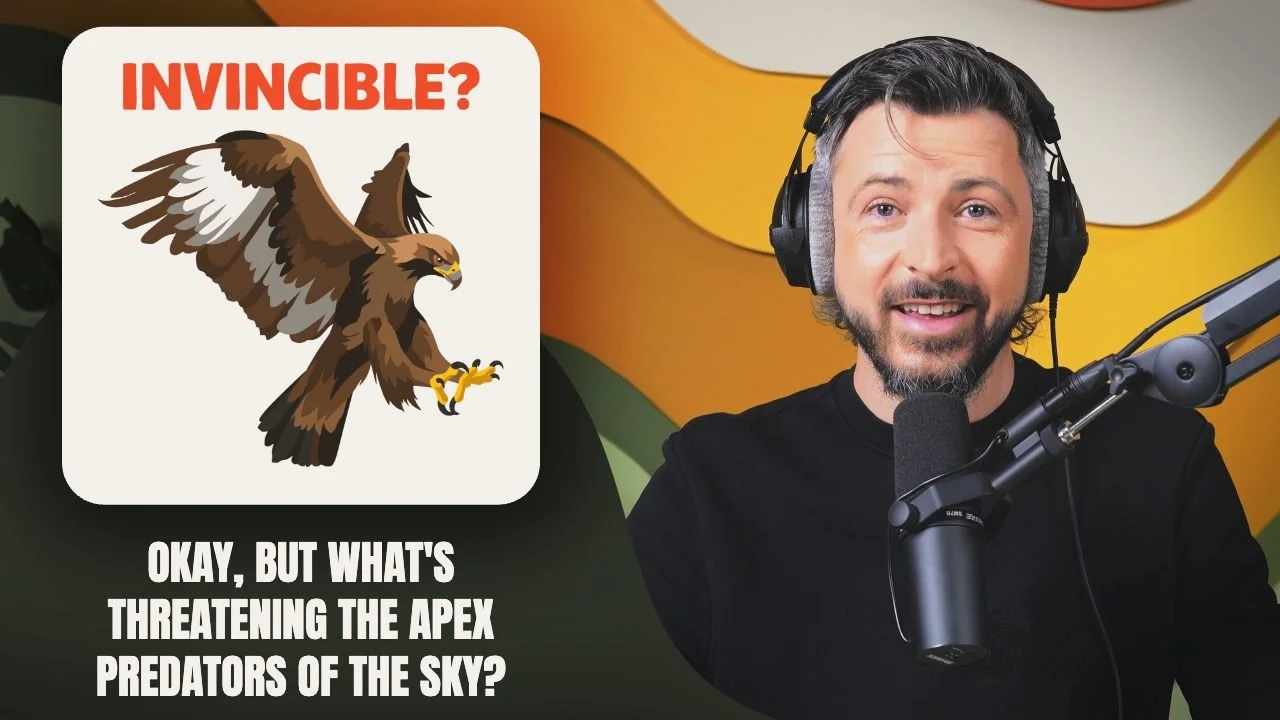
Release Date: Oct 15, 2026An adult eagle has no natural predators, so why are birds of prey declining? Dr. Todd Katzner, a wildlife biologist with the U.S. Geological Survey, explains the surprising dangers facing golden eagles and their kin, from spinning wind turbines to a threat small enough to fit on a grain of rice.
Transcript
In this episode
- Why golden eagles that can clearly see a wind turbine still collide with one: tip speeds of 100 to 200 miles per hour, orographic updraft that puts them at blade height, and no evolutionary history of threats from the sky
- What is being done about it, from siting wind farms and raising cut-in speeds for bats to IdentiFlight's camera-based shutdowns and painting one blade black
- How lead from hunting ammunition reaches eagles and California condors through gut piles, why a fragment the size of a grain of rice can kill a bird, and why griffon vultures will not flap their way across the Strait of Gibraltar
Scott Taylor: An adult eagle has no natural predators. Unless it's sick or injured, nothing looks at a golden or bald eagle and sees a meal. And yet, eagles and other birds of prey around the world have declined. Some of the reasons are what you'd expect. Habitat loss, nest disturbance, and pesticides have all cut into breeding success. DDT caused widespread nest failures until it was banned, and many raptor populations have bounced back since. Adults, which have evolved to live a very long time, face their own threats. They get electrocuted when their big wingspan bridges two wires. They get shot. They get hit by cars while hunting along roadsides. And there's avian flu, which we've talked about here on the podcast.
Scott Taylor: But some of the threats are more surprising. Growing up in southern Ontario, the nuclear power station down the road was just a fact of life. My dad worked there. It's the reason my family settled where they did. It's one of the largest nuclear facilities on the planet, supplying roughly a third of Ontario's electricity. So when wind turbines started showing up in the farm fields around our county, it seemed a little odd. We already had all that power. But the grid was there, it's a windy place, and clean energy makes a lot of sense. Today, wind supply is close to 10% of Ontario's electricity. In Iowa and South Dakota, it's more than half. That's a real win. But development always comes with consequences, and for wind energy, one of them is birds. Turbines aren't the only surprising threat. Another one is small enough to fit on a grain of rice, and it's showing up in eagles across North America.
Scott Taylor: Which brings us to the topic of today's episode. Okay, but what's threatening the apex predators of the sky? To help us unpack that, I'm joined by Dr. Todd Katzner, a supervisory research wildlife biologist with the U.S. Geological Survey. After the break, Todd explains why an eagle that can clearly see a wind turbine can still fly into one. We get into the tech trying to keep them apart, and we follow that other surprising threat from the landscape. Stay tuned.
Scott Taylor: Welcome back to the podcast, everyone. I'm really excited to have Todd with us today. Thanks for joining us, Todd.
Todd Katzner: Thank you. It's great to be here. I'm excited to talk about birds.
Scott Taylor: Yeah, I appreciate you taking the time. So we're going to talk a lot about golden eagles today, which are the largest species of native eagle in North America, but they're also in other parts of the world. Could you describe them physically for folks who don't have video?
Todd Katzner: Sure golden eagles are a they're a large bird they're brown they're called golden eagles because they have sort of a yellow gold set of feathers on the back of their head when they're young golden eagles have white sort of mixed in their tail and that's one of the ways we can tell them they have a Holarctic distribution they're distributed throughout North America and Europe and Asia all the way down into Mexico and North America. And they're actually all the way down as far south as Ethiopia in Africa. Yeah, there's an isolated population in Ethiopia, a small population. Golden eagles eat medium size to large mammals and birds. So they eat a lot of, they'll eat mice, but they eat a lot of things like grouse and marmots and rabbits and ground squirrels. They can take foxes. They do a lot of scavenging in the winter, so they eat deer and elk that have died for one reason or another. You know, bald eagles, you can see in big numbers in the Chesapeake Bay or in the upper Mississippi River in winter. Golden eagles tend to be a lot more solitary. They nest in trees or on cliffs. Particularly abundant in the American West, both in the United States and in Canada and in Alaska. There is an eastern population that is small. It's about 5,000 individuals. They breed in Quebec, Ontario, in Labrador, and they migrate down through the Appalachians in winter in the eastern U.S.
Scott Taylor: Oh I didn't know that.
Todd Katzner: Really cool, but hard to see, and their behavior seems pretty different in the East.
Scott Taylor: Oh, really? The eastern birds do behave differently? I've always wondered that because they nest north of where I grew up. And so we see them now with pretty good regularity. I mean, we see bald eagles like every day along Lake Huron, but we see golden eagles every once in a while. But out here, like almost every day I drive up Boulder Canyon, I see golden eagles in part because there's a nest that I drive by. But that's cool that there's behavioral differences between the east and west.
Todd Katzner: The biggest behavioral difference is sort of a habitat use thing. In the West, if you want to see golden eagles, you go to open habitats, right? In the east I used to think that open habitats would attract eagles but when we started putting telemetry on these birds we realized that during the winter they're really using forested habitats heavily yeah and it is super cool you know I I've seen them fly through the forest like a goshawk.
Scott Taylor: That's crazy.
Todd Katzner: It's really remarkable and actually I've taken some of those lessons to the west and you know we've put trail cameras out in the east to attract golden eagles and we put a roadkill deer in the forest we put a trail camera on it and what we've seen is if you put that trail camera out in a big field you get lots of bald eagles and ravens and the golden eagles don't bother to come near it if you put it in an opening in the forest it's 20 or 30 meters big you don't get bald eagles and you only get golden eagles and so it is super cool.
Scott Taylor: That's so cool. Yeah. I just don't think of them as a forest bird in any way. Like their wing shape is just not right for it. You know, when you see like a harpy eagle that has these short stubby little wings that are oddly small for its body size, it's because they help that eagle navigate like hunting in the rainforest, which is very dense. But it'd be so cool to see a golden eagle in the forest. I'll have to try harder next time I'm at home in the winter. Yeah. There are conservation challenges facing golden eagles in particular and other large birds of prey. And you've studied why golden eagles collide with wind turbines and wind energy has been kind of a growing sector in North America and across the world for decades. The past few decades. You tell us a bit about why they collide with wind turbines? I think when you're standing there looking at them, it's hard to understand why they might actually hit them. And a little bit about what's going on to kind of prevent it.
Todd Katzner: One way to do this is to kind of set the stage with some basic facts and I think those facts give context to understanding how this can happen the first thing that's really important to understand you know these wind turbines look like they're turning really slowly right when they're going fast they're doing something like 16 revolutions per minute, 16 or 17. So number, you know, I mean, your car is doing thousands per minute, right? And so they're going a lot slower in terms of rotations than a car or a bicycle wheel or something like that. The blades on these things are 40, 50 meters long, right? And so in the center, they're not going that fast. But the tip speeds out at the end, they can be 100, 200 miles per hour. So they're whipping around. You think about the amount of area they've got to cover. To do 16 revolutions per minute and it's really fast so even though the number of revolutions isn't that great parts of that blade are moving super fast and so that's one thing that's important to understand another thing that's really important to understand is how golden eagles fly golden eagles are like the vultures they don't like to flap their wings right they're not built to flap a hummingbird can flap like 50 or more times per second, right? Golden eagles would prefer to flap 30 or 50 times in a day. That's kind of their ideal day, right? They don't want to go, they don't want, they want to use environmental updraft to move. And so there's two basic kinds of updraft that birds like golden eagle use. There's actually a few more, but there's two main types. The most common or the one that we all know about is thermal updraft and so exactly yeah the sun is hot it heats the ground heats the air and the hot air rises right so when you see a bird circling it it's kind of riding the one well It's trying to stay within that column as it's going up, right? If you're a golden eagle and you're in a thermal, you tend to go really high. I mean, a lot higher than a wind turbine right so generally if you're in a thermal you're well above the ground you can get way up in the air the other type of updraft that a golden eagle or lots of birds use is what we call orographic or deflected updraft And so if a wind comes along and it hits a cliff or a hill, it's going to get popped up, right? Can't go down. It's got to go somewhere. It's going to go up. And so orographic updraft happens around buildings. It happens on hillsides. It happens on highway berms. You know, most highways are raised. And so you see birds soaring along ridge lines. You see them soaring over buildings. And if you watch a bird soaring along a building, or a ridge line if you see it coming in perpendicular to that ridge line when it gets right to that ridge line it's going to pop up when it gets to the edge of the building it's going to pop up because it's hitting that updraft I said thermals get really high in the air, right? And that's awesome. Orographic or deflected updraft is much lower, closer to the ground than is thermal updraft. And so orographic updraft in the best of conditions peters out at 200 250 meters above the ground a wind turbine is 100 to 150 sometimes 200 meters above the ground so if you're a golden eagle and you're riding orographic updraft you are right in the sweet spot for interaction with that wind turbine So we got two facts that I've kind of laid out. We got these really high tip speeds. We've got this use of environmental updraft that puts them right where they're in the danger zone. And then the third thing to understand...
Todd Katzner: Is that golden eagles are the boss of the sky okay they have evolved with nothing that basically comes after them except for maybe the occasional other golden eagle right they predation is not a serious threat in general for golden eagles and so when you're a golden eagle and you're in the sky you don't need to worry about anybody coming after you from above or from the side.
Scott Taylor: Huh.
Todd Katzner: So there's nothing in their evolutionary history that has prepared them for a threat from the sky. So we know that golden eagles see wind turbines, but what we think is that they're particularly vulnerable when they're distracted. Right and so there's evidence that when they're hunting they're at particular risk so they're flying along but they're looking down below them they're not looking where they're going and there's actually evidence when people have watched migrating golden eagles near wind turbines you can see them coming down a ridge line and then they'll kind of bend out of the way go around the wind turbines and come back if you see them when they're foraging you know, they're like us or a dog or something. They're focused on their goal and they don't always pay attention to the other stuff. Another time when they get hit is when there's social interactions, when they're afraid of something or they're reacting to something or they're chasing another eagle. Those are the types of things. So you got these birds that are encountering this object that's moving really quickly in the sky. They're using updraft that puts them right at just at the wrong altitude above ground to be at risk they're not evolved to think about risks and then they're distracted you know they're playing with their cell phone or something and they don't see what's coming you know yeah.
Scott Taylor: Yeah, looking for a hare to attack or something like that. Yeah, and when I think back to the first time I saw wind turbines, it was when I visited California as a kid. And they are also often built on ridge lines too for exactly the same reason that the eagles are there. So that is not a great combination. Do we have an idea how much mortality is caused by wind turbines across the country? And especially in the, you know, we've... There's a lot more wind turbines now than there were 30 years ago. Yeah.
Todd Katzner: Yeah it is it's really hard to get accurate empirical or data-based estimates for this and the reason is that regulatory constraints on the energy developers are sort of short term. So generally, if you're building a wind facility, you're required in many situations, not all, but in many situations, you're required to monitor for one to three years, right? After that, you're no longer required to monitor. So, yeah.
Scott Taylor: That seems short-sighted.
Todd Katzner: You know, there's a whole suite of trade-offs that need to be made, right? And monitoring is expensive. And so, you know, right now we're using electricity and that electricity comes from somewhere, right? And our electricity would be more expensive if... there was more monitoring if there was more this there was more that it would be cheaper if there was less of that stuff and those are social trade-offs you know one of the things I'm a USGS scientist and so my job is to focus on the science and not speak to the social trade-offs but it those do exist and those are things that the decisions that get made.
Scott Taylor: What's being done kind of reduce mortality then is there anything we can do I've seen other kinds of designs of wind turbines although what I've kind of seen in North America is all the standard if I asked you to draw a turbine that's what it would look like but there are other designs and what other things are being done.
Todd Katzner: Basically if you want to reduce the risk to golden eagles or any bird from wind turbines there are kind of two times you can do it pre-construction basically means Don't put it in the bad places, put it in the good places, right? Pre-construction depends on science, people studying where the birds go, trying to anticipate what the risk might be. It's inherently imperfect. But there is quite a bit that we can do it's also cheaper because if you have two identical plots of land and I mean identical in terms of the wind resource the connection to electrical infrastructure land ownership if one of them is bad for collision risk and the other has low collision risk then it's really cheap to just pick the one that has low collision risk The other alternative is post-construction. And post-construction, there are a couple of different things that you can do. One of them, anything post-construction costs money, right? And so one of the things you can do is what has been termed operational mitigation, basically turning off the wind turbines. And so the blades get feathered below a certain wind speed. And it turns out that if you want to reduce the fatalities of bats, you just raise that threshold just a little bit. And it's something as simple as below four and a half meters per second, the turbine blades don't bother spinning. If you raise that to five and a half meters per second, then you reduce your bat fatalities by 50 or 80%. And your annual energy production is only about 1% different. So it really is, it's probably one of the most, the simplest, most straightforward ways that we can mitigate. If you want to talk about mitigating for eagles there has been there has been some operational mitigation seasonal shutdowns during the breeding season during the summer when they're hunting things like that there's some of that that's really expensive because you're shutting it down for weeks at a time potentially the other thing that people have done that has been fairly effective and I've been involved in some work with this has been using computer vision systems or radar systems. The most effective of these can actually go and take a picture of a bird, identify it, use an AI system or a machine learning system to identify what species that is. And, you know, it's not a perfect identification. It's saying it's 80% likely to be a golden eagle or a ferruginous hawk or whatever. And then it makes a decision is this golden eagle or ferruginous hawk coming towards the turbine is it close enough that we need to do something about it and then if it's close enough is it a species that we care about because we might care less about turkey vultures than we do about golden eagles the computer system can then shut down the turbine there's really good data showing that works really effectively in some settings, right? So I was part of a study at a wind facility called Top of the World in near Casper, Wyoming.
Scott Taylor: That's not too far from here.
Todd Katzner: Yep, it is not too far from you at all. And convincing evidence that IdentiFlight was making a really nice difference for the survivorship to the eagles. Top of the World is fairly topographically simple. It's kind of rolling hills. You put the same things in Altamont where the hills are much steeper and there's a lot more topography. Computer vision is good, but it can't see through hills. So if an eagle's behind a hill, right? So it doesn't work as well in some of the more complex settings, there are a few other things. I'm also part of a study that's happening right next to Top of the World near Casper at a place called Rolling Hills, where the company that owns this facility has made a massive investment in painting one blade out of three, painting it black. And there's some research out of Europe suggesting that fatality rates dramatically decrease when you paint one out of three wind turbine blades black so we've got a long-term study the stuff out of Europe is generally small numbers of turbines we've got 28 of them painted and we are super excited about it it's a multi-year study and you know we don't have any preliminary information but it's one of the ways that people have proposed you could be making a difference.
Scott Taylor: That just makes the turbine more visually obvious to them or stands out more on the landscape or something like that. Interesting. Yeah. There are other threats and one of the other ones you've thought a lot about and looked into a lot with respect to eagles, although this threat is, to other birds as well, like scavenging birds and water birds is lead poisoning. And, you know, you and I have. Probably played with toys that we shouldn't have historically but turns out like a lot of I don't know Fisher-Price stuff from when I was a kid has higher lead content that you might have wanted sometimes people don't understand where birds even get lead poisoning from. So can you tell us a little bit about the main routes for lead poisoning and then how big of a problem it is? Because it's actually like a huge problem.
Todd Katzner: It's a big deal. The one source of lead that is pervasive and that gets spread all over the landscape is lead from hunting ammunition. I should preface what I'm about to say by saying that I hunt. I hunt pretty regularly. When I started hunting, I used lead ammunition. I don't anymore, and I haven't for a number of years. Historically, lead was used in shotgun ammunition for waterfowl hunting. And it's been known since the 1880s or so that lead poisoning affects waterfowl. And what happens is that when a shotgun is discharged over water, most of the pellets end up falling to the ground or into the water and where they become available to be ingested by ducks or other waterfowl as grit because they want pebbles or small objects in their crop so they can...
Scott Taylor: Yeah, and they're little round objects. Of course they would eat them. Yeah.
Todd Katzner: Exactly and so lead poisoning affects almost all types of Anseriformes ducks and geese or it has affected them and there is we no longer use lead for waterfowl hunting and the real the reason that happened It's a great success story. And a big reason it happened is because the duck hunting community realized that this was having negative effects on the resource that they were using and that they depended on for their duck hunting. And so a lot of the pressure for this came from the duck hunting community. Hunters are conservationists much of the time. There is still lots of legacy lead out there. What does this have to do with eagles? So what's happening now is that the lead that is used for hunting is used for upland game bird hunting, shotgun hunting, turkey, grouse, things like that, squirrels, and it's used in rifle ammunition. Eagles and vultures and hawks get lead into their system because they eat gut piles from hunter-killed game or they eat an animal that was wounded that stumbled off that wasn't recovered by a hunter and eventually died. And those have become an increasingly important source of lead poisoning. So California condors you know one of the rarest birds in the world the only thing holding back their recovery is lead poisoning.
Scott Taylor: I know I heard that recently and I was shocked that like, it's a thing we know how to solve and we've solved with ducks. And then it's still this problem because we're still using lead shot and all these other ways. It just is kind of mind blowing that we have the solution. We see that the solution works and we haven't been able to pull it off yet in that context.
Todd Katzner: Well you know it's interesting so we see the same thing with eagles one of my graduate students had a really nice paper where he showed we got samples from over a thousand eagles from across North America and we showed that basically 50% of these eagles have evidence of repeated high exposure to lead on a regular, so it's not just like a one-off, like every year they're getting it time and time again. And the evidence you see are lead levels in bone. And we call it chronic, well, we don't call it chronic exposure. Veterinarians have established a threshold that they call chronic exposure. And that means above this level, this bird is experiencing health impacts from that lead. And that's a threshold that's clinically determined by veterinarians. Most of the eagles in the country have this. All of the California condors are repeatedly exposed to lead. I think Americans and humans don't enjoy being told what to do. Don't tell me what to do, right?
Scott Taylor: Yeah, fair enough.
Todd Katzner: But hunters were conservationists. That's something I said before, and we have good evidence for that. And so in Arizona, there were programs that were started to encourage hunters to either use non-lead ammunition or if they kill the game animal in condor range to pack the gut pile out, right? So that you're not leaving lead on the landscape. And there has been huge numbers of hunters who have subscribed to that and it has had a positive effect for condors. And so if you give people the voluntary option and you say, hey, you know, if you're using lead, you're going to end up poisoning birds as well. If you use copper, you're still going to enjoy your hunt, but you're also going to not poison birds. A lot of people subscribe to that. A lead bullet is designed to fragment when it hits a game animal when a lead bullet hits a deer there can be many hundreds of tiny little pieces of lead in that deer the ducks and geese are getting this because they want grit. Eagles are getting this because they're eating a gut pile and a fragment the size of a grain of rice can kill a bird.
Scott Taylor: Yeah. Birds, they don't have teeth, as we've talked about on the podcast before. And they have this really cool organ called the gizzard. And in the gizzard is where they grind up their food. And in order to help with that, they consume little pebbles or stones that get worn down over time. And so that is why they would maybe see a tiny little ball of lead and eat it on purpose and then get lead poisoning and die. So yeah, a very interesting distinction. We've reached the part of the show we call That's B.S., or That's Bird Stuff, where we give our guests an opportunity to debunk a myth that ruffles their feathers. So, Todd, what do you want to call BS on?
Todd Katzner: I'd like to call BS on the common misperception that birds need to flap to fly. And this really ruffled my feathers because I submitted a paper to a scientific journal once. And we talked about the soaring flight of golden eagles. And we did all kinds of cool statistical analyses on this. And we sent it to a big journal that I don't like to send papers to anymore. And the editor grumbled about it and eventually sent it, I think, to one of their friends to review it. And their friend should have known better, but basically told us that the biggest problem with the paper was that we were forgetting about the most common type of bird flight, which is flapping flight. And the reality is if you're talking about golden eagles or vultures or things like that, they don't want to flap if they can avoid it. They do everything they can to avoid it. So let me give you an example. I mentioned earlier that hummingbirds will flap something like 50 times a second, right? And so they're flapping, you know, thousands of times a minute. Probably hundreds of thousands of times per hour, day, whatever. Griffon vultures, which are a soaring bird, they migrate through Spain, and they cross the Mediterranean to go to Africa. It's a 14 kilometer gap there between Spain and Morocco. And if the bird doesn't time it right, they will fall into the water and drown and die. So they are very careful about how they do this and I have a friend of mine Keith Bildstein sat down there at Tarifa in southern Spain and just watched griffon vultures and he just counted the number of flaps they made and what he found was if they flapped more than 20 times per minute they would get over the water and they'd say, this is too hard, I'm going back. And so they would not try to make the flight if they were flapping more than 20 times per minute. So you've got hummingbirds that flap. Two or three times that in a second and griffon vultures who when they're making a 45 minute crossing and they don't want to flap 20 times per minute and so I think that it's you know sure lots of birds flap but all birds even hummingbirds use subsidy at some point they use updraft and some of them rely almost exclusively on it.
Scott Taylor: Yeah, well, that's an awesome B.S. Thanks so much for joining us on the podcast. I really appreciated getting to hear all about these amazing birds. So yeah, thanks for taking the time.
Todd Katzner: Absolutely it's fun to be here great to talk to you about this stuff.
Scott Taylor: Birds are dinosaurs, and around here we like our snacks, so we end each episode with a dinosaur nugget. Today's nugget is, some of the biggest wins for wildlife come from the smallest changes. For example, bat deaths drop by 50 to 80% when wind turbines wait for just a little more wind before they start spinning, and the turbines lose only about 1% of the energy they generate. For birds, early research suggests simply painting one blade can reduce collisions. When hunters switch from lead to copper or pack out their gut piles, eagles and condors stop swallowing lead fragments. And when climbers skip a few routes during nesting season, raptors can raise their young in peace. We don't have to choose between clean energy, hunting or the outdoors, and healthy birds. We just have to make a few smart choices.
Scott Taylor: That's a wrap on this week's episode. Okay, but what's threatening the apex predators of the sky? Speaking of small actions that make a big difference. If you enjoyed this episode, follow, subscribe, and leave us a review wherever you listen. We'll catch you next time. Byeee.
This transcript was generated using AI-assisted transcription and may contain errors or omissions. Please refer to the audio or video episode for the most accurate representation.
Credits
All audio, video, and images in this episode are either original to Okay, But... Birds (© Okay Media, LLC) or used under license/permission from the respective rights holders. Media from the Macaulay Library is used courtesy of the Cornell Lab of Ornithology as follows:
- Bald Eagle audio contributed by Darrell Peterson, ML145265541
- Golden Eagle audio contributed by W. Douglas Robinson, ML612942188
- Golden Eagle audio contributed by Kathy Groschupf, ML57165
- American Goshawk video contributed by Dan J. MacNeal, ML297994251
- Harpy Eagle audio contributed by Curtis Marantz, ML81101
- Ruby-throated Hummingbird audio contributed by Trenton Voytko, ML604314061
- Ferruginous Hawk audio contributed by Gerrit Vyn, ML172487