E27: Okay, but… pigeons!
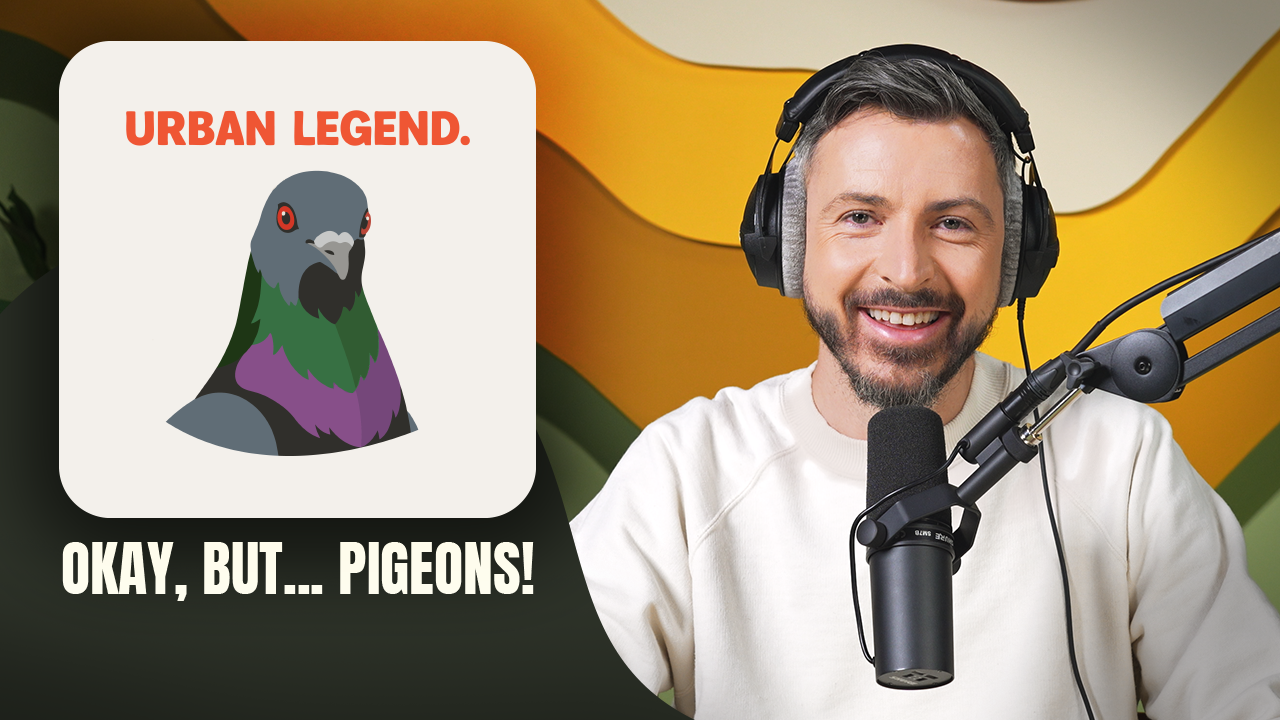
Release Date: June 18, 2026They’ve been called "rats with wings," but pigeons are actually elite athletes, historical icons, and evolutionary marvels. Scott Taylor chats with Dr. Elizabeth Carlen, a postdoc at the Living Earth Collaborative at Washington University in St. Louis, to look past the common stereotypes and uncover the remarkable biology of the Rock Pigeon.
Transcript
In this episode
- How a domesticated bird went feral and became the most successful city bird on the continent
- What thousands of years alongside humans did to pigeon behavior and tolerance
- How feral pigeons survive cities full of peregrine falcons and red-tailed hawks
- Why pigeon population structure across the Northeast mirrors human geography
- What flight distance between city populations reveals about urban evolution
- Why the bird people dismiss as a pest is one of the best urban study systems available
Scott Taylor: Two medals for valor, a 99% cancer detection rate, a starring role in Charles Darwin's most important book. And if you live in a city, you probably stepped around one this morning and called it a. Pest. We do this with a lot of common things. In North America. A Blue Jay is a flash of cobalt and a loud opinion in the trees, and for most experienced birders, it barely earns a second glance. Hand a pair of binoculars to a visitor from the UK or Japan and watch what happens when a Blue Jay lands 6 feet away. Now take that we stop noticing it. Instinct give the animal a cosmopolitan range, an outsized ability to thrive next to humans, and a tendency. To occasionally. Poop on a windshield or your head and you stop noticing it a different way. You start being annoyed by it. You stop calling it by its real name. You start using the slur rats with wings. You write it off.
Scott Taylor: Enter the pigeon, AKA the Rock Dove, AKA the Rock Pigeon AKA depending on your last sidewalk encounter. The pigeon is one of the most successful and quietly remarkable birds on the planet. They were one of the very first birds humans ever domesticated. Between 5 and 10,000 years ago. They navigate by the sun and Earth's magnetic field. They carried military communications across two world wars with a 95% delivery success rate. Charles Darwin kept them as pets and used them as the central case study in On the Origin of Species as a textbook example of the power of artificial selection to generate many forms. From one, they have learned to distinguish between paintings by Monet and Picasso, and in one study at UC Davis, learned to spot cancer in pathology slides at roughly 99% accuracy. As a flock, every rat with wings you stepped around in a subway station is descended from a bird that has been quietly outperforming our expectations for centuries. Which brings us to the topic of today's episode. Okay, but pigeons. To help us unpack just how awesome pigeons are, I'm joined by Dr. Elizabeth Carlen, an evolutionary ecologist and postdoctoral fellow at the Living Earth Collaborative at Washington University in Saint Louis. She did her PhD on the feral pigeons of the northeastern mega city from Boston down through DC. Which led to her. Research being featured on Saturday Night Live and got her dubbed the Pigeon Stalker by The New York Times. After the break, Liz walks us through. What the global takeover of urban spaces by pigeons actually says about urbanization as a force of nature. We get into our own research, which found that something as simple as how close a human can get to a pigeon before it flies turns out to be a window into evolution happening in real time. Stay tuned.
Scott Taylor: Well, welcome back to the podcast everyone. I'm really excited to be joined by Liz to talk all about pigeons.
Elizabeth Carlen: Thank you so much for having me, Scott.
Scott Taylor: Of course, I thought we'd start off with just the fact that most people write pigeons off. You know, they're these birds we see day-to-day, especially if we live in cities. People write them off as a nuisance. Some people call them unfortunately rats with wings, but like. Tell us all the. Reasons why they're getting it wrong.
Elizabeth Carlen: They're getting it wrong for so many reasons. First of all, instead of thinking about pigeons as a pest, let's think about them as this organism that has been kind of forced to live in this environment that it's not. It wasn't designed to live in it. It didn't evolve to live in in these cities. And here it is doing a phenomenal job living alongside us and, and really taking advantage of that urban habitat. So they're, they're scrappy little guys, You know, they're, they're underdogs in a way. I, you know, I did my PhD in New York and oftentimes pigeons were the only wildlife that I was seeing on a daily basis. And it was kind of that reminder that I could be connected to nature even in a city. Think when we're surrounded by concrete and pavement and buildings, we kind of forget that we as humans are still a part of nature. And these pigeons were this beautiful reminder to me that that we are a part of nature. Here they are living alongside us. And hey, they're actually supporting the peregrine falcon population. They're supporting the red-tailed hawk population. And so I really liked that aspect of pigeons, more than I ever thought I would.
Scott Taylor: Definitely, yeah, I think that that piece that we do live with nature, we're part of nature and pigeons can remind us of that regardless of where we are, is is really beautiful. And and, you know, they're with us in all these places for a lot of really interesting reasons, right. Like they didn't just, if we think about their native range, which is, and correct me if I'm wrong, but like I think of the Strait of Gibraltar as part of the native range of the, you know, the Rock Dove.
Elizabeth Carlen: Yeah, North Africa, the Mideast and Southern Europe are kind of where where the they evolved.
Scott Taylor: And then, like, what are some of the reasons we brought them with us? Because they didn't just fly to North America or South America or other parts of Europe, right?
Elizabeth Carlen: Right. So they're on six of the seven continents now because European colonizers brought them with them in part because they were really tasty. They they're really good. And if you ever get the chance to eat squab, I highly recommend it. It tastes a lot like beef. You know, it's this really rich dark meat. And you know, that is that is one reason we brought them with us. They're this lovely tasting animal. On top of that, their guano, their poop produces fertilizer. And we can, you know, have pigeons in these dovecotes and then they poop everywhere. And we scoop that poop out and we toss it on our agricultural lands. And so they're not only providing meat, but they're helping fertilize our crops. And that's like a win, win. And so we started bringing them everywhere because they they provided this for us.
Scott Taylor: Squab is still on the menu, but typically now only at high end restaurants. A lot of people order squab. I don't think they maybe even realize that they're eating a pigeon or a rock dove. From a just urbanization and force of nature perspective, what can we learn from pigeons?
Elizabeth Carlen: So I think for a long time, we thought that evolution took a really long time to take place. That was when I was kind of going to school. We're like, oh, it's on the order of millennia. And here we are finding out that, you know, urban spaces can provide this this very rapid selection for organisms. And so for me at least, pigeons are this great case study of urban evolution where cities are shaping this wildlife population. And so I'm really excited about pigeons as this potential model to study cities all around the world. And I was quite surprised when I entered my PhD and people were not working on these wild pigeons. There were very fair, very few groups thinking about pigeons, and maybe that's because they're considered a trash bird, but there's a lot to be studied there in terms of how are they doing in urban spaces. How are they, you know, how are they not developing diabetes when they're eating donut? There was one of my favorite places in New York City to catch pigeons was a place where someone would come and dump out bags of doughnuts for the pigeons.
Scott Taylor: Really.
Elizabeth Carlen: And, you know, 2300 pigeons would flock down into this little square and eat up those doughnuts very quickly, fly away. And then maybe 45 minutes later, another person would come out and dump a bag of rice. And so how these pigeons were able to kind of eat this this human anthropogenic food and, and be able to not get super sick from it, not develop diabetes, these high blood sugar levels, not develop all these endocrine problems and digestive problems. I think is really interesting.
Scott Taylor: Yeah. And so in that context of this altered diet, there's other species in urban spaces that people are starting to study and think about the same questions, right? Like these urban diets typically are more complex carbohydrate rich than a natural diet. And that does have implications for I think raccoons and coyotes and possibly other species have been studied in the same context, like over evolutionary time. How are how are they changing in order to actually be able to process these foods, which is really cool. Some of your research looked at how close a human can get to a pigeon before it flies away. One, why is it interesting? Like why were you excited to look at that specifically? And then what's driving the variation that you found?
Elizabeth Carlen: So I thought this experiment was so funny because I can guarantee everybody listening right now has done this experiment at some point in their life.
Scott Taylor: True participatory science, right?
Elizabeth Carlen: Right, right. That everybody has looked at how close they could get if they could catch the pigeon, if they could touch the pigeon, all of those things. And I, I really liked that idea. And then additionally, like when I got to New York, people and I said I was studying pigeons, people kept saying, well, you know, why can I get so close to pigeons in Times Square? Like I could practically kick a pigeon in Times Square. They won't get out of the way. And I thought that was really interesting because Times Square is just, it's flooded with people. But, you know, Prospect Park looks very different than Times Square. And, you know, Greenwood Cemetery looks very different. So there were, you know, New York has suburbs and industrial areas and heavily urbanized areas. And so I was just really interested in this question. We use flight initiation distance really frequently as an animal behavior study, which is just, again, how close can I approach this organism before it starts to flee? And it doesn't have to fly away. It could run away or jump or, you know, however it escapes and it, it seemed like a, an easy project that nobody had tackled, which was kind of surprising. And so an undergrad that I was working with went out and collected hundreds of data points walking around the city and got to see all parts of New York City. We went to Staten Island and tried to find pigeons on Staten Island, which was more difficult than I thought it would be.
Scott Taylor: Oh. Interesting.
Elizabeth Carlen: Yeah.
Scott Taylor: Staten Island's pretty suburban.
Elizabeth Carlen: Yeah. And, and we found that in areas with more impervious surface, more roads, fewer trees, less canopy cover, you could approach a pigeon more closely. We don't know if this is a behavioral modification that pigeons know that in in places like Times Square, if they don't run away, maybe they'll get a food reward. Or maybe that humans aren't really a threat and so they don't really need to exert energy to flee that animal, right? Because there's this cost benefit analysis that each organism is doing as it's deciding. Do I stay and continue this behavior that might provide some selection advantage? Or do I get away from here because this is a real threat? And so in these heavily urbanized areas with lots of people, lots of buildings, lots of roadways, you can approach these pigeons. But as soon as you get to places that are, that have more tree cover, have fewer people, the pigeons aren't going to allow you to approach.
Scott Taylor: Is that a learned behavior? That's something that they learn from other individuals in the flock.
Elizabeth Carlen: Unfortunately, because we were walking towards these animals and see how close we could get, we also then could not capture them.
Scott Taylor: Right. Yeah, the.
Elizabeth Carlen: Whole point, the whole point is to see them flee. And so we couldn't, we couldn't capture them. So we don't know if it's a, a genetic mechanism or not. And you know, they are responding to cues in their environment. My my undergrad Richard, who's now a PhD. He's now a doctor He just defended.
Scott Taylor: Congrats, Richard. Nice.
Elizabeth Carlen: He came up with this great word because, you know, sometimes we'd be going to approach a flock of pigeons and they'd all scatter like we don't, we don't think we did that. We don't think that was us. He's like, we were hawk blocked. The hawks moved down and and blocked us from collecting our data point at that location. And that happened frequently. So we know these hawks were hunting these pigeons, that these pigeons were aware of what predators were around them. And so we also ended up looking at at predators and found that in places with more peregrine falcons, you could more closely approach pigeons and in areas with more red-tailed hawks, you couldn't approach pigeons as easily. And I was so confused by this. I am not an ornithologist. I am a, I'm a pigeon specialist. This, I was so confused by this difference of peregrine falcons and, and red-tailed hawks. And why would pigeons be responding differently in areas with these? But those two predators hunt very differently. Peregrine falcons hunt in the air. Red-tailed hawks hunt on the ground. So it might be worth, you know, the pigeons are doing these calculations where they're saying, oh, if there's red-tailed hawks around, I'm just going to get out of here. And if there's peregrine falcons around, maybe I'll, I'll just kind of stick around a little bit longer. And red-tailed hawks are also notoriously like, OK with people being around. I had one in Washington Square Park just like swooped down so close to me. I could feel the air rushed by me. And, and peregrine falcons typically won't get that close to us. And so it could also be that pigeons are using people as cover.
Scott Taylor: Yeah, that's really interesting to think about the the human shield of it all, which we've talked about in another episode with Fran Bonnier. Thinking about urbanization specifically. Like in certain situations, if organisms can get everything they need and humans provide kind of this protection from predators, that can actually be good for their reproductive or there's individual fitness, you know, if they survive. And so peregrines and and red-tails, I guess, are the main predators, at least in North American cities of pigeons. And I'd imagine in other parts of the world, it's other kind of large raptors picking off adults. Are there any other like predator prey relationships that are interesting to think about in the context of pigeons in cities or?
Elizabeth Carlen: So feral cats are probably eating pigeons.
Scott Taylor: Right.
Elizabeth Carlen: Yeah. But unfortunately, we couldn't get data from New York City on where the feral cat populations are, so in New York.
Scott Taylor: City.
Elizabeth Carlen: Yeah, so New York City actually tracks this. And there are there's cat colony people that know where the cat colonies are and feed the cat colonies. New York City tracks this, but they were not willing to share that data with me.
Scott Taylor: Interesting cats are very controversial. Cat lovers love cats and bird lovers don't. And outdoor cats do lead to the deaths of, you know, billion plus birds a year, plus other things, small mammals, snakes, etcetera. So they are a problem. Yeah, I guess that makes sense that they would prey on pigeons. So pigeons do very well in cities and it's partially because we've created cliffs for them and they are in the wild cliff nesters. Could you talk just a little bit about just the pigeon from eggs to fledging and where they build their nests, how they build their nests, and what pigeon babies look like?
Elizabeth Carlen: So most people or there's a rumor going around that pigeons are not real. This is something that 20 year old boys seem to ask me when I come and give guest lectures about pigeons. And part of this started because people have never seen baby pigeons, or at least think that they haven't seen baby pigeons and baby pigeons. Maybe you don't want to see one. They're not very cute. They are not they're they're not like ducklings. They're not like little chicks. They are pretty weird looking. They're usually hatched in clutches of two and both the male and the female are caring for the offspring as they're being raised those babies, because the parents will produce this, this pigeon milk, which is, is very different than mammal milk. It is not secreted by a mammary gland. It is produced in the crop and is kind of a cottage cheese like substance that they're then regurgitating into the baby chick's mouth. And you know that that very fatty, rich substance helps this chick grow up very quickly. And so another reason that we may might not see these baby birds is because you don't realize necessarily that you're seeing a young individual. Often times people will take a picture and send it to me and say, hey, this pigeon looks really, you know, gross what's going on with it. And I'm just like, that's just a very young pigeon. It hasn't grown into its plumage fully yet. And and so that's part of why you think it looks weird. The mother and father will kind of co-parent these two chicks, raising them in the nest. The nests are not the most beautiful nest that you've ever seen. Like hummingbird nests are so intricate and they take the lichen and place it around and they're just beautifully made pigeons. Find a cliff, find a flat place, put a stick or two there so the the eggs don't roll off and they are good to go. And you know right after I defended my dissertation I get a phone call from my cousin freaking out and she she FaceTimes me and says a pigeon laid an egg on my bed while I was out of my apartment for the day.
Scott Taylor: In New York City.
Elizabeth Carlen: In New York City, she had left the window cracked open a few inches and a pigeon had come in. She had put her single stick down on the bed and laid her egg because she found a very nice, you know, comfortable place.
Scott Taylor: Yeah, your cousin. Was lucky to have an expert on the other end of the line to be like what do? I do.
Elizabeth Carlen: What do I do? She was so happy and I said she could turn it into avocado toast and charge a hipster, you know, an impermanent amount of money.
Scott Taylor: Take it down to Brooklyn, yeah. Yeah, yeah, no free range pigeon egg.
Elizabeth Carlen: Instead, I told her to just dispose of the egg and, you know, put the stick outside and close the window. And that you know, pretty quickly the the mother and father would would start would lay another clutch and start to raise a new a new set of of pigeons so they can reproduce about every six weeks.
Scott Taylor: Wow, Yeah, I was wondering that because like there are a lot of pigeons, but they don't lay a lot of eggs per individual. But if they can do that rapidly, and this pigeon milk thing is just so cool to think about. I mean, it's gross and in a way, but fascinating. I think it evolutionarily some of the same cells. So they're not mammary glands, obviously, because they're birds. But there's similar molecular pathways, I think, between the pigeon milk that these birds produce and the milk that mammals produce, which is just amazing. And then if you think about like on a bunch of episodes of the podcast, we've talked about like the insect apocalypse and the fact that a lot of insect eating birds are declining because their food resources are going away with for various reasons. But pigeons don't need to feed their chicks insects. They feed them this stuff they make themselves that they convert maybe doughnuts into if the adults are eating doughnuts and making their pigeon milk. And so they're like primed to be really, really successful in these these habitats that we have like heavily altered. It's just so cool to think about.
Elizabeth Carlen: It's it's really awesome that yeah, that we get to have this bird that's that's evolved alongside us that's able to take advantage of our our same resources.
Scott Taylor: Yeah, totally. I mean, along those lines, you mapped the genetics of these feral pigeons. And maybe if you could talk about just what the word feral means before we get into this, but you did this across the entire northeastern US and you found that their population structure mirrors human geography, which is just so interesting. So tell us a bit about that research and what you found and, and what surprised you out of all of that?
Elizabeth Carlen: Yeah. So when I started working on pigeons, I was like, oh, just like this flight initiation distance study, it's going to be super easy to catch pigeons. I was very naive in that it was not that easy to catch pigeons. And I went through a whole set of different techniques trying to capture them because I needed a large sample size. I needed pigeons from, you know, these 6-7 cities all up and down the East Coast and ended up using something called a net gun, which looks really cool. It makes me feel like Spider-Man. So it, it looks like a big flashlight, right? And it shoots this net out over the pigeons and and captures them, kind of tangles them up. And luckily, because just of how doves are, they're pretty calm, which once you've caught them.
Scott Taylor: Yeah, yeah.
Elizabeth Carlen: And they'll never bite you, you know, like they're this, this great organism to work on as soon as you figure out how to catch them.
Scott Taylor: Yeah, they're much nicer than a chickadee, which will just peck and peck and peck and sometimes even draw blood.
Elizabeth Carlen: Yeah, the cardinals, because they have those beaks to to crack open seeds. I mean, my finger turned black and blue from a cardinal bite. But pigeons, I've stuck my finger in their beaks and there's nothing. Although there is one breed of pigeon that that is slightly aggressive we can talk about.
Scott Taylor: Yeah, let's get into pigeon breeds after we talk more about the genetics of all this.
Elizabeth Carlen: Yeah. Because pigeons have this ability to kind of fly and move, I was, I was interested in them across this wide range. My PhD advisor actually suggested that I, I really broadly expand because they are this feral organism that's kind of in all these cities. Feral is a complicated term for a lot of people and there is a lot of disagreement over what feral means. To me broadly, it means an animal that was once the the species was once domesticated and now it's back kind of in the wild living on its own. And I think there's a common misconception about pigeons, that they need us to survive. And so you see a lot of people feeding pigeons because they feel like they, the pigeons need us. And so if I don't go dump this bag of rice or this bag of doughnuts, you know, the pigeons won't survive. They'll be OK. They are still wild animals.
Scott Taylor: Yeah, they're resilient.
Elizabeth Carlen: They are. And so these, these feral organisms, you know, are, are just living alongside us and Boston down to Washington, DC is known as the BosWash corridor or the Northeast mega city. And it, you know, contains 17% of the US landmass. So not a lot of the US landmass, but like 53 million people in this area. So it's super heavily urbanized. I collected blood from pigeons, from hundreds of pigeons that I caught all across this area and then basically built 23andMe but for pigeons. So I, you know, figuring out who's related to who, who is distant cousins with who else, and then was able to kind of map out how that that family tree mapped back back onto the landscape. And I found that pigeons from Boston and Providence were genetically kind of different from pigeons in New York and further South. And that was weird. That was not at all was I was expecting, I was expecting each city to kind of be this urban island because you typically don't see pigeons in the suburbs. But then when I started to look at this this region more, this light at night, when you light up that region at night, you see that there is actually massive connectivity between New York and Washington DC and then across Connecticut, you get this like suburban forested area and then you have Providence and Boston. And So what I think is going on is that the pigeons like hit Connecticut and they're like, this is weird. Why would I cross this forest? I'm not a forest bird. I'm not a forest bird. I don't do forest, forest or dangerous right there. There's other birds in there. There are other things that could hunt me. I'm good. I'm just going to go back to the city. And so while we do see pigeons, like very randomly scattered across Connecticut that, you know, in the cities, that something about just this big block of suburbanization is kind of preventing the pigeons from wanting to move. And it was not at all what I was expecting. And I am super excited to hopefully expand this project across the US to see if that pattern holds.
Scott Taylor: Yeah, it's really interesting. I think we come into things as scientists with ideas and and when the pattern doesn't match the idea like flips the way we need to think about it. And the fact that forests are likely barriers or these large forests that areas urban forests in the case that you're talking about would prevent a bird from moving if if you know, it's more of this cliff-dwelling urban adapted species, really, really interesting. You're, you're doing this work in this very open environment, right? And so people are walking by you and asking what are you doing? What, what are you doing, crazy lady?
Elizabeth Carlen: Yeah.
Scott Taylor: And, and bags of pigeons, right.
Elizabeth Carlen: I would take like the paper bags from Whole Foods. And when the pigeon would come out of the net, they'd go in a paper bag to kind of dark, safe, calm space. And so I'd have like, you know, 10 paper bags lined up and then I'd be pulling a pigeon out of each. One, yeah. And and I look kind of odd. And of course, in New York City, that's not the weirdest thing anybody has seen that day. And so the New Yorkers would just kind of pass me by. But in other cities, I would get stopped and asked, what are you doing? I would get asked if I was handing out food. And then I'd have to explain, well, you don't really want to eat city pigeon because there's lead level poisoning in many of them, right?
Scott Taylor: Yeah.
Elizabeth Carlen: So if you're if you're going to eat squab, you know you want farm raised squab. I wouldn't recommend eating anything out of out of these American cities at least.
Scott Taylor: Yeah, and we alluded to this earlier, but pigeons were important in On the Origin of Species. You know, there's whole parts of the book dedicated to the speed with which artificial selection can change one into many. And there are many different kinds of pigeon breeds, right?
Elizabeth Carlen: Right. So most people kind of think of when you say breeds, they think of something like dog breeds, right? And as diverse as dog breeds are, pigeon breeds are equally diverse, if not more. And there's tons of different breeds of pigeons, everything from these little chubby guys that almost look like teddy bears to ones with curly feathers. Sometimes they'll have a big fan tail that almost looks like a peacock's tail. They'll have feathered feet. They come in all different colors, from all white to all black with iridescence. And sometimes they have like, a naked neck, which looks really weird. Or they'll have a really long limbs, like long legs.
Scott Taylor: Yeah, there's. This really tall ones and the ones with the tiny, tiny little bill.
Elizabeth Carlen: Right, Tiny tiny bill that have to be hand fed.
Scott Taylor: Oh my God, do they?
Elizabeth Carlen: Yeah, that's crazy. The breeders will hand feed them. And so there's all this diversity that we've been able to breed into pigeons, which is really cool. And in the same way that we have dog shows, we have pigeon shows. And I highly recommend going to a pigeon show if you get the chance. The people there are super interesting. They love pigeons. They're, you know, just all kinds of people, people that grew up on farms, kind of grew up doing this, people that got into it later in life. And it, you know, I was offered so many pigeons by these people. Like if you want to get started on pigeon breeding, we will give you your first 10 pigeons and you never took.
Scott Taylor: Them up on it.
Elizabeth Carlen: I live in an apartment.
Scott Taylor: I mean, that sounds like you could just do it on the roof, right? Come on. We've reached the part of the show that we call That's B.S. Or That's Bird Stuff where we give our guests an opportunity to debunk a myth. That ruffles their feathers. So Liz, what do you want to call B.S. on?
Elizabeth Carlen: I want to call B.S. on the fact that pigeons are dirty. I'm so sick of people telling me that pigeons are gross, dirty birds and that I'm going to contract rabies. From them. That is wrong. For anybody out there, pigeons do not have rabies. They can't have rabies. Their body temperature is not a temperature that rabies can survive at. It does not survive in birds. It is mammal specific. You are a mammal. A pigeon is a bird. It's not going to give you rabies.
Scott Taylor: Awesome. Well, thanks so much for joining us on the podcast today. It's always such a pleasure to talk to you, and I'm happy to have learned much more about pigeons, so thanks for taking the time.
Elizabeth Carlen: Thank you for having me.
Scott Taylor: Birds are dinosaurs, and around here we like our snacks, so we end each episode with a Dinosaur Nugget. Today's nugget is: pigeons are so much more than rats with wings. They aren't actually dirty, although they do carry high levels of lead because of the pollution we've exposed them to. They're great parents and they feed their chicks milk. And if you're new to bird watching, pigeons are a great way to start. No binoculars, no app, no hike. Just look down. That's a wrap on this week's episode. Okay, but pigeons. If you're now slightly less likely to call a pigeon a rat with wings, our work here is done. Leave us a rating, drop a review, hit like and subscribe and tell a friend who still needs converting. We'll catch you next time. Byeee.
This transcript was generated using AI-assisted transcription and may contain errors or omissions. Please refer to the audio or video episode for the most accurate representation.
Credits
All audio, video, and images in this episode are either original to Okay, But... Birds (© Okay Media, LLC) or used under license/permission from the respective rights holders. Media from the Macaulay Library is used courtesy of the Cornell Lab of Ornithology as follows:
- Blue Jay audio contributed by Gaetan Dupont, ML173749
- Rock Pigeon (Feral Pigeon) audio contributed by James Kimball, ML3891
- Peregrine Falcon audio contributed by Mike Andersen, ML136378
- Red-tailed Hawk audio contributed by David McCartt, ML229578