E26: OKAY, but did birds originate the open relationship?
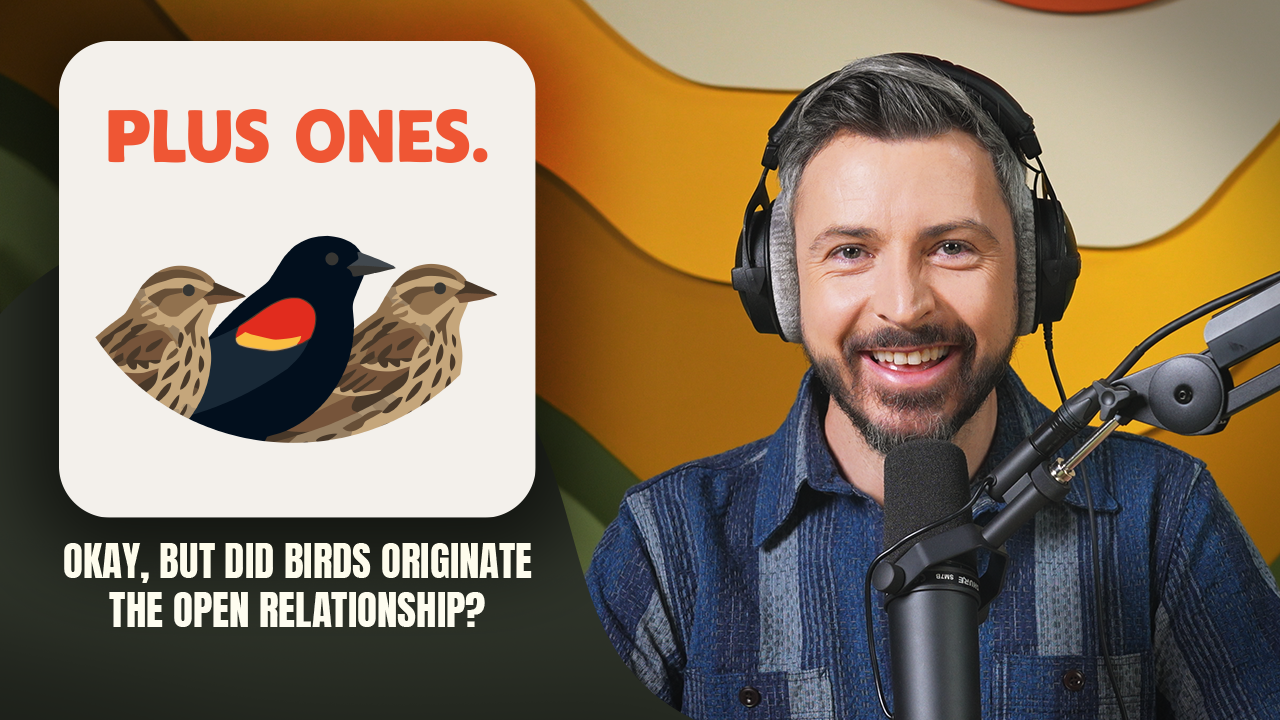
Release Date: June 11, 2026 We borrowed a phrase from human dating and tried to pin it on birds. Turns out they never needed the rulebook. Dr. Wenfei Tong, biologist and author of Bird Love, joins Scott to unpack what bird partnerships actually look like once you stop projecting our scripts onto them, from females who run the territory to males who guard their paternity in deeply weird ways.
Transcript
In this episode
- Why one of the plainest birds in the garden has among the most complicated sex lives
- How a female dunnock ends up with more than one mate defending her territory
- What changes when the female controls the better patch of habitat
- What cloacal pecking is and what a male gains from it
- How sperm competition shapes behavior after mating rather than before
- Why a single species can run several different mating systems at once
Scott Taylor: There are two ways to tell a bird love story. There's the March of the Penguins version: two birds waddling toward each other across the ice, swelling music, a voiceover about devotion and mating for life. And then there's the Maury version. The DNA results are in. You are not the father. Last week we put out our 25th episode, which feels like a good excuse to go back to where this whole thing started. Episode one. Okay, but is bird monogamy just PR? That's where we drew a line between two kinds of monogamy. Social monogamy is who you see a bird with: the partner it shares a territory with, builds a nest with, and raises chicks with. Genetic monogamy is who actually made those chicks. And here's the thing: although most birds are socially monogamous, almost none are genetically monogamous. The gap is where the drama lives. So 24 episodes later, here's today's question. Okay, but did birds originate the open relationship? And to jump ahead, the answer is not quite. Not because birds are more faithful than we thought, but because "open relationship" is our term, built around our rules, for getting around our expectations. Birds never agreed to any of that. They aren't bending the rules of monogamy. They're running on a completely different set of pressures we keep trying to read our own story into. Food, neighbors, predators, timing, genetic compatibility. But semantics aside, I'm excited to welcome Dr. Wenfei Tong, biologist and author of the book Bird Love, to the show. After the break, Wenfei walks us through what bird partnerships actually look like when we stop projecting. We get into why cooperation and conflict are happening in the same nest at the same time. And we talk about what all of this says about the stories we tell ourselves. Stay tuned.
Scott Taylor: Well, welcome back to the podcast, everyone. I'm really excited to have Wenfei with us today. Thanks for joining us, Wenfei.
Wenfei Tong: Thanks so much for having me, Scott.
Scott Taylor: Yeah, of course. So in episode one of the podcast, we proved mating for life is mostly PR. But monogamy is just one of many ways that birds pair up and raise chicks. Could you walk us through the range of bird mating systems?
Wenfei Tong: Yeah, thanks, Scott. That's such a fun topic. One of the things I really wanted to cover in this book, Bird Love, was just that word you mentioned: range. That there's such a range and such a spectrum and such flexibility, not just among species, but within species. So, you know, humans, we like to classify things, we like things in neat, tidy boxes. So we've got four main categories of mating systems. You've got social monogamy. Then you've got polygyny, so one male, multiple females. You've got the flip of that, polyandry, so multiple males mating with a single female. And my favorite, polygynandry, which humans sometimes refer to as promiscuity. It's just everyone mating with everyone else, no strict pair bonds formed. And some of this can take place flexibly within a single species. The whole mating system thing is really about investing your genes in the next generation. Who wins the lottery in terms of getting more genes? If you think about finding a partner as a way to get more bang for your genetic buck, then sometimes if offspring are really expensive to rear, like a human, or like a Laysan albatross, a long-lived bird that needs a lot of learning and experience and childcare, then often it's not possible for both parents to raise the chick. So for the majority of birds, social monogamy exists because you basically need more than one parent to successfully rear anyone. And there's so much cool conflict that goes on in terms of who gets to do more of the care, who has to do more of the care, and how you could punish your partner if they try to play hooky or mate with someone else. So for birds that don't need so much childcare, where it's possible for one parent to successfully raise the offspring, that's where you tend to see polygyny or polyandry take place.
Scott Taylor: Yeah. Or the promiscuity. But it makes sense that in general it takes a lot of work to raise chicks. I think about the chickadees that we study. If you have 10 little baby chickadees in a nest box, it's impossible for one parent to bring enough food over the period these chicks are growing rapidly. So obviously evolution would favor at least two birds raising these chicks. And in some cases you even have helpers at the nest, which we've talked about in other episodes. It makes intuitive sense that this social monogamy piece would be so common. And then it's really fun to think about what evolution does with those mating systems when one individual can successfully raise the chicks.
Wenfei Tong: And some of my favorite examples are populations where it could go either way. A lot of shorebirds especially have fairly independent kids who hatch with their eyes open, can run fast, find their own food. They don't need that much care. And then whoever can skip off first often does. There's a study looking at lots of shorebirds: in general, if the migration is very long, the female tends to disappear first and leave the male holding the chicks.
Scott Taylor: Nice.
Wenfei Tong: The explanation there is partly that it's so expensive to lay the egg, she then has to fuel up for her migration, so she's not going to also take care of the chicks. And in some cases it's a mating-market game, a game-theory thing of whoever is rarer. If males are rarer, they're more in demand, so it's easier for them to find a new partner, in which case they get to abscond first, and vice versa. In the Kentish plover, I think, is the best example: if females are the rare ones in a population, they're the ones who leave first, and the males are all holding the chicks.
Scott Taylor: Yeah, the flexible examples are really cool. I saw a spotted sandpiper nest once and it was...
Wenfei Tong: They're cool because they're polyandrous.
Scott Taylor: Yeah, they have sequential polyandry, right? The female builds a nest, lays eggs, and then once the male's incubating, she leaves to go do it again somewhere else.
Wenfei Tong: I think so. And she's bigger and showier, and the males choose her based on her spot size. Very cool.
Scott Taylor: Yeah. And that kind of bleeds into the next thing I wanted to chat about. In jacanas, for example, males do all of the parental care and females are territorial in these marshes that jacanas live in. Phalaropes have females that compete for mates, and the female phalaropes are brightly colored, and we tend to refer to this as flipped sex roles, since it's most common that males are the colorful territorial ones. What are your thoughts on how this evolves and what determines which sex invests more in the offspring? It seems common in these shorebird-esque creatures.
Wenfei Tong: Yeah. Of course we come to this with a very mammalian, high-investment-by-mother, primate, great-ape view of things. If you were talking to fish, the flipped sex roles would be completely different. My son has a really lovely Eric Carle book about seahorses and pipefish, with paternal care being the predominant role in many fish. So I'm all for that. One of the explanations everyone comes up with is just ancestry. A lot of the ratites, the tinamous, birds that split off from the tree of life fairly early, have predominantly male incubation and a lot of male care. Cassowaries take this to an extreme, where the females are much larger than the males and fight for the males. And there's that idea that if you only need one adult to take care of the kids, it frees up the other one to start competing for mates. The only example of females being large and competitive and males doing all the childcare that exists in a bird with altricial young, and by altricial I mean very helpless, naked, blind, pink little chicks, is the black coucal. And they're fascinating. They're part of the cuckoo family, but they're non-parasitic.
Scott Taylor: Okay.
Wenfei Tong: They're the only birds we know of with that kind of very helpless chick where there's very strong sexual selection on the females. The females are, I think, 70% larger than males or something like that. And they do all the classic male things: they sing, they defend the territory, and the males do all the childcare. How that evolved in black coucals is really fascinating, partly because the other coucals don't quite do this. They may have hints of sexual selection on the females, but not such a strong skew.
Scott Taylor: Yeah, I didn't know that about black coucals. This altricial versus precocial young thing: when you were describing the shorebird young, that's what we think about as precocial. If you've ever hatched eggs or had chickens, when they come out they look like a little bird, they're functional, they can run around and eat. That's precocial. And, you know, when you're a kid who asks a lot of questions, you might be called precocious. But altricial is maybe what we're more familiar with, which all passerines have: helpless, little, pink, don't even have their eyes open when they hatch. So it's very cool that coucals actually have altricial young alongside this male parental care.
Wenfei Tong: And it could be, in some cases, that's associated with very high predation. Black coucals do suffer very high predation rates. I think spotted sandpipers that we were talking about often do too.
Scott Taylor: Yeah.
Wenfei Tong: So in those situations, the explanations, and these explanations aren't mutually exclusive...
Scott Taylor: Yeah, exactly. Important to remember.
Wenfei Tong: It's helpful. And sometimes it's hard to test them, that's the other thing. But they sound good. I know you've got an episode on cooperative breeding.
Scott Taylor: Yeah, with Nancy.
Wenfei Tong: But I find it so interesting that the flip side of this is something biologists like to call cooperative polyandry. Which basically means you've got a system with multiple males helping to feed the offspring of at least one female, sometimes multiple females as well. So the distinction between that and cooperative breeding in general sort of breaks down for me. But the thing a lot of those systems have in common is very limited resources, like a limited number of nest holes. One of my favorite examples is eclectus parrots. You've got some flipped-sex-role stuff going on. Female eclectus parrots are this amazing bright red and purplish-blue color, and they live in places like Australia, Papua New Guinea. The males are very blended in with the canopy green, still beautiful and striking, but definitely not the one you'd typically pick as the male if you saw a photo of both sexes. And there the nest holes are really in short supply. So females will savagely guard their territories, their nest holes, and the males are all dying to find any nest hole, any female, and then they all try to mate with that female and she lays eggs. And sometimes there's more than one female who lays eggs in a nest hole.
Scott Taylor: Really? So the females will sometimes cooperate, even.
Wenfei Tong: To the extent that the females are sharing the nest hole.
Scott Taylor: Yeah, yeah.
Wenfei Tong: But this brings up the question of where cooperation starts being competition and conflict as well. With eclectus parrots it's fascinating because they have a very skewed sex ratio, one of the most skewed of any bird we know. Lots more males than females. And sometimes the skew seems to happen really early on. We don't know exactly how they do it, but some of it seems to be infanticide by mom.
Scott Taylor: Oh, interesting.
Wenfei Tong: She only lays two eggs at a time, so once they hatch they're really easy to sex because of these color differences. And there's suggested evidence that mum will kill off daughters more than she kills off sons.
Scott Taylor: Wow.
Wenfei Tong: There's also a suggestion that mom can manipulate the sex ratio of her kids before she even lays the egg. And this might be easier in birds because, as you know, the females are the ones with the two different sex chromosomes, not the males. So you end up with all these extra males who are just dying to father something or someone. And so they're totally willing to share the paternal care, and the paternity of a single nest hole of chicks.
Scott Taylor: That's interesting. Why are their nest holes so limited? I guess parrots typically don't excavate cavities, so they're reliant on cavity production by some other species, or what?
Wenfei Tong: It's the right kind of tree, maybe.
Scott Taylor: Oh, okay.
Wenfei Tong: I don't know. They're very fussy, I suppose.
Scott Taylor: Yeah, they look like they'd be fussy birds. You see them and you're like, standards. Little fancy. In other systems where there's a resource that's limited, like marshes, which are patchy habitats across the landscape, male marsh wrens, for example, can take over a lot of a marsh. And then you get multiple females nesting within that male's territory because they just need a marsh to breed in. It's either multiple females with one male, or you don't get to breed. So it's similar in the sense that there's this controlled resource by one sex that leads the other sex to be okay with sharing a mate.
Scott Taylor: I mean, I guess the other classic is the red-winged blackbirds.
Wenfei Tong: Right.
Scott Taylor: Where the females do this. It's almost like the females are doing this mental calculus of, is it better to be on a very good territory but be female number two, so you don't get as much help, but still maybe your odds of raising more chicks are better than being the only social mate of a male with a subpar territory.
Wenfei Tong: Yeah. In red-winged blackbirds, probably the most familiar bird to folks listening, do males help with parental care? If they have multiple females within their territory, are they provisioning all of those nests, but at lower frequencies?
Scott Taylor: Yeah, I think so. Although in some birds, and this is one of my favorites, in one of the flycatchers in Europe, there was a study where males would provision based on how much they thought they'd sired the chicks.
Wenfei Tong: Okay.
Scott Taylor: And you can manipulate this by temporarily kidnapping the male, so he knows he didn't fertilize those eggs, and then he reduces his care on those nests.
Wenfei Tong: Interesting.
Scott Taylor: So that's part of the conflict, part of this deal.
Wenfei Tong: Yeah. We've talked a lot about systems where you have one of one sex and multiples of the other. There are a lot of birds with these crazy elaborate mating displays. Things like bowerbirds, that basically build art installations to attract a female. Or manakins, the famous ones. Manakins are crazy. They do all these amazing displays, including moonwalking. Why do these absurdly elaborate courtship displays evolve? What about mating systems allows that to happen?
Scott Taylor: It's a winner-takes-all situation, typically. Whoever's most attractive, given their displays or songs or plumage or all of the above, it tends to be one or two individuals out of a large population who pass on their genes to a very large proportion of the next generation. And that's what allows this kind of elaborate stuff to evolve. Why they do that is what everyone loves to try to explain. One of my favorite explanations brings it all the way back to Darwin, when he proposed sexual selection as purely arbitrary. It's just a fashion that evolved, an aesthetic preference. A very famous evolutionary biologist named Ronald Fisher managed to model it, and we tend to call it the sexy son hypothesis these days, because mostly it's females doing the choosing of very elaborate male plumage. I love that idea because it's so arbitrary: from a single fashion preference, in a few generations, amplified over time, you get very large differences in which sex has ornaments and which doesn't, and the elaborateness of those ornaments, purely based on preference. And that ornament evolves to become more and more elaborate until it sort of breaks down, because you just can't escape predators with a huge tail or a beacon of shiny feathers in everyone's eyes. There's always a trade-off. The other main flavor of explanation, not mutually exclusive, is that these very costly displays must be an indicator of something like good genes. So you could say it's a handicap, because only someone strong or well-defended against parasites or fast enough can mount such an expensive display. Like, you can only afford a Porsche if you genuinely have money. You can't just steal a Porsche.
Wenfei Tong: Well, you can, but you'd get put in jail. Or it would break down.
Scott Taylor: It would break down fast. You wouldn't garner all those matings.
Wenfei Tong: Exactly. You'd be limited.
Scott Taylor: Yeah. So there's that part of the elaborate-display explanation as well. But I really like the idea that based on just arbitrary preference alone, some of this could happen.
Wenfei Tong: And in a lot of these systems, where you have incredibly elaborate courtship displays evolving in males, the young are often altricial, but females don't have that many. In birds of paradise, I think it's just a couple chicks. I don't actually know for bowerbirds, but they also live in parts of the planet where there are lots of resources, tropical rainforest or resource-rich areas. Thinking back to "it takes two parents to raise all these chicks because they require a lot of investment", in a lot of the habitats where we see these super elaborate males and females doing all the parental care, there's a lot of food available.
Scott Taylor: Right. Or they're precocial, the independent kids, like all the lekking grouse species. All those dancing chickens.
Wenfei Tong: We love our dancing chickens out here in Colorado. But yeah, peacocks and all the really crazy-looking pheasants, all of those also have precocial offspring. So either they have precocial offspring that don't need a lot of care, and you get these elaborate males evolving, or they have altricial offspring but live in places where it's really easy to get a lot of food for your chicks.
Scott Taylor: Which is neat.
Wenfei Tong: Yeah, neat to think about how much food-resource availability and how difficult it is to raise chicks influences the evolution of these different reproductive strategies, in this case these typically elaborate males.
Scott Taylor: Yeah. Although of course in the tropics a lot of the females sing as well.
Wenfei Tong: Yeah, that's true.
Scott Taylor: So, back to your question about whether it's really the female doing the choosing all the time, there are definitely a lot more examples of the typical mating system we're more used to, social monogamy, where the displays are not so one-sided. They can be elaborate, but they're just not so one-sided, so both sexes have them. Like blue-footed boobies: both sexes show off their blue feet and choose each other. Or another favorite example of mine is greater flamingos, where the females definitely attract males based on how pink or red they are, and they even apply rouge to themselves from a special preen gland. I find that so cool.
Wenfei Tong: That's really cool. I didn't know that. Makeup.
Scott Taylor: That's an example of a fairly honest signal, where if the bird is very pink or reddish, it's probably an honest indicator of how healthy it is.
Wenfei Tong: The blue color of a blue-footed booby's feet is really important. It's a combination of structural color, which is the blue, and carotenoids, which are yellow. So aquamarine-colored feet indicate high quality, because they're getting all these carotenoids from their diet. If you take a male blue-footed booby and prevent him from accessing food for a while, then put him back with his mate, his foot color changes enough that her next egg is smaller. She reduces investment in real time by evaluating the color of her mate's feet. And if you do the opposite, restrict the female's food, her foot color changes enough that he will display to her less. So it's this reciprocal, dynamic signaling with these blue feet. And with blue-footed boobies it's even cooler. Have you seen them in the wild?
Scott Taylor: Yes.
Wenfei Tong: So the females are bigger, and it looks like their pupil is bigger from a distance. You can tell their sex from a distance just by looking, like, oh, that one has a bigger pupil. But up close, it doesn't have a bigger pupil. It has dark pigment in the iris around the pupil that makes the pupil look bigger. Which, if you think about the belladonna hypothesis, this idea that dilated pupils indicate sexual arousal, I feel like blue-footed boobies have other aspects of sexual selection going on. Isn't it cool? And there's no way to test it. You couldn't put contacts in the eyes of these females.
Scott Taylor: It's making me wonder, could we...
Wenfei Tong: How could you figure it out? But it's fascinating.
Scott Taylor: Manipulate it.
Wenfei Tong: With blue-footed boobies, they already have the blue feet, the crazy dances. So why wouldn't they have other aspects of sexual selection that were kind of runaway? In this case it would be a female signal that males were cueing in on, this perceived larger, dilated pupil. But I don't know. I've thought about ways to test it, but these are plunge-diving birds...
Scott Taylor: Yeah, that's true. The contacts would fly right off.
Wenfei Tong: Exactly.
Scott Taylor: But I love that as an idea of essentially how to deceive, potentially.
Wenfei Tong: Yeah, definitely. And it's interesting that the belladonna hypothesis has mostly been studied in mammals. But if you've ever had a pet parrot, their pupils are just dilating and contracting as they interact with you.
Scott Taylor: Fascinating. Oh, I've seen that.
Wenfei Tong: Yeah.
Scott Taylor: How do other parrots feel about that? What's the...
Wenfei Tong: I don't know. When my budgie was really excited about giving my earlobe some food, because he was confused about who his mate was, his pupils would be going nuts. So there's got to be something there.
Scott Taylor: You know, you could test that with parrots. I just saw a study with parrots calling each other, making friends online, having favorites to talk to on FaceTime or video chat. Because they'd get lonely as single parrots at home with their human family, they'd like to hang out with other parrots, so they'd have their favorites about who to call. Which is so predictably parrot-like. So you could digitally manipulate the pupil size, or the speed with which the fellow parrot was expanding and contracting its pupils, and figure out what their pupils are saying to each other. That would be so cool.
Wenfei Tong: That would be really cool. There are all these interesting... I think the elaborateness of all these bird displays fascinates us just because it's so visually obvious. Humans are so visual. But I wanted to talk about this little brown bird that doesn't have an elaborate courtship display, and briefly came up in episode one when we were talking with Carrie. The dunnock, from a mating-systems perspective, can do everything at once. Could you dive more into the dunnock? I know you really like them.
Scott Taylor: I do. I don't know how you know I like them. Is it because I keep writing about them?
Wenfei Tong: I think it's probably because you keep writing about them.
Scott Taylor: I tried to do my PhD with Nick Davies, who's the person we can credit for essentially all these revolutionary ideas about mating systems. I thought I'd go back to his very seminal paper, because the title says it all: "Cooperation and conflict among dunnocks. " I should read this, because it's just so funny. He quotes this at the beginning of his paper: "Unobtrusive, quiet and retiring without being shy, humble and homely in its deportment and habits, sober and unpretending in its dress, while still neat and graceful, the dunnock exhibits a pattern which many of a higher grade might imitate, with advantage to themselves and benefit to others through an improved example. " Okay, so Nick is quoting there, right? And then in the next paragraph he says: "It is perhaps unfortunate that the Reverend F. O. Morris urged his parishioners to emulate the life of the dunnock, or hedge sparrow, because the most striking feature of this small passerine bird is its extraordinary sexual behavior and an extremely variable mating system. "
Wenfei Tong: Yeah, I love that.
Scott Taylor: I think that says it all. So then the rest of the time, Nick is basically trying to figure out why this mating system is so variable. And it all comes down to conflict between the sexes. Sexual conflict. The idea that both males and females want to get as many chicks into the next generation as possible. If you're female, that's happening partly because you have a larger territory with better food if you're a strong female, and if you can get more parental care, more males to help you. So if a female has a territory that's pretty large, it's impossible for a single male to defend it. That's when you tend to get polyandry: one female and two males, usually two, trying to duke it out to see who's going to be the senior male and father more of her offspring. There's tons of competition between those two males for access to the female. And they'll try to titrate how much they care for the chicks based on who got to mate more with her.
Wenfei Tong: That's crazy.
Scott Taylor: And there's typically an alpha and a beta male. The polygynandry often happens when it's impossible for the males and females to exclusively defend their territories. So you end up with a shared mating system of everyone, two males and two females, sharing things. The males are not passive in all this. Their preference would be to have a female exclusively mating with them, and they do a lot of things to try to make sure that's the case. If they can't do it by guarding the territory, they do it by guarding the female as much as they can, and by doing this amazing cloacal pecking.
Wenfei Tong: Oh yeah, I've seen videos of that.
Scott Taylor: I got to see it in my garden in Cambridge. I had a pair of dunnocks in my garden, and I was like, oh, I really hope I get to see this weird behavior. With most birds like dunnocks, they just touch cloacae, sometimes called a cloacal kiss. It's very brief, the sperm is transferred, and things move on. But Nick has this really fun anecdote of seeing a female dunnock doing her little wing-flapping display, and the male coming up, and instead of just mating with her, he pecks very vigorously at her cloaca for a long time. A few minutes, which seems like a long time if you're watching a bird.
Wenfei Tong: That's longer than the cloacal kiss.
Scott Taylor: Way longer. And she eventually extrudes a little glistening packet.
Wenfei Tong: Oh, interesting.
Scott Taylor: It's sperm from whoever mated with her before that. Especially in those situations where there are two males with one or more females in the same territory, it's really worth making sure that your rival's sperm is not in there before you mate with the female.
Wenfei Tong: And you got to see this in your garden in Cambridge.
Scott Taylor: Yeah, I kept looking for it, so that was very exciting.
Wenfei Tong: We're so biologists, we're just curious about the curious things. I would have wanted to see that too, so I'm glad you got to. We've reached the part of the show we call That's B. S., or That's Bird Stuff, where we give our guests an opportunity to debunk a myth that ruffles their feathers. So, Wenfei, what do you want to call B. S. on?
Wenfei Tong: Specifically related to the title of the book, Bird Love. I had a review at some point complaining that there was nothing about love in the book. And that made me think, oh, you must be consuming some really wonderfully sanitized Hallmark version of human existence. Nature is very amoral, is the take-home. Any kind of relationship that looks cooperative, there's always the other side of it, with conflict and cooperation at the same time. The myth of "we pledge allegiance to each other and we will be faithful and love each other forevermore", it's complete bunk.
Scott Taylor: Awesome. Well, thanks so much for joining us on the podcast today. I really appreciate it. This is such a fascinating topic, and it's always really fun to talk about. Thanks for taking the time.
Wenfei Tong: Thank you.
Scott Taylor: Birds are dinosaurs, and around here we like our snacks, so we end each episode with a dinosaur nugget. Today's nugget is: birds didn't invent the open relationship. They never needed the rules in the first place. We're the ones who built a whole vocabulary just to describe what they've been doing all along without a second thought. Bird relationships are so much more interesting and complicated than the majority of us ever imagined. We created Okay, But... Birds because birds are cool. Case in point. That's a wrap on this week's episode. Okay, but did birds originate the open relationship? If you liked this episode, share it with a friend, whether they own binoculars and are bird-obsessed or may just be bird-curious. Help us get the word out. We'll catch you next time. Bye. Okay, But... Birds is hosted by Scott Taylor, with production and creative by Zach Karl.
This transcript was generated using AI-assisted transcription and may contain errors or omissions. Please refer to the audio or video episode for the most accurate representation.
Credits
All audio, video, and images in this episode are either original to Okay, But... Birds (© Okay Media, LLC) or used under license/permission from the respective rights holders. Media from the Macaulay Library is used courtesy of the Cornell Lab of Ornithology as follows:
- Blue-footed Booby audio contributed by Robert I. Bowman, ML85906
- Laysan Albatross audio contributed by Ted Miller, ML117679.
- Black-capped Chickadee audio contributed by Jay McGowan, ML202239.
- Spotted Sandpiper audio contributed by Lucas DeCicco, ML516963.
- Northern Jacana audio contributed by Gerrit Vyn, ML140224.
- Red-necked Phalarope audio contributed by Bob McGuire, ML235440.
- Black Coucal audio contributed by Myles E. W. North, ML3084.
- Papuan Eclectus audio contributed by Thane Pratt, ML169808.
- Red-winged Blackbird audio contributed by Wil Hershberger, ML249827.
- Red-winged Blackbird audio contributed by Wil Hershberger, ML94215.
- Red-capped Manakin audio contributed by David L. Ross Jr., ML57360.
- Blue-footed Booby audio contributed by Robert I. Bowman, ML85906.
- Greater Flamingo audio contributed by Myles E. W. North, ML2443.
- Dunnock audio contributed by Niels Krabbe, ML249162