
E48: Okay, but is birdsong really a boys club?
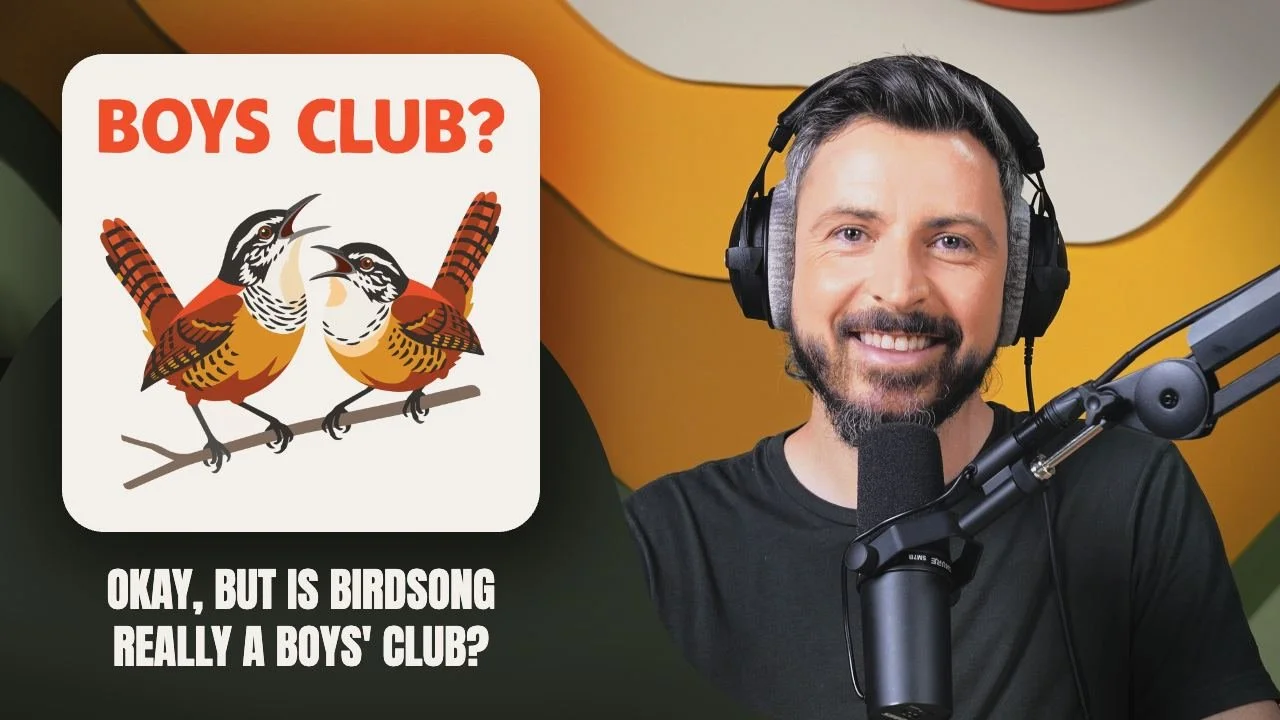
Release Date: Nov 12, 2026Picture a bird singing. Odds are you pictured a male, because that is what the field guides taught us. Dr. Karan Odom of the University of the Pacific studies female birdsong, and she explains why assuming that the bird singing is male says more about scientists than about the birds.
Support the science: the Female Birdsong Project turns 10 in 2027 and is raising money to check the species nobody has studied yet.
Transcript
In this episode
- Why the rule that only male birds sing comes from where scientists happened to be standing
- How a study of the songbird family tree found a 92% likelihood that females sang in the ancestor of all songbirds
- House wrens, cardinals, orioles and mockingbirds: the female singers you can hear in a North American backyard
- Tropical wren duets so tightly coordinated that a male and female sound like one bird
Scott Taylor: Figure skating is for girls. When I was a kid, that was just a thing people said. The boys in my class said it, most of them hockey players. The girls said it. Some of the girls who actually figure skated said it. I got my first pair of figure skates when I was seven and I skated all the way through high school. The skates are still in my office and I still get out on the ice from time to time, though I'm more careful than I used to be. We do this constantly. We take an activity and assign it a gender. It's a bad habit. Well, it's more than a bad habit. Guys can be figure skaters, really good ones. Girls can play hockey, often better than men can. And you might assume this is a human problem, a thing we do to each other in our schools and our workplaces, and that it stops at the edge of our own species. Unfortunately, it does not. Who we are as people shapes what we study as scientists. It shapes what we expect to find, and it shapes what we manage to notice. Take birds. Picture one singing right now in your head. I'd bet money the bird you just pictured is a male because male birds sing. That's the rule. It's in the field guides. It's in the textbooks. It's in every ornithology course I've ever sat in on, but not the one I teach. And depending on where you're standing on this planet, you might be right. But go south, get into the tropics, and your odds of being right drop to something closer to a coin flip. Which brings us to the topic of today's episode. Okay, but is birdsong really a boys club? To help us explore this topic, I'm joined by Dr. Karan Odom, an assistant professor at University of the Pacific. After the break, Karan takes us back through the songbird family tree to ask who was singing when songbirds first evolved. We get into why a whole field of science spent decades looking past it and what that has to do with who is holding the binoculars. And she tells us what to listen for in our own backyards next spring. Stay tuned.
Scott Taylor: Welcome back to the podcast, everyone. I'm really excited to have Karan here today to talk all about bird song. Thanks for joining us, Karan.
Karan Odom: Thank you, Scott. I'm delighted to get to speak to you today.
Scott Taylor: Yeah, well, I couldn't think of a better guest to, debunk a really huge myth, this idea that only male birds sing. I think when most of us picture a bird singing, we're programmed to picture a male. Is that actually right?
Karan Odom: Not necessarily. In fact, it actually turns out that in a lot of species, it is the female that sings. And there's a lot of species where females do sing. And I think that whether or not you're hearing a male or a female probably depends a lot on where in the world you are when you're hearing that bird.
Scott Taylor: Tell us a little bit more about that geographic variation piece then. Where might you expect or be more cautious to say, okay, I hear a bird singing. That's definitely a male.
Karan Odom: Yeah, so it turns out in temperate regions, a lot of the places that we've been studying birdsong for decades, that due to birds breeding over short periods and a lot of the species being migratory, that in these regions, actually, there's been selection against female song. And so in those regions, female song is a lot less likely. And so it's a lot more likely that if you see a bird singing, it is the male. Singing in more north temperate, cooler climate regions. But if you go to the tropics, it's a very different story. I would say your chances are much closer to 50-50 that individual that you see could be a female.
Scott Taylor: That's really cool. It's interesting that there's this latitudinal variation in that. Why did scientists spend so long believing song was just a male bird thing? Is it because of this bias in where we were studying them then?
Karan Odom: I think so, yes. So that's a big part of it. So just the fact that there is this geographic variation and then layer on top of that the fact that behavioral ecology as a field kind of started in Europe and more northern climate regions where I just said female birdsong is less common. And in a lot of Western universities where people were studying animal behavior, they probably were not observing female birdsong as much. And so that certainly had something to do with it. More recently, we've come to realize that possibly even who you are. Whether you yourself are a man, woman, male, or female, could be influencing whether you're studying male birdsong or female birdsong. It actually turns out that women researchers are more likely to study female birdsong.
Scott Taylor: This bias in who we are and what we decide to study or even how we characterize how organisms are acting is really pervasive. I mean, a lot of animal behavior started off with studying aggression and territoriality. And, you know, it was all about what the male's doing and very much had a passive role for the females. Like, okay, the males will fight the females, maybe not even. Like they might not even have choice, which come to understand is also messed up. Like if you approach things from the other angle, from the angle of, you know, thinking about choice in females, it's a much more holistic way to look at it. But even in these temperate areas, like you're saying, some female birds do sing. So if people had been looking for it earlier, they would have found some of it, not as much as in the tropics, right? But some.
Karan Odom: Yes and so a really interesting thing is I would I do a lot of research and work with Lauryn Benedict at Colorado University and yeah just a little bit north of you all and Lauryn's been doing some interesting research that just recently she's been digging into some of the history on when people were starting to first notice female bird song and it turns out that For a while, people were documenting female birdsong at pretty decent rates, maybe kind of comparably to how much it occurs in temperate regions. And then somewhere kind of in the 70s and 80s, the focus switched a bit more to male birdsong. We haven't quite dug into that yet to figure out some of the reasons why. So this may even be sort of more recent bias or a more recent focus on male birdsong.
Scott Taylor: Yeah, just north of us here.
Scott Taylor: Are some of the North temperate birds where females will sing?
Karan Odom: Yes, and so I think people are always surprised when I talk about this. And so it turns out there's quite a lot. There's the Northern Cardinal, and so that's one of the ones where it's much more obvious and easy to see.
Scott Taylor: Because they look so different than the males. Yeah.
Karan Odom: They look so different. Yeah, so dichromatism, the fact that male and female look different, is really helpful. So let's put a pin in that because I'd like to circle back to how that can cause some challenges. For other temperate species, we also have things that you could tell males from females, like orioles not a lot, but some temperate warblers, females sing. But then we have things like mockingbirds, chickadees, nuthatches, if you consider nuthatches to really have a song. And yeah, sort of, a little bit, it depends on the time of year. Then one that I'd love people to be recording more, but I think is a real challenge because males and females look the same, is gray.
Scott Taylor: Oh, cool. Gray catbird females sing. And that's interesting because you just named two mimics, right? Mockingbirds and gray catbirds. It's cool that it's some of the mimics where you see this female song as well. So you've conducted studies across the whole songbird family tree. Can you tell us a little bit about your findings in the context of female song?
Karan Odom: During my PhD, we were interested in figuring out just how common female birdsong was, how many females around the world might be singing. And so we went to Handbook of the Birds of the World. At that time, they were print. They weren't even online. So I spent a lot of time sitting in the library reading books. Pretty old school. What we found to us, as group actually largely of women studying female birdsong, we were pretty surprised that we found that 71% of the species that we were looking at had... female birdsong. There was evidence that 71% of those species that we were looking at had it. Then on top of that, we wanted to take that the next level. And we thought, since this is so common, what are the chances that this evolved early on? That this isn't something just that happened in a few species or a few lineages. And so we did something called an ancestral state reconstruction. And so we took all that information that we gathered on which species have it, which species don't. And we use computer algorithms to help us reconstruct the likelihood that the ancestor, so the ancestor of songbirds, did the female sing, so whether the ancestor had it. And what we found was a kind of resounding yes, that likelihood that the female sang in the ancestor of all songbirds. This was surprising to us. We were pretty excited when we got this result.
Scott Taylor: Yeah, totally. I mean, if you think about when you're introduced to birding or you're introduced to birds, how frequently it's like males are colorful and sing, females are drab and quiet. And then that like goes through when we're taught animal behavior, when we're taught ornithology, like that finding is pretty incredible. I mean, one, I would have been stunned to be, you know, reading these books in the library, which sounds magical. We need to do more of that. And finding that 71% of the species you're looking at had recorded song, but this really high confidence that the ancestral state for all songbirds was that both males and females sing or sang is really incredible. The first songbirds the ancestors of all of them and songbirds are the most diverse group of birds there's you know of the ten and a half to eleven thousand plus species of birds more than six thousand of them are songbirds what does flipping it from like males acquired song in songbirds to females lost song change how you think we should think about all of it.
Karan Odom: So to us, this was really the most exciting part. Think it was particularly exciting because we had been, at least in recent time, been thinking of birdsong as this sexually selected trait. And so we thought that had evolved primarily in males in order to attract females and to compete with other males for access to females. And so this kind of flips that idea on its head this means that this behavior evolved in both males and females and so then I kind of paused there because that's kind of where we were at is then so what does that mean so that means it doesn't just evolve in males and so then it means that maybe the reason it evolved or a reason that evolved was not just exclusively for that, not just exclusively to attract mates or for males to attract females. And so this actually of joined a current resurgence that was happening of something called social selection. And social selection is a bit broader concept than sexual selection. And so it says that you could still have complex behaviors like complex birdsong, but that maybe it can be used in both sexes for broader resource defense, things like defending territories or defending a specific nest site or specific resources like food that you might need all year round.
Scott Taylor: Yeah, I mean, the broader idea that only males would be engaging in those behaviors is kind of insane when you think about it just for a second. Like females also need access to food. They need a good territory for their young to survive and, you know, fledge. They need the nesting site. They need all of these things. And so why wouldn't they be engaged in all of that? And song is a way that birds communicate, you know?
Karan Odom: Yes. And so I'm focusing a lot on house wrens. We had a paper come out last year was kind of a follow-up to that other big study and so it built on that big study it used the same baseline data set and then we expanded on it we added more species we looked at female song in a little more depth like how much are females singing not just whether or not they're singing But the big thing we added is that we wanted to look at evolutionary pressures. We wanted to look what it is that might have selected for a female birdsong in the first place and what selects for a female birdsong under various conditions. We found not surprisingly this seems to be associated with tropical breeding but even more specifically year-round territoriality so if you're living in the same place year-round again maybe you're needing to use this behavior to defend these year-round resources maybe you're doing this all year with your mate But then we found this interesting thing that I think is what I'm still wrapping my head around and I keep having little epiphanies about is that we found this association with biparental care or when both the male and female are providing care for the young, or it can even be that the male is helping take care of things while the female is incubating, that maybe he'll bring her food or maybe he'll defend the area around the nest as well. So if the male is helping with reproduction, females are more likely to sing. And so this is a cool idea that I'm still wrapping my head around how that shapes this behavior.
Scott Taylor: Yeah that's very cool when do they sing are they singing when they're interacting with their mate or are they singing on their own out like on territory like are there any clues from that kind of the behavioral piece of where they are when they're singing.
Karan Odom: Yes, a little bit. Yeah. And so. Think actually a little bit more the context. So this is a piece that we've been digging into a little bit more. And my recent master's student, Molly Gleason, her thesis was actually on this. And so she looked at this idea that maybe it has something to do with the male being around sort of this idea of like good dads. And so she looked at if there's an association with female singing, at the time that she chooses a mate it's sort of in that first interaction around the nest box and at the nest box and with the male and are females singing more in that situation or are females singing more in other situations later into the breeding season when She may have established a mate, but where multiple resources might come into contention if she were to lose the territory, like her nest and a nest that she's established, her nest box, things like that. It turns out that females get pretty defensive as things go on, and they get especially defensive around... the time shortly before laying eggs, actually. And so she has a nest. She's built that nest. She's probably getting ready to lay eggs. If she loses that resource at that time, that's a really big deal. And so we find actually that females are singing most to other females. And we actually think that this is females preventing loss of those really important resources, loss of these breeding resources that she needs to be able to have young.
Scott Taylor: Yeah, and in the context of house wrens, they're cavity nesters, but they're not cavity creators. So they're just using cavities they find, sometimes pretty funny ones, to make their nests. But it would make sense that they are particularly territorial right around the time they're ready to lay, and that would be directed at females, because females are probably prospecting for these really limited resources, unless we put up nest boxes as well and get lots and lots of house wrens, which makes them very nice to study. Do you see then variation? Like if a female's on what you've come to understand is like not as high quality of a territory, is there less female song in that scenario then?
Karan Odom: That is a really great question, Scott. I'm going to write that one down.
Scott Taylor: Oh, great. Yeah.
Karan Odom: Because all of a sudden I see some territories in my head. Mind's eye and where females just did not sing much and they're some of the ones that are chosen at the end of the season they're sort of the last chosen and we think they're not quite as high quality territory and those females kind of have a tendency to just hunker down stay there breed and then once they're done they move on but they don't seem to be singing as much this is just a few anecdotal females that I can immediately think of but cool question.
Scott Taylor: Yeah. Well, that's cool, though, because maybe if it's like the not as good territories, there isn't the social pressure from other females still prospecting, right? So maybe there isn't like this social reason to sing as much as you would if you had acquired one of these really awesome territories that everyone was trying to... sidle in on yeah and so for house wrens then is there evidence of female song and house wrens across the range in north america like is a lot of our listeners are here in north america and they might be wondering if a female house wren in their backyard is singing.
Karan Odom: We think so. They seem to be singing coast to coast so I hope in between as well.
Scott Taylor: Anywhere you are in North America, you're probably hearing female house wrens sing, but it's kind of hard to know if it's the female back to the question, you know, our comment from earlier, if you see a female cardinal sing, you can tell that it's a female, but house wrens, there's very little sexual dimorphism that we can see at least. So I guess you know they're females because you've banded them and you've been observing them carefully on their territories, right?
Karan Odom: To some extent, yes. But so a thing that we started to realize pretty early on and then we measured it in order to show that this was true is that the female house wrens specifically, and so I'm going to emphasize the house wrens, the female and male have kind of a different song. And there's also a little bit of a gradation, so some females can have a song that's a little bit more similar to the male song, but a lot of the female songs are simpler, shorter, and kind of squeaky. It's like they do a continuous version of the male song versus the male song is kind of bubbly and up and down and all over the place with a lot of frequency modulation. So she's kind of doing like the middle component of that in kind of a continuous way. And so there, once you've noticed that and we've kind of trained ourselves to listen for it, then you can start hearing it everywhere.
Scott Taylor: For me, I think the first time I was introduced to the fact that female birds sing and sing like quite a lot was with some of these birds that duet, which is a little bit different. It's not as familiar to those of us that grew up kind of birding in North America, but it's a relatively, I mean, I don't know if common's the right word, but it seems like a lot of, again, down in the tropics, there's more of this duetting behavior. Can you tell us a little bit about it? It's just like, it's so complex and amazing sounding to me.
Karan Odom: Yeah, so that was my first love of bird song were bird duets. And that's kind of what got me into the field and got me thinking about female song in the first place.
Scott Taylor: Yeah, I can see how that would be the gateway drug.
Karan Odom: Yes, I think, yeah, for a lot of us probably. They're super cool. So it's mated male and a mated female. They can sometimes sing in, so they're singing together, but they sometimes can sing in just this amazing degree of coordination. And there's some lineages that are particularly well known for this. The wrens, actually, the New World wrens, there's a lot of different things we call wrens, but the New World wrens are amazing duetters. And there's four different genera. They all kind of have their own slightly different way of duetting. But some of them duet... in such tight coordination that it sounds like just one bird fluidly singing, but it's actually a fast-paced alternation of the male and the female singing in response to each other's.
Scott Taylor: Yeah, the first time I heard them I was like that is not two birds that can't like the level of coordination required is insane and then it does it just sounds like a single beautiful bird song but it's this coordinated response between like you're saying a mated pair and these are neotropical birds right like central and like do they get into south america as well.
Karan Odom: Yes, all throughout a lot of South America.
Scott Taylor: Yeah so it's like and they're singing together it's there's got to be some you know pair bonding or pair reinforcement or territorial defense or all of the above that's led to the evolution of this right yeah.
Karan Odom: Yeah, and we do kind of think it's a little bit of all of the above. Some of the early studies on this were showing some of the same things that we're actually finding in house wrens, that there's a lot of female-female competition going on. In a lot of these new world wrens, the females have her own component of the song. And so that seems to be a wren thing. And so it's very likely that she can then interact and other people would know that this is the female singing her song. In the New World wrens specifically, we also think that this behavior, this duetting is, in female song, is tied to pair coordination. And so we actually found that the pairs that have, the most coordinated songs, the species with most coordinated songs, also have the longest breeding season. And so this is just a correlational analysis, but we think that maybe what this means is that these individuals have to be coordinating care over a long part of the year, and that this is helping them either reestablish those pair bonds or coordinate with each other. And this is sort of an outward display of that commitment. So it's pretty cool.
Scott Taylor: Yeah, that's super cool. I mean, it makes me think of the board game Wavelength, which I really love, where if you play it with your partner, it's sometimes an interesting test of whether you are or are not aligned. And when you are aligned, everything's easier. So it would make sense that the breeding season would be more successful or go longer. So now our listeners, some of which probably never thought about the fact that female birds sing, might be wondering, all right, I know female birds sing. What do you think they could start noticing in their backyards? We talked about this a little bit, but you say, listen for songs that don't sound exactly like what you've been trained on for the male, and that might be a female singing, or what would you suggest people look out for? Yeah.
Karan Odom: Yes, so you could be looking for female behaviors like female incubating, female that builds a nest in species that we know that only the female does these things. Obviously the lowest hanging fruit is when the female and male look different. We've had actually some really cool observations submitted for the female birdsong project that I help coordinate. And some of those were of warbler species where somebody either saw a pale bird singing and then that pale bird getting onto a nest after it sings and then continues incubating. And so pretty much hands down in a new world warbler, that probably means that that's the female. And so we've had some submissions and some documentation of female birds on that way. It's much easier when the female looks different than the male but people have observed similar things mockingbirds saying the female sings a lot actually on the nest and so yeah.
Scott Taylor: That seems like not a good idea if you don't want predators to know where your nest is. Yeah.
Karan Odom: One would think one would think some people have found some indication that that's detrimental and leads to lower reproductive success but we ourselves in larger data sets have not seen that and the person who studies this sees that not irregularly so I don't know somehow the females are getting away with that.
Scott Taylor: Even if they're singing from the nest, they nest in very dense, tangled undergrowth. And so maybe that's enough of deterrent for a potential nest predator.
Karan Odom: And I think they're doing a little bit of a softer song too.
Scott Taylor: Okay. Yeah. Yeah. You got to be really tuned to it. Tell us more about the Female Song Project and how you got that started, what it is, and how people can participate.
Karan Odom: Yes, so first off I want to say that we're closing in on our 10-year anniversary. So I'm glad you asked about that. And so we've been sort of thinking, what do we do at this milestone? And so traditionally what the Female Birdsong Project has been on, so we have a website if you're interested to know more. Femalebirdsong.org. So the idea behind it is just simply to get people observing and documenting and especially recording female bird songs. Some of the early work that we did after that first study was to just look at how many female bird songs are represented in recording collections. And we found it was very low for probably... Yeah, for all of the reasons that we've been talking about. And so we wanted to get the word out there. So I think we have been doing a decent job of doing that. People can submit their observations through eBird. If they simply saw a female sing, they can submit recordings if they're able to get the female recorded. Nowadays, we all carry little recording devices in our pocket. And if you have Merlin, you could just pop up Merlin, record, save that recording, and you can upload that to your eBird report or to Macaulay Library or to xeno-canto. And so this was the idea behind the female birdsong project was to increase recordings and collections through just anybody and everybody who might be anywhere in the world and observe female birdsong. We also find ourselves in a position of figuring out how to fund some of this research as so many are. And so we're also starting a little bit of crowdfunding. So we have... any of this was exciting to you, if you'd like to see us be re-evaluating the status of female birdsong, if you'd like to see us get people involved in recording more female birdsong, we'd really like to make a big push to get as many birdsongs and female birdsongs into these recording collections. In the next year as possible. And so if you're interested in this, you'd like to see it happen, then please check out our website.
Scott Taylor: We've reached the part of the show we call That's B.S., or That's Bird Stuff, where we give our guests an opportunity to debunk a myth that ruffles their feathers. So Karan, what do you want to call BS on?
Karan Odom: Well, Scott, I have to say, I think that we just spent the last 30 or so minutes calling some BS. So, yeah, so I think I don't have particularly much to add to that. But I do hope that people have gotten the strong take home that if you see or hear a bird singing, do not assume that it's a male and take a close look. And if you can't tell immediately. Then either recognize that it could be a male or a female if it's a monochromatic species where males and females look the same, and maybe look for some other interesting behaviors that might let you know if this is a male or a female bird.
Scott Taylor: Yeah, I think that's an excellent BS. The whole episode is all about the fact that you can't assume the bird you hear singing is a male. It's been really great having you on the podcast, Karan. Thanks for taking the time to talk about female birdsong. It is a fascinating topic and I appreciate that you took the time.
Karan Odom: Thank you, Scott. It was delightful. I really enjoyed speaking with you.
Scott Taylor: Birds are dinosaurs and around here we like our snacks. So we end each episode with a dinosaur nugget. Today's nugget is people tend to think of science as a thing that arrives at an answer and stops. It mostly doesn't. For decades, the answer was that male birds sing and that answer held because of where we were looking and who was doing the looking. Now we know the ancestor of every songbird alive today almost certainly had a female that sang. And we are only starting to work out what all that singing is actually for. There are species out there right now where nobody has ever confirmed whether the female sings. Not because the answer is complicated, but because we haven't looked for it yet. If you want to help fund that work directly, the Female Birdsong Project is turning 10 in 2027, and they're raising money to go after the gaps. To donate, visit femalebirdsong.org. That's a wrap on this week's episode. Okay, but is birdsong really a boys club? If you like this one, help us out. Leave a rating or review and follow the show wherever you're listening. We'll catch you next time. Byeee.
This transcript was generated using AI-assisted transcription and may contain errors or omissions. Please refer to the audio or video episode for the most accurate representation.
Credits
All audio, video, and images in this episode are either original to Okay, But... Birds (© Okay Media, LLC) or used under license/permission from the respective rights holders. Media from the Macaulay Library is used courtesy of the Cornell Lab of Ornithology as follows:
- Northern Cardinal audio contributed by Wil Hershberger, ML100764
- Bullock's Oriole audio contributed by William R. Fish, ML22790
- Northern Mockingbird audio contributed by Bob McGuire, ML197002
- Black-capped Chickadee audio contributed by Bob McGuire, ML197114
- Tufted Titmouse audio contributed by Randolph Little, ML191246
- White-breasted Nuthatch audio contributed by Wil Hershberger, ML306062
- Gray Catbird audio contributed by Wil Hershberger, ML94317
- Northern House Wren audio contributed by Randolph Little, ML144011
- Bay Wren audio contributed by David L. Ross, Jr., ML57484