E40: Okay, but... cranes!
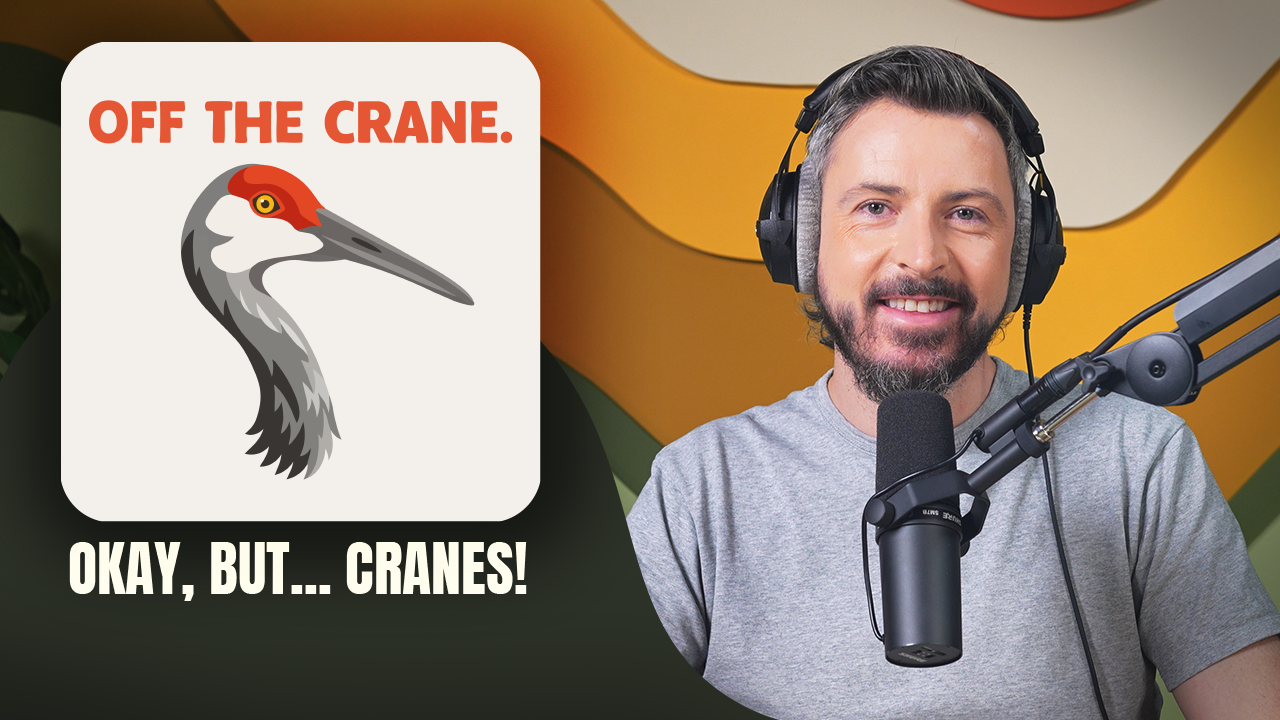
Release Date: Sep 17, 2026There are only 15 crane species on Earth, and 11 of them are in trouble. Dr. Andy Caven of the International Crane Foundation studies two: the sandhill cranes that pack one stretch of Nebraska's Platte River every spring, and the whooping crane, back from the edge and still nowhere near safe.
Transcript
In this episode
- Why more than a million sandhill cranes, about a third of all the cranes on Earth, stop on one stretch of Nebraska's Platte River every spring
- Why there are only 15 crane species in the world, and why 11 of them are in trouble
- How the whooping crane came back from about 21 birds, and why poaching and lost genetic diversity keep that recovery fragile
- How a fight over the Grayrocks Dam and protections for the whooping crane helped create the Crane Trust and safeguard the Platte
- What a wet meadow is, why it is so hard to restore, and how cost-share programs with ranchers create crane habitat
- How a crane's coiled windpipe carries its calls for kilometers, and why cranes cannot live on waste corn alone
Scott Taylor: I was working my first spring as a naturalist at Rondeau Provincial Park on the north shore of Lake Erie, one of the largest protected coastal wetlands on the whole side of the lake. It was early, fog still sitting on the marsh, and before I saw anything, I heard them. Sandhill cranes make some of my favorite bird sounds. I don't remember the first time I heard one, but I remember that morning really clearly, and honestly, every time I hear them, it still feels special. Standing near a big flock of them is overwhelming in the best way. Cranes are almost everywhere. Grasslands and wetlands on every continent except South America and Antarctica. Big, loud, impossible to miss. So, you'd be forgiven for assuming there are hundreds of species of them. Can you name every crane on Earth? Don't worry, I got you. Sandhill, Sarus, Grey-crowned, Plus, the whooping crane, demoiselle, brolga, white-naped, Siberian, wattled, blue, black-crowned, hooded, black-necked, red-crowned, and common, sometimes called the Eurasian. Not hundreds, just 15 species, 11 of which are in trouble. Drained wetlands, power lines, turbines, illegal shooting, drought, rising seas, melting permafrost. Cranes are one of the most endangered bird families on Earth. They're also one of the most beloved. Longevity and fidelity in Japan, though if you heard episode one you know where I land on bird fidelity. Immortality in China. Bravery and leadership in South Africa. Divine messengers and omens of spring in Greece. Vigilance across much of Europe. The Celts went the other way entirely. Death, war, betrayal. A king of the underworld who occasionally took crane form. Seeing one was bad news. So, even if you don't know anything about birds, if I asked you to draw a crane, you could probably do a pretty good job. Which brings us to the topic of today's episode, Okay, But... Cranes. To help us unpack that, I'm joined by Dr. Andy Caven, Director of Central Flyway Programs for the International Crane Foundation. After the break, Andy takes us to a river in Nebraska and gives us a number I made him say twice. We get into what a wet meadow actually is and why soggy grassland is worth fighting over. And we talk about what it takes to bring a bird back from almost nothing and how fragile that comeback still is. Stay tuned.
Scott Taylor: Welcome back to the podcast, everyone. I'm really excited to have Andy here today to talk all about cranes. Andy, thanks so much for joining us.
Andy Caven: Thanks for having me, Scott.
Scott Taylor: Yeah, this topic is an exciting one to me. Well, they all are. But I mean, cranes are these amazing, big, recognizable birds that make some of my favorite bird sounds. And I'm wondering if we could start just with what made you fall in love with cranes, especially out of all the birds you could have studied.
Andy Caven: Yeah, I feel like sometimes they welcome you in, right? Their charisma, their communication, right? I mean, the 20 plus vocalizations that are distinct, you know, all the different social behaviors, but also their... Everybody talks about umbrella species in ecology, and they're really the real deal. They need so much space, and they're so picky sometimes about what habitats they use that really when you find them, you know you're in a pretty interesting and important space. I think that's what made me first fall in love with them, and then learning more about their natural history and behavior, I was hooked, and all of a sudden I was a crane person.
Scott Taylor: Yeah. So I guess, yeah, you've spent years studying the Platte River as this crane stopover site. And I'm wondering, you know, here in Colorado, when we want to see cranes, we either go there or down into Alamosa during the migration period. What's so great about the Platte River in this part of the world that hundreds of thousands or, I guess, is it hundreds of thousands or tens of thousands of these birds stop over?
Andy Caven: Oh, it's millions. It's actually I'm working on a new paper that's forthcoming where we use thermal imagery, a big partnership to count them at night before they move. And we had over a million. And I'd previously written a metadata analysis with all the different survey sources and estimated based on math that I thought there was about one point two million at the peak or one point one million. And the thermal survey actually proved that out. One point one to one point three.
Scott Taylor: That's like very satisfying as a scientist to be like, I think it's this and I'm going to use math. And then you could just use a camera and be like, yeah, I was right. That's amazing. Million. Wow. Yeah.
Andy Caven: Yeah, it was pretty neat. I'm excited for that paper to come out. Bradley Pickens with the US Fish and Wildlife Service was the lead. I think I might be second or third author. It was a big collaborative. But it's not just the biggest gathering of cranes in North America. It's the biggest gathering of cranes in the world. And yeah, it is absolutely the biggest gathering in the world. And what's interesting is there's only 3 million cranes total in the world across all 15 species. Three million.
Scott Taylor: Really? I didn't know that. Wow, that's amazing.
Scott Taylor: And then there's a million of them all together.
Andy Caven: Right in one place right there so three half the cranes in the world of the 15 species there's three million about half the cranes in the world are represented by sandhill cranes and people say oh they're so abundant as not really you know by contrast you know there's you know several six million mallards you know alone right so there's more there's twice as many mallards in north america as there are cranes in the world of all species right so they're rare taxa but the sandhills are the most abundant and even they are such an ecological indicator right although leopold's marshland elegy right like that call means something the interesting thing about flyways most of them follow a river or something right like the mississippi flyway right but the great plains the central flyway is like a stepladder And each one of these east-west rivers that run from, you know, high elevations where you live in Colorado and trickle down into the Missouri Basin, you know, they create a spot to stop. And so you can have big gaps, you know. And I think that kind of promotes congregation. And also the Platte historically, you know, even though it's highly modified and impacted, it's still a reliable place for whooping cranes it's incredibly important too and it was really interesting because a lot it's the only critical habitat for the whooping crane that is privately owned all the rest are state or federal refuges it is privately owned which is why there's ngos up and down that river doing the private lands work, building the preserves. And the Crane Trust, which I used to work for, now I work for the International Crane Foundation. There's only two crane organizations in North America, and I've worked for both. But, you know.
Scott Taylor: Nowhere to go next. Just pounce. Hmm.
Andy Caven: Where to go next? But the Crane Trust actually was... form based on a lawsuit for the whooping crane in fact in the early endangered species litigations there was a Grayrocks Dam proposed to create energy it was actually building the dam to cool a coal-fired power plant and it was going to pull a significant more water from the headwaters that run into the Platte and to mitigate that they all came to an agreement that they were like okay pay seven million dollars to protect habitat on the Platte we'll call it even And that's what's happened, and that's what created the crane trust. So it's this long history. The conservation history of the Platte is a fascinating thing, too. So I'm waxing away, but I had a big question I used to ask people. I was like, well, did the Platte save the whooping crane, or did the whooping crane save the Platte?
Scott Taylor: Yeah. That's interesting to think about. I mean, and this was all motivated by whooping cranes, right? It wasn't as motivated by sandhills as just like whooping cranes have declined precipitously. Like they got down to what? Fewer than 25 birds. And then.
Andy Caven: Yeah, I've kind of charted it out. It gets a little confusing because there was two remnant populations. It could have gone either way. And whooping cranes were both non-migratory and migratory. And there was a small population in the 1930s left in southwest Louisiana. And there was the population left on the coast of Texas. And they were non-migratory and they were extirpated in 1950. So we lost that one. And we went back and reintroduced them there in 2011. And that reintroduction has gone better than any reintroduction to date.
Scott Taylor: And which one, the Louisiana population was non-migratory or?
Scott Taylor: And those ones that you reintroduced to Louisiana are non-migratory still. Okay. Interesting.
Andy Caven: They're non-migratory. Yep. Yep. Shootings is still a big problem there. And that was one of the causes of their declines in the first place. I think there was like three or four shot last year. It was like, yeah. Mostly the hunters have been like very good. You know, bird hunters have been very good about reporting sightings and not shooting whooping cranes. It's mostly been people without hunting licenses who are poaching, who are involved in shooting sports. And there's sort of a culture of, you know, well, we don't want you eating our... our crawfish and our crawfish farm or something like that right and hazing birds off that and so then you know they can get shot they can get shot that way and you know but there have been accidents we had four five four or five whooping cranes it was five actually but I think they were only prosecuted for four because the one was injured and died later but in Oklahoma you know there was a bunch of people who were new to crane hunting and you know whooping cranes flow flew over and it was probably a little bit earlier in terms of light than they should have shot and they shot those five whooping cranes and then covered it up in total they got down to 21 in the world at one point except the population that persisted itself got down to 16, 15 or 16. There's some debate. So now we have approximately 700 in the wild, about 540, 550 in the Aransas-Wood Buffalo population, about 80 in the Louisiana non-migratory population, about 65 in the eastern migratory population, which is reintroduced. So Louisiana and the eastern migratory population both reintroduced. Faring variably they're not self-sustaining you know so really there's only one self-sustaining population in the world.
Scott Taylor: That's the Aransas-Wood Buffalo population. Yeah. So the Eastern migratory population, where do they migrate to and from?
Andy Caven: Yeah that's an interesting story too that population is famous their introduction started in 2001 and they were trained to fly from Wisconsin to Florida via ultralight aircraft At some point, the older birds were leading that migration, and there was no reason to really keep up the ultralight-led migration. But people loved it so much, it was a big kind of debate about whether it continues or not. But eventually, the Fish and Wildlife Service said, we need to let this population try to be more natural. And the partnership agreed, and hence the ultralight flights quit. Well, after that, the older birds, there's some research that was done that suggested the older birds actually led the charge to shortstop, and the migration became progressively shorter. So now they mostly winter between southern Indiana and central Tennessee. Yeah. What's funny is their ecology differs. The further north groups tend to eat a little bit more waste grain and be more gregarious. And the ones wintering further south tend to eat more animal matter and plant matter and be more territorial. And it's all about what resources are defensible or not. So where they winter totally even influences their behavior. Randswood buffalo is the same way. In the salt marsh on the wintering grounds, they're territorial. In migration, they're gregarious because there's not defensible resources. And then back up to the breeding territory, they're territorial. So their behavior can vary widely by ecological context, which I love about them. I mean, the poaching thing's huge. So we have to actually, we have to get outreach. What we've learned is we used to have a real poaching issue in the Eastern migratory population. And after 15, 20 years of intense outreach efforts.
Andy Caven: Actually the put we actually can see per our data the shootings per year going on average going down.
Scott Taylor: With your outreach data.
Andy Caven: Yeah that we have the lowest shootings per year per population size in that population relative to the Aransas-Wood Buffalo population or the louisiana non-migratory population I did an analysis a while ago of like sources of mortality above and below expected across the populations and actually after all that outreach that eastern migratory population poaching was below expected.
Scott Taylor: So a lot of your research looks at these wet meadows, which you have mentioned as crane habitat. Can you explain what a wet meadow is to general audience and why restoring these kind of soggy grasslands matters so much for crane conservation?
Andy Caven: Yeah, wet meadows, you know, if you look at a kind of a grassland ecosystem, right, cranes don't like trees, you know. They like these big wetland grassland landscapes. And in a grassland environment, you go from, and let's say it's a mixed grass prairie, you go from kind of an upland mixed grass prairie down into what's a subirrigated lowland prairie because you're getting into the wetland footprint, especially in a river valley. Those roots of a big bluestem can go deep or whatever. So you get the subirrigated lowland prairie then you get a wet meadow zone then you get a shallow marsh zone a deep marsh zone and open water and so wet meadows are really the tipping point between a mesic upland area and a wetland and what's really interesting they have wetland plants But they're not wet all the time. They tend to be inundated in the spring. They could hold standing water, or they could just be moist and saturated. And they're saturated for a long enough part of the growing season that these wetland features develop. But it can vary widely from year to year based on things like river flows especially in river in riverine areas yeah they're really neat systems and they tend to be very productive in terms of invertebrate biomass and birds love them for that reason you know it's not just cranes eat worms and snails both species of cranes whooping cranes and sandhill cranes that are in them. But a lot of other mesic bird life likes them too. Say for instance, like Wilson's phalaropes or, you know, swamp sparrows or, you know, on the drier end of them, bobolinks. And so they're really neat habitats. I love them. Because they're so dynamic and it's what we've lost a lot of because you know if you're going to plow a field that zone generally gets plowed up along with the grass but people leave the marsh because like we can't farm that it's too wet but this transition zone has been lost a lot of places.
Scott Taylor: What's the name for a group of cranes, actually?
Andy Caven: Oh, geez. I know it, and I just forgot because you asked me. There is a funny name for it. No, it's a siege. It's a siege.
Scott Taylor: It doesn't matter. Maybe it'll come to you. Zach will look it up. A siege of cranes. Okay. Well, that's cool. All right. Anyways. Okay. At the top of the episode, we played a clip of a crane gathering. Tell us what it's like to experience one in person. And I mean, cranes are kind of known for their vocalization. So how do they make all that noise?
Andy Caven: Yeah, I mean, this modified trachea is unique and evolutionarily distinctive and curls around in their body in a way that allows amplification of their call. So both whooping cranes and sandhill cranes, you can hear their calls for several kilometers, which means something on the breeding season. That is, I'm claiming this part of the wetland, and you know where I am. And I've heard both species call back and forth to each other, too. I mean, that was some of this drama of sitting at that nest for forever. You could actually hear like totally different wetlands, like over a kilometer apart. They'd kind of get some territorial battles going across those wetlands, you know, calling at each other. And sometimes sandhill cranes and whooping cranes would call back and forth in certain ways. So there's a lot of, yeah, interspecific and conspecific crane behavior. But yeah, their behavioral repertoire is huge, you know, in terms of different threat displays. And those are often paired with vocalizations, like many different kinds of like purrs, you know, some aggressive, some actually pair bonding. You know, the unison calls the most famous call.
Andy Caven: You know, and it's neat because it is done both in sort of a defensive and a pair bonding way. It can be like, this is our territory. It can be like, you know, joy, success, we've raised a chick. But, you know, the male does one long call, and this is pretty true across cranes, and the female calls it about twice the rate. So it's like...
Andy Caven: And it's something amazing to watch. But yeah, they're very distinctive. Many different kinds of calls. One of my favorite ones Sandhill Cranes make is like... kind of like that you know I mean they make so many calls and they all mean different things but yeah their behavioral repertoire is incredibly diverse and you can study just that bird for a long time and it's still hard to interpret all of it because they can they're so communicative and they're so social right they they're meant to be social.
Scott Taylor: Yeah. Super social. Yeah. Yeah. No, that's amazing. I'm sure it's when you're in a, or near, well, I mean, having been near a pretty big flock of sandhill cranes, it's quite overwhelming and you're right. There's so much variation in the vocalizations they make. It's pretty incredible to be close and hear it all.
Scott Taylor: You talk to ranchers and farmers and agencies and conservationists all trying to, you know, pull in the same direction or conserve cranes. It's critical to, I mean, certainly for whooping cranes, you need this kind of collaboration, but cranes in general, like you say, are these generally grassland or wetland birds across the planet. And so it's always going to be this collaborative effort, right?
Andy Caven: So my colleague, Dr. Carter Crouch, actually hired, he was my first hire at the International Crane Foundation. He and I have, and Katie Fernald, his right-hand person in Texas, have kind of worked on getting this program up and running called Wells and Water for Whooping Cranes. And basically, it's a little bit of a wetland restoration where you put a solar pump on these coastal wetlands that have dried out. And during drought, there's not enough fresh water on the landscape for whooping cranes in coastal Texas. But those solar wells pump it out. Now you have fresh water so they can drink because they can't drink saltwater. And also, you can use them as cattle tanks too. I mean, the cattle can drink out of them. They bring in wildlife too for like duck hunting and stuff if that's your objective. And so it can benefit the landowner's objectives. And we cost share on that. It's like, well, if you want to put one of these in, we'll pay half of it. And that's the kind of program I love. Right. It's like, you want this, we want this, we'll pay for half of it. And it creates habitat. And there's all kinds of programs like that, you know.
Scott Taylor: Okay cool yeah so like these collaborative programs yeah.
Andy Caven: And you have to me, you have to have skin in the game and you have to do something that can benefit sustainable working lands. I think, you know, there's cool programs like Audubon's Bird Friendly Beef and whatever. There's different organizations have different things, you know. And if you... So for a lot of ranchers and farmers, things like the wetland reserve easement program work really well because they pay a huge percentage of the value of the land for you to restore it to wetland and keep it that way. But there's still, you know, working lands practices you can do with it. But the landowners have to know. The program's known well with the help of people like us in conservation. And then they have to make an informed choice of whether this works for them or not. But I love providing a smorgasbord. And I really love things with a lot of carrot to them. Like, I don't care about the pound seeds. I want to make friends. With these people with working lands I want to help them hopefully make money in their sustainable working lands that benefit birds and create that community and relationship and I think that's the only way we're going to succeed because the great plains is you know most states are over 95% privately owned and yeah, we're not going to succeed in bird conservation without good private lands programs. And I think now we're getting to a point where we have people in delivery. We need the right programs and we need enough money to deliver them. So that's kind of where we're at now. But 20 years ago, from what I understand, there's just not enough people delivering. Now we have some people, but now we need more money and more programs and more flexibility. I think that's my take. And, you know, I'm sure others have other takes.
Scott Taylor: Yeah. When we were talking about whooping cranes, we talked about the fact that the population got really small. We didn't really touch on what the genetic research has told us about how sensitive they are to, you know, how fragile their recovery is in the context of genetic diversity. What kind of work has been done in that field?
Andy Caven: We did a project that's been published recently on whooping crane genetics, kind of updating what we knew and actually using old museum records to compare them to current records. It really showed like 70% of the genetic diversity has been lost, but, th there's pluses and minuses runs of homozygosity meaning, you know, unique alleles have been lost, are longer, but we've probably purged most of the most deleterious variants. Genetics that are left you know they're not terrible which is good you know the other interesting thing is you know the birds that exist now are not the norm of what existed historically right like we have a genetic outlier and that makes sense in terms of behavior too you know the whooping crane population that persisted might have had one of the longest migrations A much more common migration would have been, say, you know, the prairie potholes in Iowa down to, you know, the Cajun prairie in Louisiana, you know.
Scott Taylor: Oh yeah. Okay. So much shorter. Yeah.
Andy Caven: Yeah, so, you know, the ones that persisted are distinct in and of themselves.
Scott Taylor: Genetically a little bit different. Yeah. Yeah. That's cool. So genetically not horrible outlook for the whooping cranes, which is great to hear. Yeah.
Andy Caven: Still losing, though. That's the issue. Like, they're still becoming more homogenous. So it's going to be a long time before they're really generating new genetic material at a rate exceeding loss.
Scott Taylor: Loss yeah well especially if four birds are getting shot every year like that's too much loss from a population from a genetic variation perspective to be sustainable are there any like translocation programs between the different populations now I mean is it complicated by the fact that there's two migratory populations and one sedentary population.
Andy Caven: I think there's been concerns. The thing is the remnant population has been growing without much intervention except for habitat conservation and management and restoration as well as some water management and outreach. And so I think people are reluctant to intervene with that population, which I agree with. I'm on the boat that's, hey, if it's growing at 2% to 4% per year, let's not mess with it. Yep, let it cook. But the other populations are not doing as well, especially the eastern migratory population. It's actually been declining even with supplementation.
Scott Taylor: Just let it cook. Yeah, exactly.
Andy Caven: And in that same genetics paper, we did find there was private variation in the reintroduced and the remnant population. And so bringing a couple eggs from the remnant to the reintroduced populations could have some nice benefits. But that's not happening yet. And I think it could, and it probably should.
Scott Taylor: Do you have a favorite moment in the field with cranes? I'm sure there's so many of them, but is there one that sticks in your brain? I have this one I already described, hearing them for the first time in that wetland, but what about for you?
Andy Caven: Oh man, there's too many, you know, and they're more about me than the cranes in some ways. Like there's, you know, on the Platte River, you know, it's just some hard grinds and a lot of outreach and, you know, pushing really hard. And, you know, I feel so blessed, you know, cranes have taken me so many places. Like Mike and I's work, you know, we're one of the only few groups ever to study whooping cranes on the nest at Wood Buffalo. There's, we actually, the funny thing is there's way more work done on reintroduced nesting because it's, you know, in the lower 48.
Scott Taylor: More accessible. Yeah. Yeah.
Andy Caven: Yeah. Then the remnant. So we got helicoptered in and dropped for like, or 10 or 11 days. You know, I can't remember for 90 or plus miles from a road. Like there was no way out. And watch this whole progress of nesting and seeing the eggs pip and really documenting their differential care of the older and younger chick. And that was some of what was novel, but just the ability to be 30 meters from a nest. Mike and I had to pop, We had to practice in the parking lot, throwing up our pop-up blinds in minutes, right? And I was telling you before we started recording, we had to have a contingency plan and a mobile incubator if we scared the birds off to collect the egg. And then we had to evac and all this stuff. So we pop up our blinds, put up the camo, pop in. And we don't leave those for over eight days after that. Our toilet's a bucket in there. You know, they're so small, you can't stand up, you know, and, you got a whisper, you're scared of the cranes. And it was this insane meditation on whooping crane behavior. And of course the one was molting, which was, you know, where we've reintroduced them, things may have become asynchronous a little bit because they nest a little bit early, but their genetics still go back to that Ranswood Buffalo population. So They tend to, the chicks tend to be old when the parent's molting. But what we saw, and I think my friend at the Canadian Wildlife Service, Mark Bidwell, is also documenting, he's going to present that at the upcoming North American Crane Working Group, that the molting up there is occurring when the chicks hatch. So the dad in this case, which you could tell them apart based on behavior and the unison call, the father in this case was not able to fly. At the time, the chick hatch. And we think the molt happens like every two, three years in general. But so that was all these fascinating lessons too, right? Like the father couldn't fly and the mother and father, how they split the duties. And it went against the dogma, right? Like, oh, the female won't leave after the chicks are hatched, you know, this sort of thing. Well, that wasn't true. She left and he was flightless and managed it. And we had all these novel things, you know, but just to watch it up close and stare at it, you know, I just, yeah, I feel blessed. I've had a lot of cool experiences like that. And, you know, cranes took me to Mongolia too to help some colleagues work on white-naped cranes over there.
Andy Caven: And that was like going back in time because there's still all the grassland and the natural gradation into the marsh, you know. And so, you know, I kind of feel like I know what the Great Plains should look like. But, you know, it's a long ways to get back to that.
Scott Taylor: Yeah. It's hard when you know. Yeah. Yeah. It's hard when you know what it should look like and then you see how altered it is. But yeah, lots of really cool experiences with cranes. I can't imagine just observing whooping cranes for that long. I've never even seen one, so I'll have to fix that next spring. But we've reached the part of the show we call That's B.S. or That's Bird Stuff, where we give our guests an opportunity to debunk a myth that ruffles their feathers. So Andy, what do you want to call BS on?
Andy Caven: I want to call BS on the fact that cranes can live on corn, especially whooping cranes. So there's some research. Oh, they got all the waste grain they need. They'll be fine. But well, waste grain is certainly lacking calcium and phosphorus and many amino acids. And it can be a good buffer against starvation and can help build up fat reserves. And sandhill cranes certainly utilize it a lot. But they still need their earthworms and their nutsedge roots and, you know, their mollusks, you know, because they need the building blocks, you know, to be able to, you know, build an egg, raise a chick, and be in truly good health condition. And it's been really hard in conservation circles at times because you're working on sort of politics. Like I worked on this Platte River recovery program where you have all these stakeholders. Some are representing an interest like water where they don't necessarily want to put in more water. And others are representing conservation. And some people want to do just the bare minimum. Some people want to do as much as they can. You know, it's be like, well, we don't need to do this for food. They have all the crane, the corn they want. And I'd be like, no, we need as much restored wetland as possible. In as best a condition as possible, because if you really want them to come out of this place thriving and in great condition, they need a very diverse diet. And people argued they didn't eat fish on the Platte, and I'd seen it. And so then I went on a kick of writing papers about it. I published a case of one eating several catfish.
Scott Taylor: All the corn they need. Yeah. Yeah.
Andy Caven: And then I wrote another paper about a family eating a diversity of fish and frogs. We knew they ate fish on the wintering grounds. We knew they ate fish at the breeding grounds. But there was this thought, yeah, why weren't they in migration? There was this thought that, oh, yeah, they can just live off waste grain in migration. And I couldn't believe people said it with a straight face. It drove me absolutely bonkers.
Scott Taylor: Yeah, totally. I mean, it's kind of the same as I wouldn't like, I can eat cornflakes and feel full, but I don't think if I just ate cornflakes, I would feel great. And I don't think I'd be able to go very far. Yeah.
Andy Caven: Long term, you would not be as handsome as you are now. Yeah, you'd have issues. Hey, thank you so much. It was really fun to be on.
Scott Taylor: Well, thanks so much for joining us on the podcast today. It's been really awesome to hear all about cranes. They're such special, cool birds. And it's great to hear that things are going well, at least for one of the whooping crane populations. But we appreciate you taking the time to chat with us.
Scott Taylor: Okay, But... Cranes.
Andy Caven: Thank you so much, Scott.
Scott Taylor: Yeah, of course. Thanks.
Scott Taylor: Birds are dinosaurs, and around here we like our snacks, so we end each episode with a dinosaur nugget. Today's nugget is, the whooping crane may have saved a river. Put the numbers from this episode together. 15 species, 3 million cranes on the entire planet, which is fewer birds than there are mallards in North America. Half of that total is sandhills, and at the peak of migration, a third of every crane on Earth is standing in one stretch of shallow water in Nebraska. That river didn't get protected because somebody thought it was pretty. A dam was proposed upstream to cool a coal plant, and it would have pulled water off the Platte. What stopped it was a bird that had been down to 21 individuals and the law written to protect it. That's a wrap on this week's episode, Okay, But... Cranes. If you liked this one, you can pay us back in short seconds by leaving a rating or review. We'll catch you next time. Byeee.
This transcript was generated using AI-assisted transcription and may contain errors or omissions. Please refer to the audio or video episode for the most accurate representation.
Credits
All audio, video, and images in this episode are either original to Okay, But... Birds (© Okay Media, LLC) or used under license/permission from the respective rights holders. Media from the Macaulay Library is used courtesy of the Cornell Lab of Ornithology as follows:
- Mallard audio contributed by Mike Andersen, ML136504
- Wilson's Phalarope audio contributed by W. Douglas Robinson, ML474658841
- Swamp Sparrow audio contributed by Wil Hershberger, ML94352