
E36: Okay, but do hummingbirds ever chill?
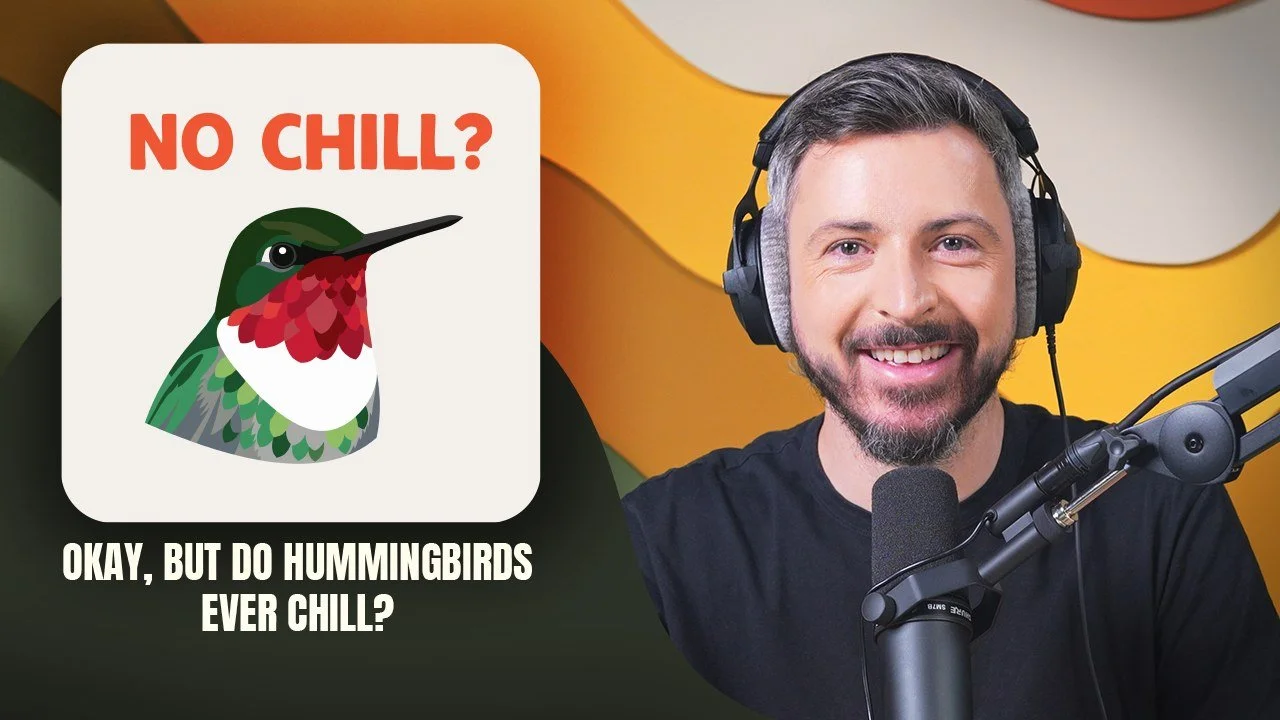
Release Date: Aug 20, 2026Hummingbirds run one of the fastest metabolisms of any animal with a backbone, which is why we picture them as permanently buzzing. Scott sits down with Dr. Anusha Shankar, assistant professor at the Tata Institute of Fundamental Research, who studies how hummingbirds budget energy in a world that keeps moving the goalposts. It turns out the blur at your feeder is the exception, not the rule.
Transcript
In this episode
- Why the same hummingbird might fly three hours one day and thirteen the next
- What happens inside a hummingbird overnight when it lets its body go cold
- How long a bird in torpor needs to become flight-capable again at dawn
- How the doubly labeled water method measures energy use in a free-flying bird
- What sugar concentration a hummingbird will reject at a feeder
- What seven months in an Ecuadorian cloud forest revealed about hummingbirds and patience
- The snoring hummingbird video Scott and Anusha discuss
Scott Taylor: People often think I need to chill. I frequently hear Scott, chill out. Scott, be cool. And sure, they're looking out for me or annoyed with me. And they're often right. But I do chill, sometimes anyways. With a cup of coffee after my morning walk with Douglas, I sit on our porch and read a book or watch the birds or answer emails. If I'm back in Canada, I sit by the lake with my feet on the limestone, listening to the waves and the birds. It's important taking time to chill, and I usually do it by myself. For us with a rep for being high-strung, how much of that is just us not being around when we do take a beat? Growing up in the East, the birds I perceived with the least amount of chill were ruby-throated hummingbirds. Manically zooming around our yard looking for flowering plants or, if we had them filled, a hummingbird feeder. These days, one thing my dad is not chill about is an empty feeder. Here in Colorado, I regularly have more than 30 hummingbirds visiting the feeders at the Mountain Research Station during the summer. Broad-tailed first, then rufous and calliope once they've started their southward migration in mid to late summer. When 30-plus hummingbirds are zipping around, it can feel really hectic. Some don't even bother perching while they're feeding. But they can't possibly always be flying here and there, can they? Turns out hummingbirds run something close to the fastest metabolism of any animal with a backbone. Which brings us to the topic of today's episode. Okay, but do hummingbirds ever chill? To help us unpack that, I'm joined by Dr. Anusha Shankar, an assistant professor at the Tata Institute of Fundamental Research in Hyderabad, India, who studies how hummingbirds manage their energy when the world around them keeps changing. After the break, Anusha walks us through what's actually happening inside a hummingbird and why shutting down can be risky business. We get into a summer in the Ecuadorian cloud forest where the birds outsmarted her nets for months straight. And we talk about what a warming world means for a creature already living close to the edge. Bonus, we're going to talk about the very weird subject of bird pee. Because why not? Stay tuned.
Scott Taylor: All right, well, welcome back to the podcast, everyone. I'm really excited to have Anusha here today to talk all about hummingbirds. Thanks for joining us, Anusha.
Anusha Shankar: Yeah, thank you so much for having me.
Scott Taylor: Of course. I mean, my cabin recently up in the mountains has just been inundated with hummingbirds. So I've been thinking about them a lot. And I know a lot of other people put up feeders for hummingbirds. And then when they arrive, they're just this little blur that's there and gone and maybe they perch. And I thought we could just start off talking about what's going on inside a hummingbird that lets it hover the way it does, which is so different from so many other birds.
Anusha Shankar: Yeah, their wings do a figure of eight motion instead of an up and down flappy flap when they hover. And I think that's really interesting. It means that their bones and their wings are arranged in a different way than in other birds. It allows them to do that. And that also allows them to fly backwards and fly like ninjas kind of upside down, unlike other birds. Their neurons fire also. They're able to program for the backstroke before they start the front stroke, is my understanding.
Scott Taylor: Really? Oh, wow.
Anusha Shankar: Yeah, I think so.
Scott Taylor: That's incredible.
Anusha Shankar: They have to do it way in advance because it's so fast.
Scott Taylor: I saw one the other day. It had an itchy face. And so it was, but it was just doing this little, yeah, I was like going in a circle and it looked like it was sick, but it was just because it was scratching its face. So everything was off kilter. And then a feather let loose and it flew normally again. It's very sweet. Hummingbirds really are running pretty extreme metabolism, right? So what does that tell us about kind of the limits of what a little vertebrate body can pull off?
Anusha Shankar: They're among the smallest vertebrates. Shrews and hummingbirds are about the smallest you can get with a backbone. They also have the highest metabolic rates of all vertebrates along with the shrews. So it depends on if you're looking at per gram or like whole animal, but they have the highest metabolic rates. And this means that an average human with an average human weight Matt Damon is my average that I calculated this from, but like 85 kilograms or something like that. If you had their metabolism, you'd have to eat about 600 packets of Lay's potato chips a day to meet your energetic requirements when Matt Damon would probably need about 15 packets of potato chips a day. So they're using up energy really fast. And this is like if you use a per gram estimate to extrapolate to the whole body.
Scott Taylor: That's incredible.
Anusha Shankar: Yeah, that's pretty much at the limit of what you can be as a vertebrate as far as we know.
Scott Taylor: So hummingbirds are at our feeders. They're flapping their wings extremely fast, being able to hover with this figure eight motion of their wings. And they have specialized muscles for that as well. I mean, the pectoralis muscle is the one that does the downstroke of wing beats. And then the supracoracoideus, which is a muscle most people haven't heard of in birds, is the muscle that pulls the wing back up. And hummingbirds have a really big supracoracoideus, right, compared to other birds.
Anusha Shankar: And a really big pectoral muscle too. It just fills their whole body cavity if you look at where it is.
Scott Taylor: Yeah, it's a huge percentage of their tiny, tiny bodies.
Anusha Shankar: And they also have way more mitochondria to power than most birds do. I think like 30% more mitochondria in their pectoral muscle.
Scott Taylor: 30% more mitochondria, the powerhouse of the cell. That's amazing. How many times per minute are they actually beating their wings?
Anusha Shankar: It's somewhere between 3,000 and 4,800 beats per minute, depending on the species.
Scott Taylor: Depending on the species. Yeah. I remember when I first saw a giant hummingbird, I could almost see its wings beating because it's such a large bird. Yeah. Yeah. Which was a weird experience to see a hummingbird whose wings you could almost, you know, discern.
Anusha Shankar: I felt exactly the same. Yeah.
Scott Taylor: Yeah. In the Eastern United States, so people are familiar with just the ruby-throated hummingbird. There's one species over there. Out here in the West, we have several more species. They're not super diverse, but how many species of hummingbirds are there on the planet? Yeah.
Anusha Shankar: There's about 16 in North America and about 370 plus in North and South America put together.
Scott Taylor: Over 370. That's quite a lot of... It's a pretty diverse group of birds. You just said hummingbirds have... They're among the smallest bodied vertebrates, but they have among the highest metabolic rate. They have all these mitochondria, more mitochondria than you'd expect for their body size, generating all this energy. And can you walk us through the cost of running an engine that hot? What does a hummingbird have to do minute to minute just to not run out of fuel?
Anusha Shankar: It's really interesting. So behaviorally, we think of them just like flying all the time and hovering all the time. But what I found was that they are really variable in how they can use their time based on what's happening in the environment. So I studied them once in Arizona, in the desert and in the mountains. If there are very few flowers available in the landscape, they can spend a lot of their time looking for flowers and moving between them and feeding on them. And so they can spend up to 13 hours a day is what I estimated foraging and flying and hovering. But if there's a lot of resources in the same landscape that are kind of clustered and are very abundant, then they can kind of stay in the same place and spend only about three hours a day hovering and flying compared to that 13 hours. So I think how they budget that energy can just vary so dramatically. And therefore, the total amount of energy they spend in a day, their daily energy expenditure can also vary hugely based on what's happening in the environment. And I can spend a maximum of like an hour on average a day. I've measured my time. And it's about an hour a day on average on like dancing. I can't imagine doing that for 13 hours a day every day for a season. Yeah. Which is what they're doing when the flowers are less abundant.
Scott Taylor: Yeah. Yeah. The abundance of the flowers influencing how active they are, how active they need to be is really interesting to think about, especially here in Colorado where we're having like we had the warmest, driest winter in 130 years. The flowering plants are like five weeks advanced. And it seems like the hummingbird migration is also a little bit ahead of schedule. And I think it might just be because they had to go. Like they had to go other places to find these nectar resources.
Anusha Shankar: We found, we published this paper once looking at the winter migration and the resources and the like greenness of the place that they're leaving from seems to really decide the timing of them leaving. So that makes a lot of sense. Yeah. Yeah. At least from coming up from Mexico. Yeah. Yeah.
Scott Taylor: So a lot of your work is about what hummingbirds are doing when they're not hovering around at our feeders, the overnight stuff. And so we've talked about torpor before on the podcast, but could you tell us just what is torpor and how do hummingbirds use it?
Anusha Shankar: Yeah, it's my favorite thing. Torpor is the ability of an animal to get cold and save energy and lower its metabolism or the rate at which it uses energy up. It also lowers its body temperature usually. And in hummingbirds, it depends on the species and the place, but they can drop down in one study down to three degrees Celsius, they found in a Peruvian study, which Chris Witt studied, who came on the podcast.
Scott Taylor: Yeah, the black metaltail. He said like 2.7 degrees Celsius internal body temperature, which is just insane.
Anusha Shankar: Yes. But it depends on the species and it depends on the outside air temperature. So some species can only go down to 18 degrees Celsius. They won't go lower than the ambient temperature. Obviously, they'll go like within one or two Celsius of the outside air temperature. And their bodies are slowing down. So the metabolic rates can drop by 60 to 98% per hour, depending on how cold they can get. And then once they hit that minimum, they'll still generate a bit of heat to maintain the minimum body temperature is what we think is happening. Yeah, it's a whole body kind of phenomenon. It takes like 20 to 30 minutes, but it can take up to an hour, hour and a half for them to cool all the way down to the outside air temperature. And then about the same amount of time, 20, 30 minutes or an hour to warm back up.
Scott Taylor: Wow, I kind of expected they would warm up a little bit faster. So they must be at like some risk of predation during those cool down and warm up windows. And where in the landscape are they going overnight? They're just perched in a tree and totally out of it?
Anusha Shankar: We think so. It's really hard to find them. There's like one science paper from the 1970s, which found one hummingbird in torpor in the wild.
Scott Taylor: And published it in science?
Anusha Shankar: And published it in science.
Scott Taylor: That's amazing.
Anusha Shankar: Data point of one, yeah.
Scott Taylor: The good old days.
Anusha Shankar: But it's that rare, I guess. I don't know. I would imagine they're just perching in a tree somewhere. I think that's the most common. But you also can't even find them with like a thermal camera if they're in torpor.
Scott Taylor: Right, because they're not going to stand out on the landscape. So can you walk us through then like how you get these measurements? Because you obviously have them in some kind of temporary captive situation. So what are you doing to get the measurements? How do you actually get the data?
Anusha Shankar: So hummingbirds come to feeders. We often can use feeder traps to catch them, which is a little bit more reliable than a usual mist net you'd use for a bird. But in some sites, they don't come to feeders because they're not used to them like in Ecuador at some of my sites. So you have to start mist-netting them. But we catch them and we can keep them in these chambers, which can just be a Tupperware box. And we pull their breath from the chamber and use these oxygen and carbon dioxide sensors to measure how much oxygen they're consuming and carbon dioxide they're producing compared to the outside air. And so this technique is called respirometry, using the respiration and measuring it to estimate their energy expenditure. And so you can estimate metabolic rates. You can even see, you can kind of guess at what substrate they're burning. So are they burning carbohydrates or fats based on the ratio of this carbon dioxide to oxygen that they're producing and consuming? So these thermal cameras can look at their surface temperature and see how it drops.
Scott Taylor: I mean, I think I've seen a video of a hummingbird. They said it was snoring. Now, I'm not sure if it actually was, but I'm curious, when you had these hummingbirds in your respiratory chambers, were they making any little noises?
Anusha Shankar: I think usually they don't. I think what might have been happening in that video, the BBC video that's very famous now. Yeah. We observed it once, maybe twice in the field in Ecuador. And I think it happens when they're disturbed and they're trying to warm up and get out.
Scott Taylor: Oh, okay. Interesting.
Anusha Shankar: Usually when a hummingbird is in torpor, at least from what we can see on the thermal cameras, they seem to not breathe for a long time, for like 10 seconds sometimes.
Scott Taylor: Oh, wow.
Anusha Shankar: And then they take four deep gasping breaths and then they don't breathe for a while. And one of the cues for me to know when they're going to come out of torpor before their body temperature starts rising is their breathing becomes more regular and periodic.
Scott Taylor: Ah, okay.
Anusha Shankar: And so I think what was happening in those videos, it does sound like snoring, I don't know if distressed is the right word, but they're kind of like... maybe gasping to come out of torpor, I think. Because it only happened when we disturbed the bird once by mistake because there was rain or something and we had to like put a shelter on it.
Scott Taylor: Oh, okay. Interesting. So only when they're disturbed and they're trying to maybe get out of torpor faster are they making these little noises?
Anusha Shankar: I would think so. Yeah.
Scott Taylor: It's amazing that it's like that such a long period of not breathing and then these four breaths. And also very cool that that's what changes before you see the body temperature change. We probably don't have the rights to that video. We'll link it so people can check it out. But interesting because it was so cute, but now I have a different perception of it. Poor little hummingbird maybe just was trying to get up and go. Oh, man. Did you measure anything on sword-billed hummingbirds?
Anusha Shankar: I didn't. I've actually never seen one.
Scott Taylor: What?
Anusha Shankar: I should have. I know. I'm an idiot. Yeah.
Scott Taylor: No.
Anusha Shankar: I should have really gone and tried to see one when I had the chance. I haven't seen one. I saw the giant, but not the sword-billed.
Scott Taylor: Okay. Well, that's pretty cool. I mean, there's a lot of really cool hummingbirds in Ecuador. At your cloud forest site, did you see like a violet-tailed sylphs?
Anusha Shankar: Yes, I've seen many violet-tailed sylphs. And I love the booted racket-tails. I saw like a mating display of a booted racket-tail once.
Scott Taylor: Oh, you did? Oh, man.
Anusha Shankar: On a Palicourea plant.
Scott Taylor: Oh, what? That's so cute.
Anusha Shankar: I have the video. Yeah. This is a booted racket-tail male. Seems to be displaying to a female. He looks pretty nice to me. He does. He has a nice racket and nice boots. Where'd he go?
Scott Taylor: Booted racket-tails are hilariously cute with their little puffs. We've talked to other folks about how birds tend to use a lot of fat instead of carbohydrates. But is that true for hummingbirds as well? Or are they using carbs instead?
Anusha Shankar: They're burning carbs for the first two hours of the night with their crop stores. And then they switch to fat for the rest of the night. Because they're relying on fat for the rest of the night. But they switch to torpor based on the fat threshold. So normally they enter at between 4% to 6% body fat. But if they're migrating, they enter at 30% body fat because they're trying to put on fat. And people have done this by labeling the nectar with isotopes and then looking at the isotopes in their breath.
Scott Taylor: Okay, so they start off burning carbs. They reach a threshold. They switch to fat, but they're trying to hold on to fat because they need it when they warm up because it's a better fuel source than carbs. And most birds burn fat instead of carbs. So it's interesting that they have this carbs to fat. And then, yeah, that threshold is really interesting. It's cool that it's variable depending on if they're migrating too. Yeah.
Anusha Shankar: Because they're fattening up and they can double their body weight in some cases to make the migration. So ruby-throated hummingbirds go from three grams to six grams before crossing the Gulf of Mexico and coming to the east coast of the U.S. And so we think that they just bulk up by putting on a lot of fat. There were times when I would feed the hummingbirds a lot of nectar in the beginning of the night. to try to see if we could help them avoid using torpor. But the small ones just kind of fly a whole bunch to try to escape and then use torpor anyway.
Scott Taylor: Okay.
Anusha Shankar: So I think based on how much they feed in the night and how much they're able to kind of store energy, you can change how much they use torpor in the night. And I was able to kind of predict that based on how late I fed them in the evening. if we fed them later, we could kind of prevent torpor entry for later in the night. But I think all of that still ties to energy storage and fat, right? Because you're allowing them to store more fat. So larger hummingbirds seem to be more territorial or have more access to feeders on average, if there are exceptions. And they seem to use torpor on average less than smaller hummingbirds.
Scott Taylor: Okay.
Anusha Shankar: Which presumably can store less energy in the evenings. So I think there's still a fat threshold kind of cue. And I don't know... Yeah, the one time when I tried to feed them a bunch and they still use torpor anyway, it tells me that I don't know. I don't know if there's much of a choice or if they kind of just have this physiological trigger.
Scott Taylor: Hummingbirds, do they get hangry? They're generally some of the most aggressive birds, especially around feeding stations. Do you think that some of that aggression is driven by just this like crazy energy budget they're living with or what?
Anusha Shankar: I don't know how to answer that. I think if you like deprive them of food for a couple of hours and they've been hovering around like in a cage, for example, when we have them in captivity and trying to get out, then they do get really wilty. And sometimes they'll use torpor during the day if they can't feed. So that's I don't think that's a that's normal for them. So I think a couple of hours of hovering is about the limit for a lot of the species that I've seen before. They don't have the energy stores anymore to deal with that. So I think if they're perching, so hovering is 10 times more expensive than perching and sitting still. And so I think if they're perching, they can probably last a lot longer without feeding. But if they're looking around for food or they're defending their territories and things like that, I think they have to feed pretty often. But I don't know how to tell if that's hangry or not.
Scott Taylor: Who knows? Maybe that's... Yeah. Try to write that into NSF and see if you can... Angry hummingbirds. Angry hummingbirds. I mean, it's interesting because when they come to my feeders, there's like individual variation on whether they'll sit while they're feeding or they'll hover while they're feeding. If I was a hummingbird, I would sit to feed. Sit. Like, just stop hovering. What are you doing, bro? But then they're also like getting ready to get away from the other hummingbird that's going to attack them. So... It's quite the calculus. All right. You've been referred to as the hummingbird pee person. And I've never actually heard that about you. And I'd love it if you could explain why.
Anusha Shankar: I get so excited when they pee. Pee is data for me.
Scott Taylor: Pee is data, all right.
Anusha Shankar: Another way that we can measure how much energy they spend is called the doubly labeled water method. And this tells you in the field how much energy they're spending in about 24 hours when they're just going about their business. And so you can inject them or feed them, ideally inject them with a double isotope of water. We'd keep them for about an hour and we'd keep them in these little bowls and they'd pee into the bowls and we'd collect the pee with the capillaries. But sometimes they only pee when they fly off and you can't keep them too long. So sometimes they'd pee on your hand and you'd be like, oh, they peed. It's this precious little water that you're taking to collect data from.
Scott Taylor: What is, I mean, I guess I've seen it, but can you describe for folks listening what hummingbird pee looks like?
Anusha Shankar: It's like water. I considered tasting it, but I didn't. I did measure.
Scott Taylor: That's definitely going in this episode.
Anusha Shankar: I don't think I tasted it, but I did measure the sugar concentration in it. Because I was wondering how effective they are at taking all of the sugar out of the water.
Scott Taylor: Yeah, yeah.
Anusha Shankar: And we did these maximum feeding rate experiments with different sugar concentrations. Their pee is almost always 0% sugar.
Scott Taylor: Oh, so they're really getting it all. And is hummingbird pee different? Like most birds excrete uric acid and there's like, they try to get as much water out of it as possible because they want to retain water. But also if they concentrate their nitrogenous waste, they don't have like, no birds have a bladder like mammals. So are hummingbirds a little bit different than other birds in that? Because I thought like the white part of bird poop is the uric acid or the quote unquote pee, right? Yeah.
Anusha Shankar: There's very little white stuff in the pee, as far as I've seen. There are some insect parts and solid parts sometimes, but a lot of it is just liquid and clear liquid, sometimes yellowish liquid.
Scott Taylor: If your diet is mostly liquid, then maybe it's a different scenario than if it's not in terms of how you're concentrating nitrogenous wastes and excreting them.
Anusha Shankar: Because you're eating less insects, you may just have less nitrogenous waste to...
Scott Taylor: That is a very good point. Yes, that there's not a lot of nitrogen in nectar, as far as I understand. It's just sugar water. So you played around with concentrations. Did you see that they preferred more concentrated sugar water?
Anusha Shankar: Of course. I didn't give them a choice between that. I had a lab mate, Ben Weinstein, who put up a high-resource feeder and a low-resource feeder and saw which hummingbird species outcompetes the other to get to the high-resource feeders. They definitely like... higher nectar, higher concentration nectar. But what we did was we measured, we was trying to see if you get super dilute, is there a threshold after which you kind of give up trying to feed and just try to save energy if it's really dilute? So we go from 10% to 2% nectar. And what you put in feeders is usually like 20% to 25%.
Scott Taylor: Mm-hmm.
Anusha Shankar: And what plants have is super variable. It can be like 8%, it can be 20%. We measured all of this in the plants as well. But if you give them 10% to 2%, but depending on the species, they kind of give up somewhere between 4% and 6%. And then they start to save energy and sit rather than keep feeding on this really terrible nectar.
Scott Taylor: Interesting.
Anusha Shankar: That's too dilute.
Scott Taylor: Yeah, yeah. That's interesting that they can detect the concentrations that accurately and then know when to give up and just save energy versus try to fuel up. But yeah, for folks listening, typically when I make hummingbird food, it's one cup of sugar to four cups of water and there's no red dye required. That's not a good thing. Red dye is not good. So clear is fine. They will find it. The reason I think most people don't put a higher concentration in their hummingbird feeders is because the speed at which it spoils, right? Like it goes bad faster.
Anusha Shankar: Gets fungus, it gets gunky. But it really depends. Like there was a plant that we studied in the 3000 meter elevation site in Ecuador called Oreocallis. It's like this giant inflorescence. And it goes from 20% nectar in the morning to about 60% in the night. So it concentrates through the day and then the bats come and feed on it and the rodents come and feed on it in the night. So I think there is some sweet spot for hummingbirds feeding on them. Yeah. And hummingbirds can tell when you put artificial sweetener instead of... They don't come to artificially sweetened nectars.
Scott Taylor: Oh, interesting.
Anusha Shankar: They're not fooled by it.
Scott Taylor: They can taste sweet too. That's like a unique thing of hummingbirds compared to other birds. It's kind of more recent research, I think.
Anusha Shankar: They have proteins that are very specific to... They're like modified for hummingbirds to be able to taste sweet.
Scott Taylor: Sweet. Yeah. And so then that makes sense that they can kind of figure out if it's artificial sweetener or what concentration the carbohydrates are at. That's really cool. Tell us a story from the field, I guess, where hummingbird did something you didn't expect. I mean, we always have these plans when we go into the fields. It doesn't always work out for you.
Anusha Shankar: No, where do I start? The mid-elevation sites, I was there for two summers, but then we couldn't get activity budgets on them by watching them because we couldn't follow them in the forest. So we thought we'd go to this really open, high-elevation site where we can see everything. And so we went to a site that was owned by the Universidad del Azuay, where my previous lab mate was now a professor. They went and did a preliminary study for me where they tried to recatch hummingbirds in 24 hours so we could do that isotope method measurement. And they re-caught seven hummingbirds that they'd caught the previous day. I then went for seven months and I never re-caught a single hummingbird in 24 hours.
Scott Taylor: Really?
Anusha Shankar: I think the whole time I only re-caught one hummingbird ever.
Scott Taylor: Oh no.
Anusha Shankar: In seven months.
Scott Taylor: That's crazy.
Anusha Shankar: And I think this was kind of like a transition site between the low elevation and the high elevation. So maybe they were just going through. Or they were just too smart for us. Like some of them would sit on our nets and just, I think, laugh at us. They were not used to feeders. So it was really hard to catch them with the feeder traps. We had to use mist nets. And we just spent hours sitting and watching mist nets. Nothing. So yeah, their prelim study was completely misleading for the next seven months.
Scott Taylor: That's a really unfortunate prelim study to mislead you so much. Oh, man. For hummingbirds, what do you think is at stake as things warm up? Maybe they won't need torpor as much, but there's some other costs we've talked about. How do you think hummingbirds are going to fare in this warming world?
Anusha Shankar: I think they're really flexible physiologically. So I think they can probably handle a lot. And I don't know, they seem so chill compared to other birds. When you catch them in the net, they just kind of hang out. But I think this phenological mismatch that we were chatting about earlier will probably be the hardest thing. If their food resources are not available for them or they're too sparse and they're not able to make ends meet in terms of getting energy in, then it doesn't matter how flexible they are about getting it out. During the day, I think it'll get really difficult for them. And I think... the heat will affect different hummingbird species very differently. So my collaborator, Don Powers, was a mentor of mine, has been a mentor for a long time. He found that larger hummingbirds probably avoid feeding in the middle of the day when it's really hot. And smaller hummingbirds have to keep feeding in the middle of the day. So I think heat will also affect different species of hummingbirds very differently.
Scott Taylor: Yeah. Yeah. That's kind of a common theme of our conversations is that birds are really resilient. They're physiologically flexible. They're adaptable and all of these things, but food is required, you know, and food resources are changing, whether the timing of them or just the abundance, if you think about insect availability. So I often get asked what my favorite bird is. So I came up with an answer. I'm curious if you've come up with what your favorite hummingbird is.
Anusha Shankar: I always say booted racket-tail.
Scott Taylor: Booted racket-tail. Yeah, that's a solid.
Anusha Shankar: Yes. It's tiny. You can barely see its feet because its feet are covered with these tiny little white fluffy boot things. And then it has, the male has a long racket tail. So when it's flying around, especially in that mating display that I saw, the male has the tail kind of lifted up and then it's like bobbing with its boots towards the female.
Scott Taylor: It's really cute. They're wearing like little puffy shoes and then have these beautiful tail feathers and
Anusha Shankar: I've never seen the bee. I would love to see the bee hummingbird.
Scott Taylor: Me neither. I would love to see the smallest bird on the planet. Are you kidding me? Yeah, we just got to plan a trip to Cuba.
Anusha Shankar: It weighs the same as a dime.
Scott Taylor: That's, I know, I have a picture of one on the end of a pencil that I use in ornithology. It's just like perch this tiny little vertebrate with all the same parts as me. Like what? It's crazy. All right. We've reached the part of the show we call That's B.S. or That's Bird Stuff, where we give our guests an opportunity to debunk a myth that ruffles their feathers. So Anusha, what do you want to call B.S. on?
Anusha Shankar: There's a couple of things. One is that it was so fascinating to me when I heard that hummingbirds are used as love charms in Mexico. And so strange because the males and females don't stay together ever. They mate and then the female takes care of the chicks and the eggs for the rest until they fledge. And so they have no, I don't think, romantic or loving interaction between them.
Scott Taylor: No.
Anusha Shankar: Yeah.
Scott Taylor: That's reasonable. I know. Yeah, they're definitely very promiscuous. There's no social bond between the male and female. So using them as a symbol of love or as a love charm makes no sense. But I've seen that in some cultures, they were warriors, which to me is much more appropriate for a hummingbird.
Anusha Shankar: Savage.
Scott Taylor: Savage little guys and girls. And what's your other one?
Anusha Shankar: Yeah, I think most of us think that by default that they're just buzzing with energy all the time. But the fact that they can go from like almost being dead in torpor to hovering at a crazy high metabolic rate and then perching for most of their day. That's what they, behaviorally, that's what they've been seen to do, that they just spend a lot of their day sitting. I think they're much more chill than we usually think of them as, which is as like buzzing around. Because that's just when we happen to see them.
Scott Taylor: Exactly. That's when they're coming to our little buffet that we've put out for them. So yeah, I guess the answer is, do hummingbirds ever chill? Yes, most of the time, actually.
Anusha Shankar: Yes. And all of the night, very often.
Scott Taylor: Yeah, exactly. Exactly. Well, thanks so much for joining us on the podcast. It's been really awesome to chat hummingbirds and torpor with you. And I appreciate you taking the time.
Anusha Shankar: Thank you. Thank you, Scott.
Scott Taylor: Birds are dinosaurs and around here we like our snacks, so we end each episode with a dinosaur nugget. Today's nugget is, the hummingbird at your feeder is not running one setting. Depending on how many flowers are out there, the same bird might spend three hours a day flying, or 13. Then the sun goes down and they do something stranger. They let themselves get cold, drop their metabolism by as much as 98%, and sit there overnight, essentially unreachable. It takes them the better part of an hour to come back online. So that little blur at your window in the morning is a bird that was, functionally, switched off a few hours earlier. The manic energy we assign to hummingbirds is just the sliver of their day when they happen to be visiting our buffet.
Scott Taylor: That's a wrap on this week's episode. Okay, but do hummingbirds ever chill? If you enjoyed it, follow the show, leave us a review, or send it to a friend who loves hummingbirds. Takes about two seconds, which is roughly 160 wing beats, so you can afford to help us out. We'll catch you next time. Byeee.
This transcript was generated using AI-assisted transcription and may contain errors or omissions. Please refer to the audio or video episode for the most accurate representation.
Credits
All audio, video, and images in this episode are either original to Okay, But... Birds (© Okay Media, LLC) or used under license/permission from the respective rights holders. Media from the Macaulay Library is used courtesy of the Cornell Lab of Ornithology as follows:
- Ruby-throated Hummingbird audio contributed by Trenton Voytko, ML604314061
- Black Metaltail audio contributed by Pedro Allasi Condo, ML663268821
- Violet-tailed Sylph audio contributed by Paul Coopmans, ML58045
- White-booted Racket-tail audio contributed by Daniel Cadena, ML256331
- Bee Hummingbird video contributed by Timothy Barksdale, ML440270