
E31: Okay, but did birds invent music?
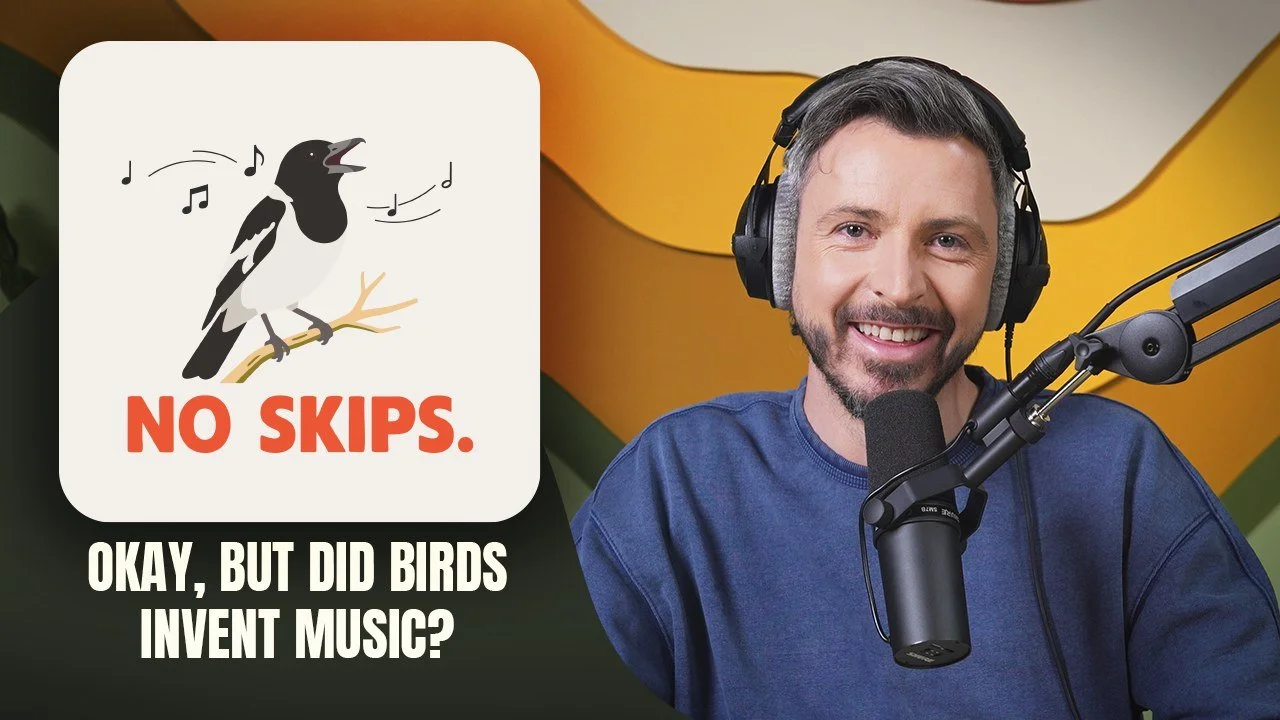
Release Date: Jul 16, 2026If a bird sings a phrase worthy of Beethoven, is that music, or just biology in a nice outfit? Dr. Hollis Taylor, a violinist, composer, and ornithologist, has spent more than two decades recording and transcribing the songs of the Pied Butcherbird, an Australian songbird whose vocal life keeps blurring that line.
Transcript
In this episode
- How a single pied butcherbird sings for seven hours overnight without repeating itself
- Why the same bird returns the following spring with an entirely new repertoire
- What a violin cannot reproduce when it tries to follow a butcherbird note for note
- Which features of birdsong, from steep glissandos to rattles, have no human instrument equivalent
- What transcribing birdsong by ear captures that a spectrogram does not
- Why calling birdsong music is a claim about the bird rather than about us
Scott Taylor: Cornell, 2015. I'm a postdoc at the Lab of Ornithology, which means by day I'm thinking very seriously about hybrid zones and population genomics, and by night, on this particular night, I'm standing shoulder to shoulder in a packed venue. Will a see if people around me scream the bridge to call me? Maybe at full volume. Carly Rae Jepsen is on stage. I am technically a grown adult with a PhD. I am also technically having the time of my life. The hooks are working, the crowd is into it. I'm worried the bass is going to give me an arrhythmia. And somewhere underneath the embarrassment of admitting this is my first real concert, I'm thinking whatever music is is happening in this room right now. I think about that night frequently because it, along with the many other concerts I've been to since, sits underneath the question I find genuinely interesting. We treat music like a uniquely human invention. Symphonies, jazz clubs, 3 chord pop songs, the entire Carly Rae Jepsen discography, ours a thing we made up. And then animals, including birds, exist over here in a separate category, doing something that resembles music but is, the textbook tells us, just function. Some bird songs just hit differently. Winter wrens in a damp cedar forest, going off for 10 seconds at a tempo no human could keep up with. Hermit thrushes at dusk, building intervals that sound to a western ear, almost composed wood thrushes singing what genuinely sounds like a duet with themselves. And look, I'm putting my cards on the table. White throated sparrows are my deep seated love and I will defend that clean whistled phrase as the most quietly perfect piece of songwriting in North America.
Scott Taylor: Which brings us to the topic of today's episode. OK, but did birds invent music? To explore this topic, we'll talk with Dr. Hollis Taylor, who has spent the last 20 plus years recording, transcribing and thinking hard about the songs of the Pied Butcherbird. For listeners who haven't seen one. The Pied Butcherbird is a medium sized black and white songbird from Australia with a sharp, hooked beak and a name it earned by impaling lizards on thorns like little hors d'oeuvres. It also sings, and it sings well. Hollis is a violinist, a composer and ornithologist, and the author of Music from Another Species, which is, as far as I can tell, the most generous and most rigorous book ever written about taking a bird seriously as a musician. After the break, Hollis walks us through how she ended up spending more than two decades recording, transcribing and thinking deeply about the songs of one bird in the Australian Outback. Stay tuned.
Scott Taylor: Well, welcome back, everyone. I'm so excited to have Hollis Taylor with us today. Thanks for joining us, Hollis.
Hollis Taylor: Thank you, Scott.
Scott Taylor: So you're a violinist, a composer, an ornithologist, and I think, you know, most scientists studying birdsong are trying to decode what it means. And I would love to start off with how you came to asking this other completely different question, which is whether birdsong is actually music.
Hollis Taylor: Well, I had an epiphany about 25 years ago on a sheep ranch in WA. It was my first trip to Australia and I was walking around looking for a kangaroo, naively because they're nocturnal, and suddenly I was surrounded by a jazz flute trio. Three Pied Butcherbirds in three different trees were singing in just this rich liquid crystal voice, and I had no idea birds sang in trios. And I was astounded. And of course, composers always need new ideas. But somehow that wasn't the source of my astonishment. I just felt like these birds were up to something really exceptional and I didn't want to, like, improve on their song. What I really wanted to do was just find out more about it. So two years later I began my PhD research into their vocalizations and for me there was never any question that it was music it for me from go, the musician in me recognized the musician in them and is birdsong music. I didn't really even think that was the best question on offer, but I was somehow forced to answer it or defend it just because there were so many misconceptions both about birdsong and also about human music. For instance, Oh, that birdsong is merely functional, whereas human music is for pure enjoyment.
Scott Taylor: I think it's interesting that you came into this where there's this standard scientific view that birdsong is just utilitarian of all for communication, territory defense, mating displays, but that that probably leaves out a lot. How have you navigated all of that?
Hollis Taylor: Well, first of all, we can assume that Pied Butcherbird vocalizations evolved for those very reasons. I I don't try to I read science and I I love what scientists have discovered. But while the functions, say, of territorial defense and finding a mate do a lot of the heavy lifting, we know that life's necessities are largely marked by pleasure. Maybe not paying taxes is not so pleasurable, but, you know, but so there's no reason to consider function and aesthetics as mutually exclusive. So I I think of songbirds as enlisting aesthetic qualities to do their work and, you know, run their lives. And it's for practical purpose. We humans do also affirm our territory, our group, our identity, our age through our musical choices. And there are now many books that musicologists have written on that topic. So that's really not contested anymore in musicological circles. So here's the problem. Music is often conceptualized as a Beethoven Symphony. And you're just not going to have that with birds because you're not going to have 100 birds fly into a small territory that can only support, you know, a small, a much smaller number. Music is not a formula, which I think is often overlooked. You find the logical way and when you find it, avoid it. That was the advice of Duke Ellington. And I think it's such good advice. So Pied Butcherbird songs, like all good music, exceed any kind of rigid set of rules or instructions. And so, as you've suggested, Scott, in my work I'm constantly bumping up against things that I think exceed the necessity of life.
Scott Taylor: And I think the more you watch animals, like even outside of music, I was asked once like if birds fly for fun. My response was, I don't know. But like I would if I could fly. And you know, you see corvids sliding down snow covered roofs on their backs and things like that. That's not functional. Someone could say like, oh, they're trying to get rid of parasites, but it's it's probably not that. It's just some other thing that they're doing because they're complex creatures and they have all these capabilities. So with with respect to Pied Butcherbirds, then they can sing in these trios, but they can be more than trios, right?
Hollis Taylor: I mean, there are group songs and there are solo songs and the group songs are, or we can call them ensemble songs as some people call them antiphons or antiphonal singing. Two or more are singing together. It be very very tight. So so kind of together that you would only think one bird were singing if you weren't looking at them. So you so you really have to, you know, not just record it, but be looking at them to know, oh, that was a duet. Or the duets can be very loose, like, say a Dixieland jazz kind of, you know, one gives a comment and another one comes back on that. So there's a range of things they do in groups. And I filmed from 2:00 to 8:00, birds singing. Sometimes they, they double, they sing in unison, you know, but you'll see their heads kind of go up and down. So you can, you can, that helps you parse who's singing what as well.
Hollis Taylor: And then the solo songs, they can do a little practicing during the day, but the main solo songs are nocturnal. These can be long. Once they start, they'll sing until dawn and then they also mimic. And if I could, I would just love to talk about their mimicry because they're nocturnal songs. They're singing for a second or two, followed by a few seconds of silence. And then all of a sudden they start this mimicry, which is often described in a kind of, when it's described in a scientific way, it's like, you know, imitation by birds of sound outside their normal characteristic vocalizations. But that's such a kind of impoverished way of thinking about mimicry because when you see a bird that normally sings slow and kind of low all of a sudden goes super high, like a tiny little bird singing non-stop and then he's doing a horse. When he then he's doing every second it changes. Or two horse, dog, cat, other birds, cell phone, ringtone, fire alarm, everything. So it's, it's just really, it's mind blowing and why the scientists don't really have even a, a good theory and there doesn't maybe even seem to be one obvious function of why birds are mimicking and Pied Butcherbirds have a good sized repertoire of their own. So of course I I love to play around with why do they do this? You know, census audio diary. My favorite is insider joke. Who knows?
Hollis Taylor: And then as far as the important part of your question, which is the communication system, we know that calls communicate. They are there. There's maybe there's likely an innate component and might be some learning involved, but some just they're born with and calls can be mobbing, nesting, feeding, flocking, greeting, whatever. And, and so those have meaning that's not challenged. Then do songs communicate? I think in a general sense, likely. But when I hear birdsong, I connect it first of all, not not to meaning or language or decoding or theory. I just connect it to other birdsong and to human music. So music is another way of communicating and not something that's weighted, waiting to be decoded into words.
Scott Taylor: Yeah, definitely. No, I like that's a really interesting way to think about it. And with respect to songs, so do these Pied Butcherbirds across the annual cycle, like do they have song all the time or do they go through periods where they're singing less? Like here in North America, obviously, like the chickadees I work on, their song is really tied to hormones that are circulating. So when when it's the non breeding season, you're not hearing fee-bee, which is very simple compared to the Pied Butcherbirds. But what is it for the butcherbirds? Like do they also have the seasonal variation in when they're singing versus calling?
Hollis Taylor: Yes they do, although they tend to sing the group songs a lot in the autumn.
Scott Taylor: Oh interesting, that's it.
Hollis Taylor: During the day diurnal and you don't hear nocturnal singing at all. It's nocturnal. Singing is a springtime approximate phenomenon.
Scott Taylor: You know you've worked on these birds for a long time. What are some of your standout experiences? One or two stories that really stand out. It would be great to hear them.
Hollis Taylor: Sure, as I alluded to they the nocturnal songs aren't long and once they start singing they'll sing till dawn and they may be several hours long. Say they start at 3:00 AM or something. And I'm, I'm once met a camper who, who suggested that the bird in their campground was starting somewhere around 11:00 or 11:30 and that I should come and check it out. So, you know, sometimes with local knowledge, it can be either gold or it can be nothing, you know, And so this was gold. I I went, I got permission from the campground, even though I was staying in another campground and I arrived at 11. I put up my mics. The birds started singing at 11:15 at night and he sang until 6:15 the following morning. That's seven hours. He took one 20 minute break. My partner suggested, well, why don't you play that song on the violin? And then I thought, Oh my gosh, how would I ever play for seven hours? You know, OK, you get a 20 minute break, but then you realize just what an expense of energy. And when I analyzed it, Scott, I was hard pressed to like find any kind of particular order to the phrases. So he wasn't on automatic.
Hollis Taylor: No, I recorded another bird over a 2 month period. I have all weather mics. He was quite regular in the trees that he sang in, so I could put up my all weather mics and not even have to be there. And I recorded him every night for two months. And there again, he didn't start with the same bits. He found a new way in each night and the next year his phrases were mostly transformed or completely transformed. One of the things that they do is they piece together things you could call a combinatorial or it's like snap together beads and you know, you got the orange bead and the blue bead and, and so around here I'm not a singer, but so bum, bum. They sing a short, long articulation, usually on F# to F, but then a bird might add a note before that. Bum, bum, bum. Or they might add a note in the middle, or they might put something at the end, you know, so so they're constantly reworking old material. I love.
Scott Taylor: Yeah. And the more you listen to them, I guess the more you can see how they do that. And especially having this year to year recordings of the same individual and really seeing that it's not like he doesn't always start this way and then he'll mix it up this way. So Pied Butcherbirds have been your focus for for a very long time. Like, are there other birds in other parts of the world? You would have heard that also and thought, oh, this is music the way you did with Pied Butcherbirds.
Hollis Taylor: You know, we have several other bird species here in Australia that sing at night that we would consider diurnal birds, the daytime birds. But they do in the spring sing at night. Them are Australian Magpies. They usually have only two phrases which they just hammer away at. They don't change it. They don't do anything. And of course I resent them because they step on the more gifted Pied Butcherbird and and then there's the Willie Wagtail bird that everyone loves here in Australia and they sing really super high. It's very silvery and doesn't really get in the way that much. Whereas the Pied Butcherbird sings like a flute or a trumpet or.
Scott Taylor: Yeah, that's, it's interesting. I was thinking about, like, what birds do I hear sometimes during the breeding season in North America? I mean, American Robins will will sometimes sing at night. But again, it's a different quality of song than what you're describing with these butcherbirds, that it's much more. Yeah, kind of all over. I'm not a musician, so I don't know how to describe it properly. But if you had the spectrogram, it would be wide. Anyways.
Hollis Taylor: Yes, I guess in that sense.
Scott Taylor: So your new book is about birdsong transcription and the process of translating like what a bird sings into something that a human musician can then read and play play. And what does that process, like the translation process reveal? A typical recording misses.
Hollis Taylor: I love that question and no one's ever asked it to me quite like that. So Music from Another Species is is my new book and it's it contains about 250 birdsong transcriptions, some of them mini pages in length, and still they're just excerpts of hours long songs. I always have to simplify them for and humans to play. It's I, I do a detailed transcription to begin with, but if I'm going to have ask a human musician to sing it or play it, I definitely have to simplify it. And the sonograms are wonderful voice prints. They give us rhythm, they give us pitch, they give us timbre, also the tone color. So those are great and they're definitely part of my process. And as I'm working through, I always put every phrase in a sonogram. And ultimately I rely on my human ear. I rely on what I've heard, but I do measure measurements.
Hollis Taylor: I've had biologists tell me that they often don't listen to a birdsong recording. They just rely on this sonogram, the trained eye. And here's where biologists and musicologists have very different questions. So biologists will be dealing with statistical difference in large data sets. I'm interested in one offs if if we think about, say, Beethoven's Fifth Symphony, if a bird sang and I actually have a recording of a bird doing this, OK, fine. But if he's saying like to a musician, it's like completely different, but statistically to a biologist, it might be not different. So it's it's a matter of what your question is, I guess what you're what you're going to use notation for. But for me, notation is. That's definitely my go-to gizmo.
Scott Taylor: Yeah, yeah. It's interesting to think about what you lose if you're just trying like we've, we've done some studies of birds where we're interested in genetic variation, but then also trying to quantify this song variation between populations in the context of like, is this a different species? I mean, we specifically aren't typically listening to the songs when we're doing that. We're looking at them and saying, OK, the amplitude is different or putting different marks on that and then asking is there a statistical difference? But yeah. It's. That's obviously going to miss stuff, especially like it can be statistically not that different, but still sound quite different to humans. Oh, man, such a different way to think about it than this. This biologist over here who who really loves birds and and the way they sound. Yeah. So you play these songs back. You're a violinist. And I'm, I'm wondering like, what happens when you try to match a butcherbird like note for note. How does the violin fall short or any other instrument that you've tried? And where does the bird do something like that? These human generated instruments really just can't replicate.
Hollis Taylor: Well, the hardest thing to replicate would be what we will call a portamento or a glissando. A gliss, you know, a swoop up or down, especially if it's very steep. Now, on my violin, of course I can. You know, I can do a slide on a piano. No, you know, you have a chromatic, you know, rather than mainly it's a matter of speed beyond that, but also timbres, tone colors that they can can do that are that are really amazing. You know, kind of real hard edged rattles or softer rattles. And sometimes I just have to do something different, even if it's not on the violin, even if it's not exactly what they did just to mark a change in tone color.
Scott Taylor: Yeah, the strings that birds are using to make these sounds is this really cool muscular organ that they have like control over both sides of, which is so different than the way, like a human larynx works. And just like how that structure and then the muscular control of it relates to any kind of instrument we've ever designed. So it makes sense to me. You'd have to sometimes improvise and just say, OK, we're going to change using this sound. But yeah, it's kind of a stand in. So human music is built around scales and intervals and and tonal centers that feel right to like human ears, right? So when you're analyzing butcherbird songs, do you find the same intervals showing up, or are they like working with an entirely different system?
Hollis Taylor: Great question. Wow. OK, so first of all, we we know that there's more than one scale or several scales that we use in certain music places all over the world use different modes and scales. Are they singing certain intervals or are they singing in the key of D or something like that? Sometimes I feel like there's a tonal center, sometimes they preference certain intervals, but usually not. And one of the reasons that I think not is because birds have absolute pitch or perfect pitch. In other words, they, they know that, you know, as AC or whatever, you know, I have that too. So I can relate a little bit to what they're doing. And so I don't need a scale, like a scale kind of keeps you knowing where home is, and I don't need that in order to find my way musically. So it could be that they don't need that either, and that's why they tend not to approach their singing so much like that.
Scott Taylor: Interesting, that made me think of So one of my favorite birds is the bullfinch, just because they're very cute. Like a male bullfinch is a very cute bird. But then I heard this story about how there used to be loggers who would, like, adopt a bullfinch and whistle classical music to the bullfinch during the song learning and crystallization period. And even if the logger didn't have perfect pitch, the bullfinch would learn it and then correct it and sing it better, which is just such an interesting. I would have. Yeah, that just sounds like the most magical thing ever to be in the woods and hear a bullfinch singing like perfect Mozart or something like that. Yeah, it's very. Cool, what do you think? Like accepting birdsong as music changes. I really like thinking about it and the way that you've described. And this idea that it can't just, I mean, certainly there's utility to these things, but there's also more than that. And what do you think it changes from a scientific or conservation perspective, or just how we should think about nature?
Hollis Taylor: Well, I don't claim that birds invented music. Perhaps like eyesight, music has been invented across species. You know, on multiple and separate evolutionary paths, we know that similarities can arise from a common selection pressure without a common ancestor or close common ancestor. So it's really been a challenge to even define music, as we talked earlier about a, you know, what is music across human music across time and geographies and cultures. And musicologists don't even have a working definition of their subject. They've kind of thrown up their hands. They looked, they went on a quest to look for universals. What is common in all human music? You can then imagine the temptation not being able to define it easily to to draw upon the word human. Music is humanly organized sound. You know, like let's let us say that. But I mean, you know, music is really what you say it is human superhuman, only certain humans across all species.
Hollis Taylor: So many people ignore the vocal accomplishment and instead take up this idea of human uniqueness and, and I guess progress. And, and although the capacity for music making emerged on an evolutionary path, evolutionary history with both animals and humans, I would, I would argue we can't say that music evolves art. And you know, art renews itself. It transforms, but it doesn't evolve if we want to use the word the way biologists do. And of course, I would want to. And so if we're accepting birdsong is music, we sort of join up then with Darwin in, in this kind of connect connectivity of all a living beings. So that's where I end up, I guess, is we could think of songbirds as ancient and substandard and primitive ancestors, or we could think of them as colleagues and contemporaries, and I do.
Scott Taylor: Yeah, yeah, no, that's a lovely way to think about it. Have people like have musicologists thought about this in the context of cetacean like whale sounds? Has anyone analyzed those in the same way that you've been thinking about in analyzing Pied Butcherbirds?
Hollis Taylor: Yes, they're starting to do that more and more, especially Alexander South in Scotland.
Scott Taylor: Yeah, that's cool, too, because I I mean, when you hear whale songs, like when you hear, you know, records of humpback whales, it really does evoke a feeling. I mean, in a, in a way that music does. All right. We've reached the part of the show we call That's B.S., or That's Bird Stuff, where we give our guests an opportunity to debunk a myth that ruffles their feathers. So Hollis, what do you want to call B.S. on?
Hollis Taylor: So some people complain that birdsong is less complex, less diverse, less inventive or innovative than human music. But are they comparing the simplest birdsong, you know, the little twit you know, which I guess could even have nuance, you know, but you'd have to get in there and analyze it. Are they comparing that to the most complex human music? Because we know that most popular and folk music, for example, is highly repetitive and formulaic and simple. So I call B.S. on how ideas like consciousness and function and language play an outsized role in how we're going to think about animal music and animal activities. So I call B.S. on people who are only in dialogue with cliches of of birdsong. And I really hope that Pied Butcherbirds will give them a broader and a deeper understanding of avian accomplishments.
Scott Taylor: Totally. That's awesome. I, I love that. Yeah. Well, thanks so much for joining us, Hollis. It's been really amazing to to chat about birds and music and these amazing Pied Butcherbirds.
Hollis Taylor: Thank you.
Scott Taylor: Birds are dinosaurs, and around here we like our snacks, so we end each episode with the Dinosaur Nugget. 7 million years longer than humans have. A single Pied Butcherbird in the Australian Outback can sing for seven hours straight through the night, almost never repeating itself, and come back the next spring with an entirely new repertoire. So the next time someone tells you music is a uniquely human invention, you can let them know we are, at best, a cover band. That's a wrap on this week's episode. OK, but did birds invent music? If you like this episode, leave us a rating or review or like and subscribe. We'll catch you next time. Byeee.
This transcript was generated using AI-assisted transcription and may contain errors or omissions. Please refer to the audio or video episode for the most accurate representation.
Credits
All audio, video, and images in this episode are either original to Okay, But... Birds (© Okay Media, LLC) or used under license/permission from the respective rights holders. Media from the Macaulay Library is used courtesy of the Cornell Lab of Ornithology as follows:
- Winter Wren audio contributed by Matthew D. Medler, ML136183
- Hermit Thrush audio contributed by Matthew D. Medler, ML169025
- Wood Thrush audio contributed by Wil Hershberger, ML168331
- White-throated Sparrow audio contributed by Bob McGuire, ML219799
- Australian Magpie audio contributed by Emma Greig, ML218159
- Willie-wagtail audio contributed by Cedar Mathers-Winn, ML188954
- Humpback Whale audio contributed by Flip Harrington, ML123414