
E13: Okay, but why do some birds babysit?
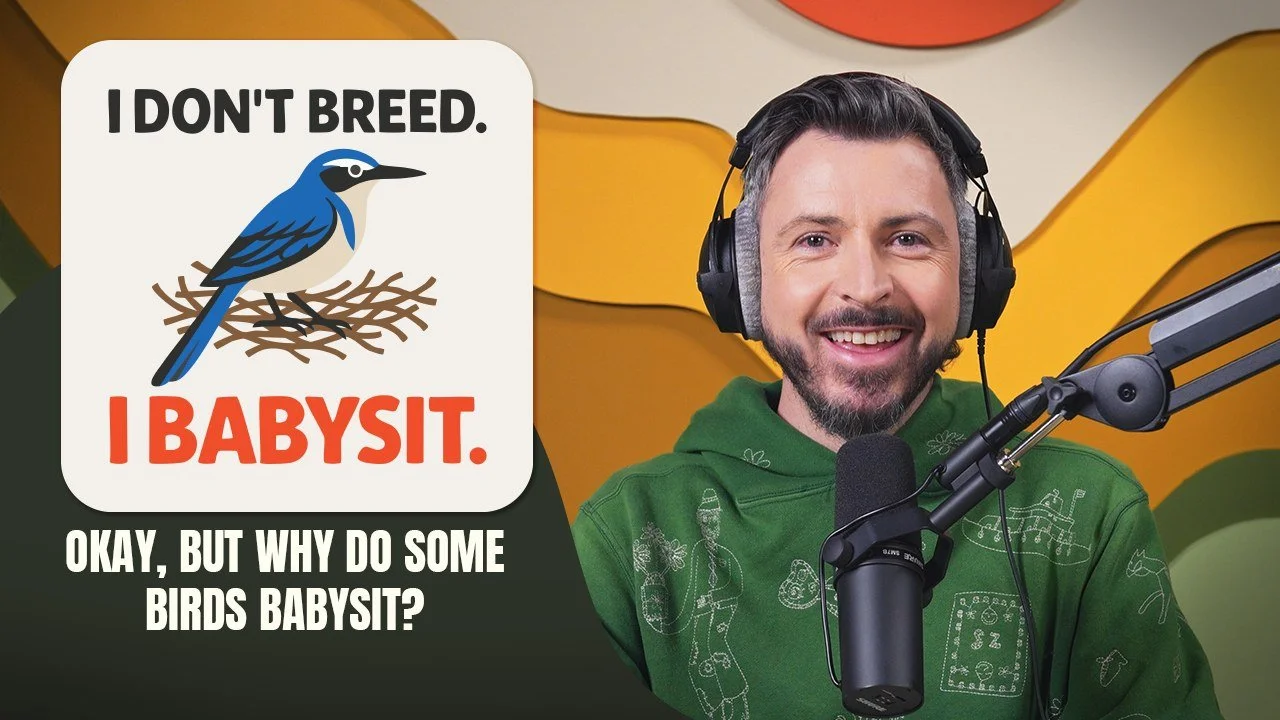
Release Date: Mar 5, 2026Some birds skip having their own families and spend years helping raise their siblings instead. It sounds like altruism, but it's probably more complicated than that. In this episode, host Dr. Scott Taylor is joined by Dr. Nancy Chen, UCLA, to unpack the notion that it takes a village to raise a child chick.
Transcript
In this episode
- Why a healthy adult bird would spend years helping at someone else's nest
- What fifty years of Florida scrub-jay records at Archbold revealed about helper behavior
- Whether helping a sibling counts as altruism or is just kin selection doing the work
- What a helper actually gains, from inherited territory to practice at raising chicks
- How a shortage of available territory pushes a species toward cooperative breeding
- What long-term pedigree data can show about family structure that a single season cannot
Scott Taylor: I had a very hard time leaving home for college. I was not excited to move. I was nervous about meeting new people, establishing new friendships, and being away from all of the things that made me feel safe. My family, Lake Huron, my little garden of ferns and wild orchids. But I did it anyways. Did I consider dropping out and moving home? Yes. That I often dread going to class? Yes. Was I very, very awkward meeting new people? 100%. But I persisted and eventually thrived. And since that first move away from home, I've moved from place to place as my life progressed. Always lucky that I had the next thing. If I'd ever moved home, I might have been called a boomerang kid, a young adult who left the nest and then came back. Usually this has a negative connotation, but this can happen for many reasons. Maybe to save money, maybe to help aging parents, maybe for better wi fi, but sometimes to help raise younger siblings. And this cooperation can feel very unique to humans. And some folks might think that humans are the only species with boomerang kids or relatives that take care of other relatives. But in the bird world, the strategy also exists, and it's fascinating and, honestly, a bit unexpected. Which brings us to the topic of today's episode. Okay, but why do some birds babysit? And I'm particularly excited to talk to today's guest, who's been a dear friend of mine for many years. The truth is, some birds don't just hang around after fledging, though some do. Many also actively help raise their younger siblings. Feed them, protect them, babysit them while mom and dad get some air. This phenomenon is called cooperative breeding, and it flips the script on what we think bird families are supposed to look like. In species like Florida scrub jays and purple crowned fairy wrens, many siblings and half siblings pitch in to raise the next generation. Sometimes it's even unrelated individuals who are helping out at the nest. It's not failure to launch, it's family hustle. So what's in it for them? Why help raise someone else's chicks instead of striking out on your own? And how do these extended family systems affect everything from survival rates to social dynamics? Today, we'll explore this surprisingly complex world of bird family life. It's sweet, it's strategic, and sometimes it's a little soap opera. Helping us decode this family drama is Dr. Nancy Chen, an assistant professor in the Department of Ecology and Evolutionary Biology at UCLA who has studied how these avian households form, function, and sometimes fall apart. Stay tuned. It's great to see you and thanks for joining us to talk about cooperative breeding.
Nancy Chen: I'm happy to be here.
Scott Taylor: So I wanted to start off just by helping people understand what it is. So what is cooperative breeding and how common is it in birds?
Nancy Chen: Yeah, so cooperative breeding is this cool reproductive behavior that we see in. In actually lots of animals. So it's not just birds. Mammals do it. Some people can argue that humans are cooperative breeders, but basically it's this behavior where offspring will wait to leave home and have babies of their own and stick around and help raise, help their parents raise kind of future generations of offspring. So oftentimes they're helping raise full siblings or half siblings, but sometimes we also see unrelated individuals actually helping out with parental care.
Scott Taylor: So cooperative breeding, like you said, you could consider humans to be cooperative breeders. In a lot of cases, it's across the kind of animal kingdom. But from a bird perspective, are there any species that are most famous for cooperative breeding behavior?
Nancy Chen: I would say there's several corvids that are known as cooperative breeding. Also, for some reason, I don't know why, but Australia, so many birds in Australia are coif rib breeders. Oh, interesting. If people are familiar with fairy wrens, which are these teeny tiny songbirds, those are pretty famous cooperative breeders. In terms of birds in North America that folks might see or recognize, Crows are cooperative breeders. And then the birds I work on, scrub jays, the Florida scorpjay specifically, are also cooperative breeders. And they're one of the first species that in which this behavior has been described.
Scott Taylor: Oh, cool. Specifically in Florida scrub jays or just
Nancy Chen: scrub jays in general, just Florida scrub jays. So there's multiple different species of scrub jays in North America, but only the ones in Florida are cooperative breeders. There's like a huge range of reproductive behavior across scrub jays.
Scott Taylor: Oh, that's really interesting that even within a species or very, very closely related species, you'd have that kind of variation in reproductive behavior.
Nancy Chen: So within the genus of scrub jays, we range from kind of your classic monogamous species. So the California scrub jays are completely monogamous. And then there's a species of scrub jays on the Channel Islands, on Santa Cruz Island. So these islands off the coast of California, the island scrub jay, they have delayed dispersal and delayed reproduction, but the offspring don't actually help with parental care. And it's only in the Florida scriptures where you get delayed dispersal and helping.
Scott Taylor: Interesting. There's definitely a Florida man joke in there about delayed dispersal and helping raise your family, but I'm not sure exactly what it is. When you say monogamous, though, just to clarify, you mean socially monogamous but not necessarily genetically, Is that right?
Nancy Chen: Yes. Yeah. Okay. California jays are socially monogamous, and they have higher rates of extra paraprotenity. So they're not genetically monogamous.
Scott Taylor: Yeah. For our listeners who are interested in that topic. So genetic versus social monogamy. Go back and listen to episode one from this season. Why would a bird delay its own reproduction to help raise its siblings instead of, you know, why would it do that instead of having its own offspring?
Nancy Chen: That's a great question. And it's been a question that's interested evolutionary biologists and people interested in bird behavior for a very long time. I was thinking about this. I think it's a kind of funny reflection on us as humans or on how evolution works. People are really interested in cooperative breeding because it's weird to have individuals helping other individuals. I guess evolution assumes every individual has to be inherently selfish. So there's multiple different theories that explain why this cooperative behavior has evolved. And they're largely divided into two different arguments. One argument is called kind of inclusive fitness or kin selection. And so this was a theory proposed by a scientist, W. D. hamilton, that most of the time, if the helpers are helping closely related offspring, then they gain what's called indirect genetic benefits. So essentially, for instance, if I were to help my parents raise my brother, my brother and I, because we're closely related, we would share a lot of our genetic makeup, right? And so if the benefits accrued, if I kind of improve the survival or reproductive success of my siblings by helping to care for them and raise them, those benefits kind of weighted by how much of my genetic material would be passed on, like via my siblings having offspring. If that outweighs any costs of my decision to delay reproducing myself, then you would expect to see cooperative breeding behavior, this cooperation evolve. So that's called kin selection. But there's also a growing kind of number of studies that show that there may also be direct benefits to helpers themselves or direct fitness benefits. So it might be good beneficial for a given individual to not leave immediately and help raise other offspring, if it helps them survive longer or if it helps them be able to produce more offspring later on in their lives. Like they could be gaining skills, or there may be benefits to living in large groups. So there's a lot of different hypotheses out there about the evolution of this behavior.
Scott Taylor: Very cool. Yeah. And so in a sense then, I mean the kin selection. Well either way, like the behavior is maybe being favored because of a selfish thing for that individual. Like the, their genes indirectly go further if they help their siblings or they're more protected from predation or they have longer to learn or whatever. Depending on which of those hypotheses you think about. That's really cool. What are some of the risks then for these helpers that people think about in the context of this evolved behavior?
Nancy Chen: I mean the biggest thing I think is you'll likely produce fewer offspring yourself. Right. Especially for species where they might wait many, many years before they start breeding themselves. Oftentimes an individual will die before they even get a chance to try to reproduce. So there are some, there's kind of like a cost benefit. There could be a little bit of bet hedging that individuals are doing trying to figure out what is the best way to maximize kind of how much of their genome gets passed on to future generations.
Scott Taylor: Yeah. So with the scrub jays, the Florida scrub jays in particular that you study, like what's the longest? Because you have this amazing pedigree of scrub jays that you should tell everyone about because it's just a mind blowing data set. But like what's the longest you've seen an individual wait to actually engage in its own reproduction after being a helper?
Nancy Chen: I mean we definitely have many, many individuals who never become breeders really.
Scott Taylor: They're just always helpers.
Nancy Chen: My collaborator Fitz, his, he always says that a whole scrub J's main purpose in life is to establish as a breeder. Like once you've become a breeder, you've made it. But sometimes we've seen some individuals wait four to five or more years before they actually become breeders. So it's quite a long time. Individuals are just waiting around, waiting for a new opportunity to arise.
Scott Taylor: Yeah. So I mean if they're waiting four or five years, I think mostly about chickadees, which generally, you know, average lifespan is 2. Sometimes they can live all the way to 10 or 11. But what's like the average lifespan of a scrub jay related to that? Like waiting four to five years to reproduce?
Nancy Chen: Yeah. Well, turns out the average lifespan, if you're considering everyone in the population, it's only 1.5 years. Oh wow.
Scott Taylor: Okay.
Nancy Chen: Largely because 70% of individuals die within their first year. But of if you make it as a breeder than on average breeders will live about five years. Maximum now is 16. I think it's our oldest recorded individual.
Scott Taylor: That's amazing. Yeah. And I think for folks listening that 70% of individuals dying, you know, within a year or so of hatching is not too out of the norm for birds that lay a lot of eggs, I guess is the simplest way to say it. There are like these live fast kind of die young birds where, you know, chickadees about half of a population or of the juveniles will die every winter. So, okay, so I guess an obvious question comes up. If there's these individuals waiting and then becoming reproductive, like what's the trigger to go from oh, I'm a helper to now I'm going to actually raise my own chicks.
Nancy Chen: I think it's all about opportunities. So the Florida scorb jays, they're restricted to this really unique dry, fire maintained habitat, scrub habitat in Florida. It's very different from what people classically think of. Like it's not the Everglades, it's not marshy, it's not wet, it's very dry and sandy and beautiful.
Scott Taylor: It's so nice there and beautiful.
Nancy Chen: I love the scrub. And these jays are habitat specialists. So they're really restricted to these scrub habitats. And because of habitat destruction, there's very little kind of high quality scrub habitat left for these jays. Which means that in many areas with high quality scrub, such as our primary study site at Archewell Biological Station. So it's this big, beautiful continuous patch of scrub that's been carefully maintained for decades. And what that means is we go out and we burn the scrub regularly because it's fire adapted. There's a lot of fire adapted species. And so the fire cycle is really important. The scorpedes have basically saturated this habitat. You can think of them as just like sardines packed in a tin. So to be able to become a breeder, these birds need to become the socially dominant pair in a given territory. So another thing I forgot to mention is that Florida scorptes are highly territorial. They stay in the same place year round and kind of defend their territory. This kind of up to 15 hectare area, that's their home turf. Generally, scrub jays are waiting for an older breeder to die so they can replace them. Very rarely we see formation of de novo or completely new territories. Or sometimes an enterprising young scrub jay will try to carve off a portion of their parents territory and then expand it. That process is what we call budding. But for the most part they're just trying to find opportunities and oftentimes they just have to wait for someone to die to replace them.
Scott Taylor: How many of the breeding pairs have helpers? Is it every breeding pair has helpers or only some? And if it's only some, do you see reproductive differences between pairs that have helping individuals versus pairs that don't have helpers?
Nancy Chen: There's quite a bit of variation in group sizes in the scrub jays. There are several breeding pairs who will have zero helpers and then some will have up to seven.
Scott Taylor: Wow. Seven helpers.
Nancy Chen: So there's a pretty big. I think that's the biggest. Yeah.
Scott Taylor: That's crazy.
Nancy Chen: There was this one group in a territory that we called Hilltop when I was a graduate student that had seven helpers and was a really big. Just like a giant family. Wow. There's mixed evidence. So there are some studies that show that Florida scrub J helpers do increase offspring survival. There's an interesting interaction with territory size. So in small territories, if you have too many helpers, it can actually be bad for the offspring because then they end up competing for limited resources. So do helpers help? Sometimes, but not always.
Scott Taylor: Right. It's really, it's more context dependent than maybe you'd intuitively think. But yeah, territory size, if that's the only place food is coming from and you have seven helpers, you might actually not have enough food for your chicks. So then in that context, is it driven by genetics, the environment, a combo, or like, what's the latest understanding of this kind of helping behavior?
Nancy Chen: That's a great question. And I would say for most species we don't know.
Scott Taylor: Yeah.
Nancy Chen: We haven't tried to ask whether or not helping behavior is genetically determined in the scrub jays. I think it's a very complex behavior and so it's hard to figure that out. There have been studies in other species. I can think of at least one paper that showed that this helping behavior was heritable. And so it means it was kind of passed on genetically, but I think jury's still out.
Scott Taylor: Yeah. And like, to really understand if something has a genetic basis, the sample sizes and all of that that you need are quite large.
Nancy Chen: And.
Scott Taylor: And if the behavior is complex like this, which is just like helping. Yeah. I can imagine it would be difficult to ever really pinpoint, but I know as we've been talking about, environmental variation has to play a role to some extent. Even if it is something that can evolve, that environmental variation probably influences the likelihood of that.
Nancy Chen: Yeah. And I think there's also a lot of chance.
Scott Taylor: Yeah, yeah. Right.
Nancy Chen: So like if you're lucky and the breeder next door dies, then there's a breeding opportunity right there that you're aware of. So it's like when I think about helping behavior, at least in the scrub jays, I feel like a lot of it just has to do with the environment and chance events like breeding opportunities.
Scott Taylor: Yeah, yeah. It's interesting. I mean, the scrub jays have such restricted habitat and they need to be in this place. I wonder how that translates across the other cooperative breeders. Like you were talking about fairy wrens. And I think superb starlings are also cooperative breeders. Is that right?
Nancy Chen: They're cooperative, yeah. And the idea there is that cooperation helps groups survive under really, really unpredictable environments.
Scott Taylor: Right, yeah. So in those cases where having extra birds to help feed chicks in a random unpredictable drought or something like that, you might increase overall fitness, which is. Yeah, it's interesting to think about those different drivers. Environmental variability or predictability or just habitat constraints. In the case of the Florida scrub jay, we've already kind of touched on this. But how often do helpers inherit their parents territory? Like is that a common thing that it kind of goes, you know, the inheritance chain is direct or is it often neighbors or is there even a pattern?
Nancy Chen: Individuals can definitely inherit territory. But what's annoying is that there's a sex bias. So in scrub jays, for the most part, only males will inherit. So sons will inherit territory because I guess it's a patriarchy too.
Scott Taylor: Patriarchy, patriarchy. What the heck? Birds, you gotta be better than that.
Nancy Chen: I know, right? But yeah, it's so annoying. Like males are always socially dominant to females and so males are the ones who are likely to inherit territory if one of their parents dies. And that is why we think females leave home earlier and move further away.
Scott Taylor: Oh, interesting. So they're like further dispersers. They leave younger, I guess, yeah. If the dominance hierarchy is kind of established that way. Importantly for anyone listening, that's not always the direction of a dominance hierarchy. Birds. There's lots of interesting examples of female individuals holding territories and being kind of the dominant ones. Like phalaropes are, I think, an interesting example of that.
Nancy Chen: And Chicanas.
Scott Taylor: Oh yeah, and Chicanas, exactly. Yeah. Sarah Lipschitz's work on Chicanas is really interesting. But yeah, the patriarchy from a longer term perspective, do you think this cooperative breeding is kind of a stable strategy or.
Nancy Chen: It's interesting because you would predict different things depending on what aspect you think matters the most for the survival of a population. So for instance, from a genetic perspective, cooperative breeding means that fewer individuals in A population will actually be reproducing and contributing to the gene pool in future generations. And that can reduce the amount of genetic diversity because essentially the reproducing population that matters is smaller than the actual kind of number of individuals or number of adults in a population. And so that could be detrimental. But from kind of a demographic perspective, it can actually be really helpful to have all of these adult non breeding individuals floating around in the population because it can buffer population size changes over time. We've seen this in the Florida scrub jays where if there's a year with really low breeder survival, so a lot of breeders die, the population size doesn't crash because there's just this whole suite of non breeders just waiting to take their places. And so it can provide a buffering effect.
Scott Taylor: That's cool. I'd never thought about that buffering effect of just having these ready to go individuals floating around and then they can take over. Yeah. If breeders die for whatever reason, I mean, from an inbreeding perspective, we know. Well, in general, like inbreeding reduces genetic variation. It can lead to the expression of deleterious or negative bad traits. For example, if you're very inbred in theory, we know that. But then your work on scrub jays kind of really showed some of those consequences really nicely. Right?
Nancy Chen: Yeah. So we've spent a lot of time thinking about consequences of inbreeding and also immigration, so movement of individuals into our study population. So the Florida scrub jays are an endangered species because it's a small population and they don't move very far. They often pair with relatives or inbreeding. And that's bad. And we showed that it's bad for fitness. We've also shown that kind of a lot of birds moving in, very important for keeping levels of inbreeding down.
Scott Taylor: Right. So bringing in new genetic variants from other neighboring populations and preventing that reduction in genetic diversity. Yeah. I think like the work on the scrub jays is really what shows the theory in a lot of ways is right about like the importance of other alleles coming in. I mean the, the work on. It's always Florida for some reason. Florida panthers also, which were very, very inbred, or Florida cougars or whatever you want to call them. Mountain lions, but not living in mountains, were very inbred in Florida until they brought those like handful. I think it was seven or eight individuals from Texas.
Nancy Chen: From Texas, yeah.
Scott Taylor: And then that we call that like genetic rescue, basically. Yeah, yeah. So you mentioned Archibald Biological Station, which is in like the Lake Wales Ridge region in Florida. I Know the, the scrub jays study has been going on for a very long time and it would be great to hear more about it. And was that the population of scrub jays where people kind of really started studying cooperative breeding?
Nancy Chen: Yeah. So one of the textbook examples of cooperative breeding is the Florida scrub jay. Glenn Wolfenden in the late 60s, kind of noticed some these birds living in groups and started banding birds. So all the individuals have this unique set of color bands on their legs to make it easy to identify different individuals in the field. The population monitoring has just increased in geographic area and they've been using standard field protocols to monitor the population for more than 50 years now, which is really incredible. And there's a ton of data. It's like Big Brother on steroids. So every individual is individually marked. There's a team that goes out to census the entire population once a month. So once a month we go, and I'm using the royal we here, we go out to every single territory and Mark who is still alive. So we know exactly how long different individuals live in our population. Mostly we are assuming that if we don't see an individual that it died, not that it moved out of our study site. And then during the breeding season, there's a whole field team that goes out and finds the nest of every single, on every single territory. I think on average it takes like nine people hours to find a single nest. And so you can imagine the amount of work that goes into this. And then every nest is tracked very closely. So we know exactly when birds start laying eggs, how many eggs are laid, how many of those eggs hatch, and then the fates of all of the nestlings that are born.
Scott Taylor: Wow, that's. Yeah. For folks listening that having that kind of data set for a wild population is extremely rare, especially one that's that long. Like 50 years of really, really continuous data is just incredible. And that's kind of what allows you to ask a lot of the questions that we're talking about, the benefits, the long term benefits, because you need to know, like how long does an individual live and what is its fitness, its reproductive output, to really understand the drivers of, you know, potentially cooperative breeding or whatever. And I don't think we think about it, but it's hard to know how long an animal lives unless it's in a zoo. Right. If it's this wild free living thing, it's hard to track and hard to measure. So yeah, the Florida scrub jay system is pretty amazing for that reason.
Nancy Chen: I know I feel very lucky to get to work with the Jays also, they're just really fun to work with. There's more and more studies showing that there's a lot of variation even within cooperative breeders. So how much different individuals help may vary. It may vary by sex, it may vary by relatedness. I think there's a lot of complexity and the decisions that these animals are making in the wild, day to day.
Scott Taylor: Yeah. And our ability to even study that is. Is. Has changed over time. Right. Like historically, we would be physically watching these interactions and trying to understand, like, you know, in the context of birds, who's provisioning or whatever. The relatedness piece is a more recent development that we can actually analyze with genetics and then some of these more nuanced behaviors or small behavioral variations. You really have to be observing in very different, multiple different ways to figure out what's going on. And I think that's. Yeah, it's important to remember it's hard to study these things. So knowing exactly what's going on is challenging. Yeah.
Nancy Chen: And technology can help in some cases. So there's very well tracking technology that's being develop that can help monitor individual movements right across the landscape, which matters. Or even measure when two individuals come within a close enough distance and interact. Or cameras. Right. Can we just put up. Oftentimes now you can just put up a camera and then record footage and analyze that later instead of sitting out there yourself watching. Which is nice, except in the scrub jays. They're too smart and we can't actually put video cameras out. Really?
Scott Taylor: What do they do? They just avoid them or attack them?
Nancy Chen: I think they abandoned the nest.
Scott Taylor: Really? Oh, wow. They're wary. Wary of Big Brother watching them at least now. I mean, from an analyzing perspective, when you have thousands of hours of video, you can train an algorithm to track it, but that's still kind of in its infancy in a lot of ways from a wildlife tracking perspective. Okay, so we've reached the part of the show that we call that's BS or that's bird stuff, where we give our guests an opportunity to debunk a myth that ruffles their feathers. So, Nancy, what do you want to call BS on?
Nancy Chen: What I want to call BS on is this common misunderstanding that if you see a baby bird on the ground, that you need to go rescue it.
Scott Taylor: Ah.
Nancy Chen: Turns out most baby birds on the ground are probably fine and you should just leave them alone.
Scott Taylor: And by probably fine, you mean they're out of the nest because they're. They did that on purpose. They're fledging. Right.
Nancy Chen: So most baby birds that People see are what we call fledglings. So they have feathers, they just are small and have no tail and look like a baby because they are a baby. But these are birds that have already left the nest. So if you try to put them back in the nest, that won't work. They'll just hop right back out. And they're not alone. Their parents will be around, probably looking for food to feed that bird. So most cases, when you see a baby bird, don't touch it. It's fine. If you move it, you might be taking it away from its parents. The one exception is sometimes you might see a baby bird that's very clearly a nestling. So it'll be naked. It'll have giant eyes that are probably closed or mostly closed. And in those cases, if you can find the nest, then you can put the bird. Try putting the bird back in the nest. If you can access it without destroying it.
Scott Taylor: Yeah, definitely. And for our listeners, a couple episodes ago, Dr. Fan Bonnier pointed out that it's totally fine to touch a baby bird. So in this case, if the bird looks very, very young, no feathers, very closed eyes, you can try to put it back in the nest and it'll be totally fine. But otherwise, just wait and watch and you'll probably see the parents come by to feed. Feed the fledgling that has feathers and is already out of the nest on purpose. Awesome. Well, thanks so much for joining us, Nancy. It's been really awesome to think about cooperative breeding and birds and hear more about these amazing Florida scrub jays.
Nancy Chen: Thank you for having me.
Scott Taylor: Birds are dinosaurs, and around here, we like our snacks. So we end each episode with a dinosaur nugget. Today's dinosaur nugget is that in a lot of bird species, raising chicks is so demanding or risky that parents don't always do it alone. Instead, you get babysitters at the nest. Sometimes those helpers are close relatives, boosting their inclusive fitness by helping kins survive even if they don't breed that season. Other times, babysitting is more like training or insurance. Helpers gain experience, are more likely to survive, and provide backup when conditions get rough. Either way, bird babysitting isn't altruism gone wild. It's an evolved strategy shaped by ecology, social structure, and the very real price tag of reproduction. That's a wrap on this week's episode. Okay, but why do some birds babysit? If you liked this episode, leave a comment, follow and subscribe. I mean it. What are you bird curious about? Let us know in the comments or through Instagram. @okaybutbirds. Byeee. Okay, But... Birds is hosted by Scott Taylor with production and creative by Zach Karl.
This transcript was generated using AI-assisted transcription and may contain errors or omissions. Please refer to the audio or video episode for the most accurate representation.
Credits
All audio, video, and images in this episode are either original to Okay, But... Birds (© Okay Media, LLC) or used under license/permission from the respective rights holders. Media from the Macaulay Library is used courtesy of the Cornell Lab of Ornithology as follows:
- Florida Scrub-Jay audio contributed by Bob McGuire, ML229211
- American Crow video contributed by Jay McGowan, ML472843
- Superb Fairywren audio contributed by Vicki Powys, ML233810
- Superb Starling audio contributed by Myles E. W. North, ML14855
- Red-necked Phalarope audio contributed by Bob McGuire, ML235440
- Northern Jacana audio contributed by Gerrit Vyn, ML140224