
E9: Okay, but is birdwatching the original Pokémon?
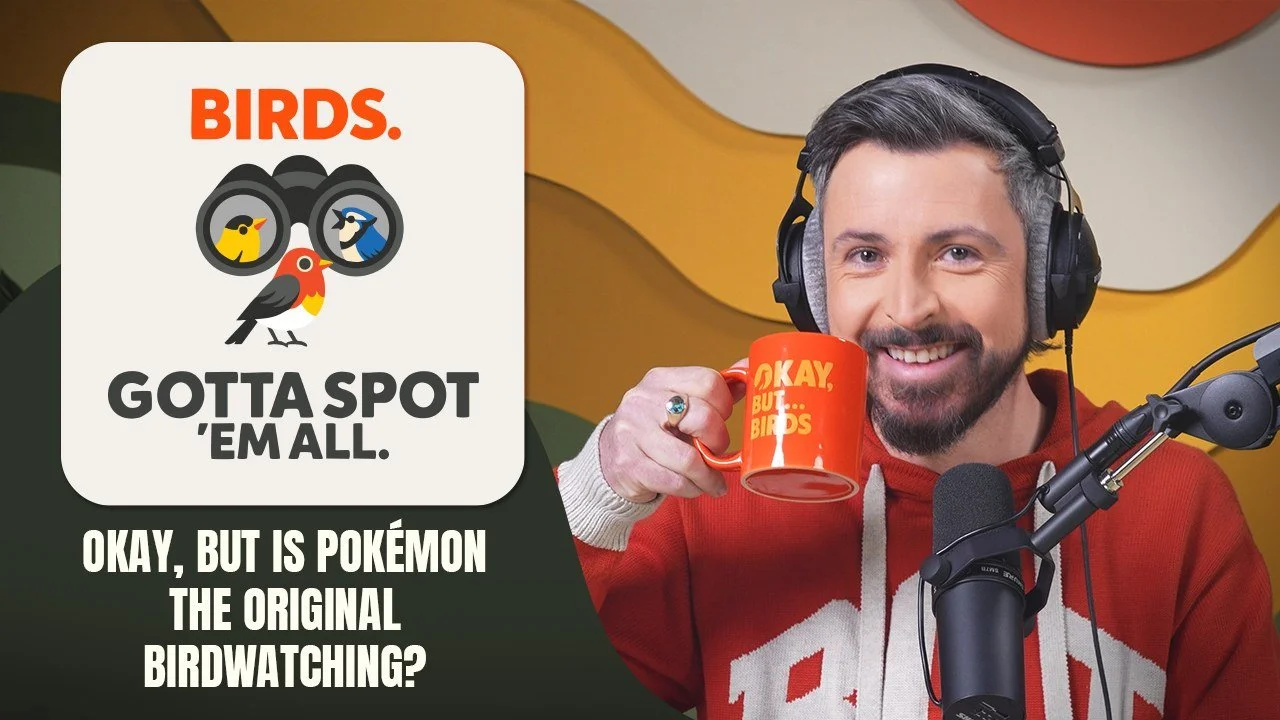
Release Date: February 5, 2026Birdwatching, birding, twitching… whatever you call it, it’s got everything: quests, rare finds, elaborate gear, a sprawling universe of characters, and a deeply committed fandom. Sound familiar? In this episode of Okay, But... Birds, host Dr. Scott Taylor is joined by NYT best-selling author and Pulitzer Prize-winning journalist Ed Yong to explore how modern birding became more accessible than ever (hello, Merlin and eBird), why it can feel like an open-world RPG, and what the Pokémon comparison misses.
Transcript
In this episode
- Why noticing one bird makes you start noticing every bird after it
- How eBird manages to function as a social network without the clout chasing
- What Merlin changed about who gets to call themselves a birder
- Where birders disagree about using recorded playback to draw a bird in
- What happens socially when a genuinely rare bird turns up near a city
- Why paying attention to birds changes your relationship to a place
Scott Taylor: When did you start paying attention to birds? For me, it was at a bird feeder. I was sitting on our kitchen counter in the small winterized cottage that I grew up in. That was the only way that five year old me could see out the window that framed our kitchen sink. My mom was doing dishes and I was helping her dry them. Her drying buddy. Her rings were carefully placed in a dish on the windowsill. A small, poorly made bowl that I think was my first attempt at pottery. The bird feeder was just out the window at the edge of the woods. It was winter and our local resident birds were very active. How do you tell these birds apart? My mom's reaction was a smile. Look at that one with the head crest. It's grayish brown but has a thick orange red bill. A little bit of reddish coloring on the wings, tail and crest. That's a female northern cardinal. And the one that's the same shape and size but bright red, that's the male. She went on to point out size and color differences of other birds and say the names Mourning Dove, Black Capped Chickadee and Dark eyed Junco as they flitted into the feeder to grab seeds. Why don't you draw them? She finally said. And that suggestion in some ways set the course for a large part of the rest of my life. I love watching birds, but maybe I'm not a hardcore birder. Since my poorly drawn morning dove in Chickadee, I've had the privilege of bird watching all over the world. I've experienced the joy and wonder of finding a rare migrant during the spring migration in southern Ontario where I grew up. A yellow throated warbler. I've watched albatross trailing after my ship as we crossed the Drake Passage on the way to the Antarctic Peninsula. And I've floated below a cliffside colony of tens of thousands of thick billedmeres in Arctic Svalbard. Oddly, I've never kept a list. For me, birding has always been more about the experience than the record. But I have decided that it's high time for my observations to be logged in ebird. And I'm working on it, I promise. I do think it's fascinating to hear how different people come to watch birds, whether from photography, because of friends or from their interest in Pokemon, like one of my former ornithology students. And now, more than ever, people are flocking to the hobby. The advent of Ebird in the early 2000s, followed by Merlin in 2014, has made modern birding more accessible than ever before. From Ariana Grande on Good hang with Amy Poehler talking about her love of the Merlin ID app to hearing about the amazing memories of mountain chickadees on the Residence on Netflix, birdwatching is really having a renaissance. Which brings us to today's question. Okay, but is birdwatching the original Pokemon? To answer this, we'll talk with science writer Ed Yong, a relatively new but very enthusiastic member of the birdwatching community. You may be familiar with Ed's work from one of his New York Times best selling books, like An Immense World, or his Pulitzer Prize winning journalism during the COVID 19 pandemic. Bird watching, birding, twitching, whatever you call it, it's got everything. Quests, rare finds, elaborate gear, a sprawling universe of characters and a deeply committed fandom. Sound familiar? That's right, birdwatching might just be the original open world rpg. You've got your spotting scope, your field guide, your app that pings when a rarity is in your zip code. There are hotspots, seasonal migrations, badge equivalents, and a community that at least in part thrives on the thrill of the chase. But here's the plot twist. This global pastime isn't just about collecting. It's also one of the most powerful engines of citizen science on the planet. And it's a pastime that connects us with the real world, a connection that has proven benefits for our mental health and well being. Birdwatchers, casual to obsessive, log millions of sightings a year. That data fuels research, shapes conservation decisions, and helps track migration shifts in real time. So while it may feel like a personal hobby, it's part of a scientific juggernaut. And it's good for you. Let's not forget the joy factor, that jolt of adrenaline when you spot a bird you've never seen before. It's real and addictive, and it might just be the healthiest dopamine hit you can get without touching your phone. Today we'll talk with someone who came to birdwatching during the COVID pandemic and who says, honestly, that birding changed his life. Science writer Ed Yong. We'll dig into his journey into the hobby, why birds have become a new obsession, the culture of birding, how it's really changed with technology and whether. Okay. That some people just really want to catch them all. Stay tuned. Thanks for joining us, Ed.
Ed Yong: Yeah, thanks for having me.
Scott Taylor: I've already told My story of how I got into birding. But how did you come about being so into bird watching as many people are finding themselves these days?
Ed Yong: Yeah. So I moved from D. C. to Oakland in the spring of 23, and I sort of wanted to spend more time outdoors. I knew I wanted to connect more with nature. You know, I'd spend, like, a lot of people a lot of years during the pandemic, cooped up and, in my case, writing about some pretty horrific stuff. So I wanted something that would get me away from that. When I moved to Oakland, many things happened in quick succession. So I moved to an area that just happens to be very birdy. So I heard a lot of birds around me. I downloaded the Merlin app, which helped me to identify what I was hearing. A friend of mine lent me her copy of Sibley Field Guide, and she'd marked all the most common backyard birds that I would be mostly likely to see. And then I just started going for walks, and I bought a pair of binoculars, and it all kind of steamrolled from there. I think one of the joys of birding is that there is this glorious, virtuous cycle between how much you look and how much you see. And the more you look, the more you see. And the more you see, the more inclined you are to spend your time looking. And that's what happened to me. Yeah.
Scott Taylor: That's awesome. I appreciate the intentionality of it all for you. I think some people fall into birding because of where they grew up or what their parents were interested in. But you've been bird watching for a number of years, and you've thought a lot about the ways that humans experience the world versus the ways that other animals experience the world. And birds have all of these amazing senses compared to us. How does that factor into your enjoyment of birding as a hobby?
Ed Yong: Yeah, it certainly gives me a greater appreciation of them when I'm out and about. So I think of birding as a multisensory activity. So I'm looking and I'm listening. Too often, I'm listening. In spring migration, especially, birding is much more of an aural activity than a visual one. So I'm trying to appreciate birds with as many senses as possible. I am very acutely aware when I'm watching them that what they experience of the world is very different than what I experience in simple ways. Like, if a bird is facing to the side, it can still see me. Obviously, its visual field wraps around. A bird is seeing very different colors than what I'm seeing. Probably an order of magnitude, if not two more kinds of hues than what I can discriminate. It always makes me amused when birders go out, like, all dressed out in camo, with camo on their cameras, buddy, they can still see you. And I think I'm just trying to think about how birds are moving through the landscape and what that seems like to them. You know, I've gone out on pelagic bird trips to look for things like albatrosses. And what I understand from the writing I've done for my book is that to a seabird, what to me looks like a featureless stretch of ocean is actually this rolling topography of mountains and valleys, of odors and scents. Understanding that, like, the sort of academic side of birds, like the knowing the kinds of things they experience that are very different to what we experience, deeply enriches how I perceive them when I'm out in the field. But I also think of birding as doing the opposite. I have loved nature for my whole life, and I've accumulated a lot of book smarts about the natural world and about birds, how they work, their evolutionary history, all of that good stuff. Birding gives me field smarts, tells me about how birds actually behave, what they're like, what their personalities are like, how they react to the times of day, the seasons, the land around them. And I think that these two different kinds of knowledge are quite distinct and very complementary. And knowing both of them, I think, gives me a much deeper and richer sense of the natural world.
Scott Taylor: Yeah, I totally agree. I mean, to your point about the albatross and their sense of what a featureless ocean is like, it's hard to kind of imagine till you're out there and you see no landmarks, and then you see these amazing birds. Just, they know where they're going. They can get back to the same island to breed every year. They can smell upwellings. I think I can't find anything. I mean, especially if the stars aren't out. But even then, I'm not a star reader.
Ed Yong: Yeah, and that's a very dramatic example. But there are so many more simpler, everyday ones. I could give you a reasonable pricey about the evolutionary history of birds, like, where they came from, but I struggle to answer the question of where do birds go at night? You know, the birds I'm watching when they just disappear, what are they doing? You know? So, like, I can give you a really detailed description of how, like, the iridescence in a hummingbird's throat works. But, like, to answer the question of where Birds sleep is hard. I think when you actually go and watch them and you try and predict and understand their behavior, it really makes you realize how much we don't know about even small, basic aspects of their lives. And I think that sense of understanding the depth of our ignorance is a very humbling, but also just very beautiful thing to know.
Scott Taylor: There is still so much more to learn from them, which I guess is why I study them. You know, when you were getting into birding, Ebird already existed. Right. So Ebird has started in 2002, and it's now the largest citizen science database on the planet, which is incredible. And I guess Merlin also already existed as well. So you had these really amazing tools to help you along with the field guide you mentioned. It's so much more accessible now. How was that for getting into the hobby for you?
Ed Yong: Oh, yeah, I totally agree. It is so accessible. The barrier to entry, like technically anyway, is exceptionally low, and I benefited greatly from that. So we think about Merlin often as just an ID tool, and it works really well as that. But I think actually the secret sauce of Merlin is that it is a pocket field guide that you can set to tell you the most common birds in any place at any time. And for someone who's starting out birding, that is just invaluable. Yeah. You know, when. When I open up a field guide and I don't have any experience, it's actually very intimidating. You know, there's all these species that you are unlikely to see. Right. You start with, like, grouse.
Scott Taylor: Yeah.
Ed Yong: And like, a lot of weird, like, vagrant ducks. And it just feels like I'll never get here. And then, like, all the backyard birds, the passerines, are, like, at the back of the book. But to be able to pull up Merlin and say, in my backyard at this time of year, what are the things I'm most likely to see? I can then work my way through that. And that's actually what I did. And I can take that along on hikes with me so that if I see a bird in the field, I can just quickly pull up my phone and scan through options. That's incredible. No shade to field guides. I use them myself, and I love them. But having this portable, customizable encyclopedia at your fingertips with sound files and tons of photos, like, forget about it. It's so useful.
Scott Taylor: Yeah. One of the cool things to me about EBIRD and Merlin and all of these modern tools, you know, when I was a kid, I had kind of a mentor who did the things for me that Merlin and EBIRD can now do for anyone joining, you know, becoming a birder.
Ed Yong: Yeah, I think in the main it is very accessible. You know, you like, you do. I do think you need a pair of binoculars. Yeah. You know, at some point that's a barrier that you're going to need to get over. And I think that they, they aren't cheap. Like a good pair of binoculars is about 250 quid. But like once you, once you get over that hump, you know, mine are basically indestructible. Right. Like I actually dropped mine last week and like the entire eyepiece rolled off but I just like snapped it back into place and I put some electrical tape and they, they're fine. Perfect. I think that. So I in my local area started this club for this birding club for people with Long Covid and other similar chronic illnesses. And I think actually birding is a great activity for people with disabilities in particular because you know, you don't have to chase birds, you can just sit and watch them with, without expending a lot of energy. And there aren't that many outdoor pursuits that are like that. When you think about spending time outdoors, you usually think about things like hiking or walking which are kind of off the table for people with certain kinds of severely energy limiting chronic illnesses of which Long Covid is one. Birding doesn't have to be like that. And I think it's been a great way to get some people who might struggle to find enough time outdoors to get them to experience the natural world and the joys of it. The EBIRD has been great for getting in touch with the local birding community. I certainly have made a lot of great friends through birding. I think that it is undeniable that as a whole the community is still largely male and largely white. And that in itself creates a barrier to entry for people who don't necessarily belong to those demographics. It can be hard to find groups of birders who are like you or who share the same values. You know, once I started getting into eBird, that also provided this incredible treasure trove of information. I've said that sometimes said before, that I think EBIRD is like the last good social media network. I agree, but no one really thinks of it in that way. But it is one, you know, I provide information to EBIRD about what I'm doing and I greatly benefit from the information that other users are providing. But I can't follow anyone, no one can follow me. There's no like clout chasing, there's no like, you know, you can't like or retweet stuff on eBird. And yet it is probably the social Internet tool that gives me the most value most often in my life. And so just being able to look at it and say, where are the places that most people are going when they go to those places, what birds do they see of the birds that I haven't seen in my county or this year, where can I go to find those birds around me? I can just answer all of these questions so easily. And it just gives you such an edge when you're starting out and you just don't know where to go or what to look for or anything like that. The only criticism I would. The only criticism I would. I know, right? I'm kidding.
Scott Taylor: Go for it.
Ed Yong: The only thing that I think EBIRD doesn't do well, I don't think it gives enough thought to the social dynamics of the experience when you start out. Because I know now, using eBird, that if you log onto the site and you think you see a rare bird and you fill in that little box that asks you for comments, your comments are going to be emailed or blasted out to like hundreds of the most obsessive nerds in your local area. And in no way is that made clear to you when you start off, like when you interact. Right. There's just this. The system works really well. But there's a lot of weird social dynamics when you first start off that are in no way made clear to you. And I think very much should be.
Scott Taylor: Yeah, that's interesting because those weird social dynamics have always been there, but now they become part of EBIRD because of the way that the information is distributed. When I was working as a naturalist before EBIRD started, people would write what they saw in our logbook and then it would be up to us to go through and be like, no, you didn't see a three toed woodpecker. You might have seen this thing, but we've got to go check on it. Still there. But it was kind of on a much smaller scale. And I agree, it would be when you're starting out, you're going to make mistakes. I did, Everyone does. But there are sometimes higher costs when you do that on eBird, especially if it goes to someone who says there's no way you could have seen this or whatever.
Ed Yong: Totally. And I think it opens people up to having their first experience with the local birding community be a negative one. Even if you have really good EBIRD reviewers, and we do, they're Wonderful. And they're very kind. If your first interaction with a local birder is someone emailing you saying, hey, you probably got this wrong. It's not good. Right. So I strongly, strongly feel ebird should have a month or two month grace period at the start. Oh, that's a good idea. When you start a new account, none of your data goes public or counts towards anything. You just get a small window of time to get the hang of it and then you get blasted out to the hundreds of obsessive nerds. Right. I think that would just make the whole thing a lot more user friendly for people who are just starting.
Scott Taylor: I think that's an amazing idea and I hope folks are listening. I think they're also trying to make it easier to connect with folks on eBird, which could be good, could be weird, depending on all the things you've talked about. At least there are no bots on Ebird anyways. Save that for the future. But it is crazy to think about what EBIRD has done for the birding community and who it allows to engage and how it enriches their experience as well. You know, like a lot of people who started birding before EBIRD didn't pay as much attention to necessarily to the numbers of birds they were seeing or those sorts of things. And it was harder to figure out, like, what are the local hotspots without just these amazing maps of all of these places you can go. And Yeah, I mean, even this weekend we used EBIRD to figure out where we could find a northern pygmy owl, which, like, if you don't have eBird, finding one of those is incredibly difficult and mostly luckily so.
Ed Yong: Yeah, yeah.
Scott Taylor: And we got a surf scoter too, which was cool for Colorado.
Ed Yong: Nice.
Scott Taylor: Yeah, yeah.
Ed Yong: You know, I use it. I use it all the time. You know, I use it when I go and chase rare birds. I use it when I'm trying to find, like, new places to go birding that I've not explored before. You know, it's tremendously useful. You know, it obviously does. It can lead you down dark paths. The whole system can be very gamified. Right.
Scott Taylor: Yeah.
Ed Yong: And I have definitely had experiences where I suddenly realized, oh, I feel like I'm chasing a number instead of actually going and experiencing birds and appreciating them. But then it's reasonably easy to pull back from that too. It always amuses me that when I look at the page on eBird, that's like the birds that I haven't seen this year in my county. That other people have seen. That page is called the year needs. Yeah, it's like, which part of Maslow's hierarchy is that? It's not the wants, it's the needs.
Scott Taylor: The needs.
Ed Yong: These birds. Yeah.
Scott Taylor: Yeah. That is funny. I agree. I think the gamification of it all, it works for some people, and that's what pulls them in. What have you noticed about hype versus harm? What are your thoughts about kind of the ethics now around bird watching, Given that you've been doing it for a while? You have to have seen different approaches to engaging with birds.
Ed Yong: Oh, for sure. You know, there's such a huge spectrum of behaviors. You know, I think birding is like science. Like any other human activity we do, it brings all sorts. It brings people who are really, really thoughtful about prioritizing the welfare of birds first. And I think people who are just chasing numbers or chasing that little dopamine hit of seeing a rarity. I sympathize with that, of course. But I do try and remind myself at all times that I think birds are a gift. And I think birding is just this truly wonderful activity. And I think it's really important to try and prioritize behaviors that are respectful and that treat birds as the gift that they are. So, you know, I, for example, I don't use playback. I know a lot of people do, and people listening probably have very strong feelings about this. My personal take on it is, you know, if birds are a gift, then birding is about positioning yourself to be. To receive that gift. You know, being in the right place at the right time and using playback feels like kind of snatching at the gif. You know, it feels very grabby. It feels like a very imperialist, like, take what you want from nature attitude. And I don't like it for that reason, you know, and similarly, like, there are just some places that you shouldn't go. There are some birds that you shouldn't disturb. You know, we talked a little bit about owls here, and I think they are a classic example. Like my. My favorite. One of my favorite things to do with birding is one of my favorite kinds of birding is to go owling, which usually means I am sitting next to my car in the middle of the forest, like in the pitch black, listening for owls. You know, I'm not shining a flashlight, and I'm not using playback. I'm just sitting and waiting. And I think that's incredibly rewarding because when you then just hear in the middle of the darkness, the tiny little hoots of A northern pygmy owl or a northern saw whet owl. And you know that it's there, but you don't get to, you know, that's all you're going to get from it. I think it's actually really quite magical.
Scott Taylor: Yeah. I mean, I've chased rare birds and it's interesting to see them when they show up in the wrong place, definitely giving them the right space and all of that. But when you just are in a place and you're bird watching and then, you know, I remember for me, I was winter bird watching near my house and this tree sparrow, American tree sparrow, just blasted out of the woods and there was this huge ruckus and then right on its tail was a northern shrike. And it was just like this really random experience. I wasn't trying to find a shrike or a tree sparrow. The tree sparrow like shot out over the frozen lake, realized that was a mistake, turned around and then the shrike hit it. And I watched it dispatch this tree sparrow six feet in front of me. That kind of random birding experience where you're not seeking anything out, you're just out there seeing what happens is pretty special. I mean, that was a spectacular experience, but they really stick with you.
Ed Yong: Yeah. And I think that sort of speaks to what I was saying about positioning yourself to receive the gift. One of the things I love most about birding is it really rewards waiting in stillness. I can traipse around for miles and see some really cool stuff, and I often do, but I also often like to just stand in one place for protracted periods of time. And you realize if you do that new stuff keeps appearing that either was hidden and you didn't notice or that's moving through an area. You know, it really rewards you anchoring yourself in position and letting the world pass you by and just noticing small things that you didn't notice before. Since I started birding, I do a lot of what's basically indistinguishable from big ear birding, which is try and see as much stuff as possible within a specific geographic area. So for me it's usually my home county. Like every year I try and and see as many species in that area as possible. I do it because it's actually phenomenal way of learning both birds and the land. If you want to find rare and unusual birds, if you want a high number of species, you have to know common birds really well. You have to understand where the birds around you are going, which habitats they use. You have to be clued into seasonal trends. You have to understand tides.
Scott Taylor: And you.
Ed Yong: Just need to be able to be very familiar with all the birds around you. Like, spotting the one bird that stands out requires you to know all the other birds actually pretty well.
Scott Taylor: I think that aspect of birding, like connecting with your local place, wherever that place is, whether you live in a city and it's a local park or you're fortunate enough to get to more natural spaces, there's all this evidence that bird watching is good for our mental health and, and good for our well being and that it helps us relax. And for me, it's that connection to the natural world that is that thing, you know, Like, I feel more at peace when I understand the place where I live. That's always been the case for me. And I think that's such an amazing part of birding for so many folks. And it also helps you notice change and the consequences of human actions and all of that.
Ed Yong: Oh yeah, very much so, yeah. I agree with all of that. I'm very grateful that I took up birding very soon after moving to, to Oakland, to this part of the world, because it has given me this completely different understanding of this space around me. It's not just about shops and restaurants and the kinds of places I would have queued into before I started birding. Now I'm thinking about random paths and sewage lagoons. Yeah, sewage lagoons.
Scott Taylor: What great places to bird. Everyone always when they don't know anything about birding, you're like, I'm just gonna go check out this sewage lagoon. They're like, what are you talking about?
Ed Yong: I know people are like, yeah, everyone assumes that you're going to like this beautiful city park, which is actually often rubbish because it's not structured as like proper habitat. No, like, usually I'm like on a mud flat. But yeah, I think it gives you great understanding of the, the place around you which feels very rooting, it feels very grounding. And I think especially at this moment in time when it is feel very easy to feel disconnected from your community, from the natural world, from the land. I think birding is a great way to, of gaining that connection. You also said one bit at the end that I really resonated with, which was about understanding change. And I think I get that a lot. You've in past episodes Talked about the 3 Billion Birds Study and the decline in bird populations. I remember writing about that study when I was a journalist and before I became a birder and you know, thinking, well, that's really sad. Hate that for us. Bummer. And then moving on with my day. And now I think about that all the time. You know, I can't not think about it. For example, this year there are far fewer pine siskins than this time last year. Is that just natural fluctuation or part of a larger trend? Last year, there were almost no brown pelicans in January, which was really shocking.
Scott Taylor: That's crazy.
Ed Yong: And they have rebounded. It's great. But again, those moments make me go, oh, what's going on? You start asking questions about change. You start wondering whether small changes are reflective of larger patterns, but you're thinking about those patterns all the time. I feel like now, knowing how much bird populations have changed, when I'm out, I'm just always thinking, there used to be more. Even when I'm going to my favorite spots and I'm looking at hundreds or thousands of shorebirds on a mud flat in front of me, I understand that there used to be more. And at some point in the future, there might be even less than this. And it just makes me feel much more invested, like I have a lot more skin in the game than I used to do.
Scott Taylor: Yeah, Yeah. I think you're not alone in that. I think there are a lot of people in my life who became birders and then started noticing even the consequences of just losing one pasture or, you know, I most recently noticed that, you know, living in Colorado, there's a lot of ongoing development on the Front Range and between where I live and where I work in Boulder, there's this field that for a long time has been an open prairie dog field. And there's this one tree, one big tree that always. Almost always, I would say invariably, but every once in a while they're not there. Almost always has two bald eagles in. It doesn't matter the time of year, they're always there. And that tree just got cut down, and that entire area is being developed into houses now. And if I wasn't paying attention to those birds, I wouldn't really be noticing the consequences of that, the development and change. For you in the. In the time that you've been birding, what do you think is the most underrated of those common birds?
Ed Yong: Oh, okay. I love an oak titmouse.
Scott Taylor: Oh, yeah.
Ed Yong: That was actually the first lifer that Merlin identified for me. I think they're super cute. My wife Liz, who, you know, is extremely into any bird with a crest, so, you know, we talk about little brown jobs in our family. We recognize little cresty jobs, and that's a Great example. I love that they have this vast repertoire of songs and calls. So if we're on a neighborhood walk and I hear a bird song that I've never heard before, chances are good that it's an oak titmouse. And then the final reason I love them is that it also. It also delights the petty side of my personality, because. So I'm in Oakland in the East Bay. During fall migration, San Francisco is just rife with rare birds. They just get a stream of rare birds coming down the coast. And so the birders there are just constantly lighting up, group chats, being like, oh, I've got five vagrant warblers on my head right now. Come and have a look. And we're just like. We're just, like, eating scraps off the table. I always like highlighting birds that we have in abundance and they don't. And the oak tit mouse is one of them. Yeah, I love them a lot.
Scott Taylor: Yeah, they're awesome. So we've reached the part of the show that we call that's BS or that's bird stuff, where we give our guests an opportunity to debunk a myth that ruffles their feathers. So, Ed, what do you want to call BS On?
Ed Yong: I don't know. I feel like we actually haven't really talked about the title of this episode. So much like this idea that of birding as Pokemon. So let's talk about that.
Scott Taylor: Great.
Ed Yong: You know, sure, running around and collecting species for a list feels a lot like aspects of Pokemon, but I think that there is a core difference that this comparison misses, which is that birds are real.
Scott Taylor: There you go.
Ed Yong: Actual things that exist. And I think that that's one of the things I truly love of birding.
Scott Taylor: Right.
Ed Yong: Like, you. You have this entire class of animals that exist around you all the time, and that it's very, very easy to overlook them. And the more you pay attention to them, the more you learn. And it feels like being let in on this secret knowledge of the world. Like, when you go out and you can start identifying birds by their calls, when you can tell subtle different. When you can tell the differences between species that look very, very similar and that you just would not have had a cl, you know, like, a year or two ago. That feels special. It feels like often people describe birding as, like, an escape from reality, and I think of it as the opposite. I think of it as an immersion in the actual reality that, you know, the natural world is vast, almost infinite in its vastness. It is around us all the time. It's literally on our doorsteps, in our gardens, in our backyards. And birding allows me to tap into that.
Scott Taylor: Yeah, I totally agree. I really appreciate you taking the time. So thanks for joining us.
Ed Yong: It's a delight to talk to you. Happy birding.
Scott Taylor: Birds are dinosaurs, and around here we like our snacks. So we end each episode with a dinosaur nugget. Today's nugget is. Well, Ed said it best. Birds, unlike Pokemon, are real. Bird watching is so much more than just the original Pokemon. It's the engine of the largest citizen science database on the planet. It's positively related to mental health and well being, and it's something you can do anywhere that you are. Never before has this hobby been more accessible. If you aren't already, get out there, watch some birds. And of course, continue to join us each week to learn even more about the science behind these fascinating creatures. That's a wrap on this week's episode. Okay, but is bird watching the original Pokemon? The show is off to an incredible start and we're already on the top show charts on Apple Podcasts. So if you haven't already, please leave a comment like and subscribe so we can reach even more of our bird loving friends. We'll catch you next time. Byeee. Okay, But... Birds is hosted by Scott Taylor with production and creative by Zach Karl.
This transcript was generated using AI-assisted transcription and may contain errors or omissions. Please refer to the audio or video episode for the most accurate representation.
Credits
All audio, video, and images in this episode are either original to Okay, But... Birds (© Okay Media, LLC) or used under license/permission from the respective rights holders. Media from the Macaulay Library is used courtesy of the Cornell Lab of Ornithology as follows:
- Oak Titmouse audio contributed by Thomas G. Sander, ML110924
- Oak Titmouse video contributed by Timothy Barksdale, ML406704
- Northern Pygmy-Owl (Rocky Mts.) audio contributed by Rob Faucett, ML25653
- Pine Siskin audio contributed by Matthew D. Medler, ML163369
- Northern Shrike (American) audio contributed by Lucas DeCicco, ML515306
- Surf Scoter video contributed by Timothy Barksdale, ML402125