E23: Okay, but can a bird really cooperate with humans?
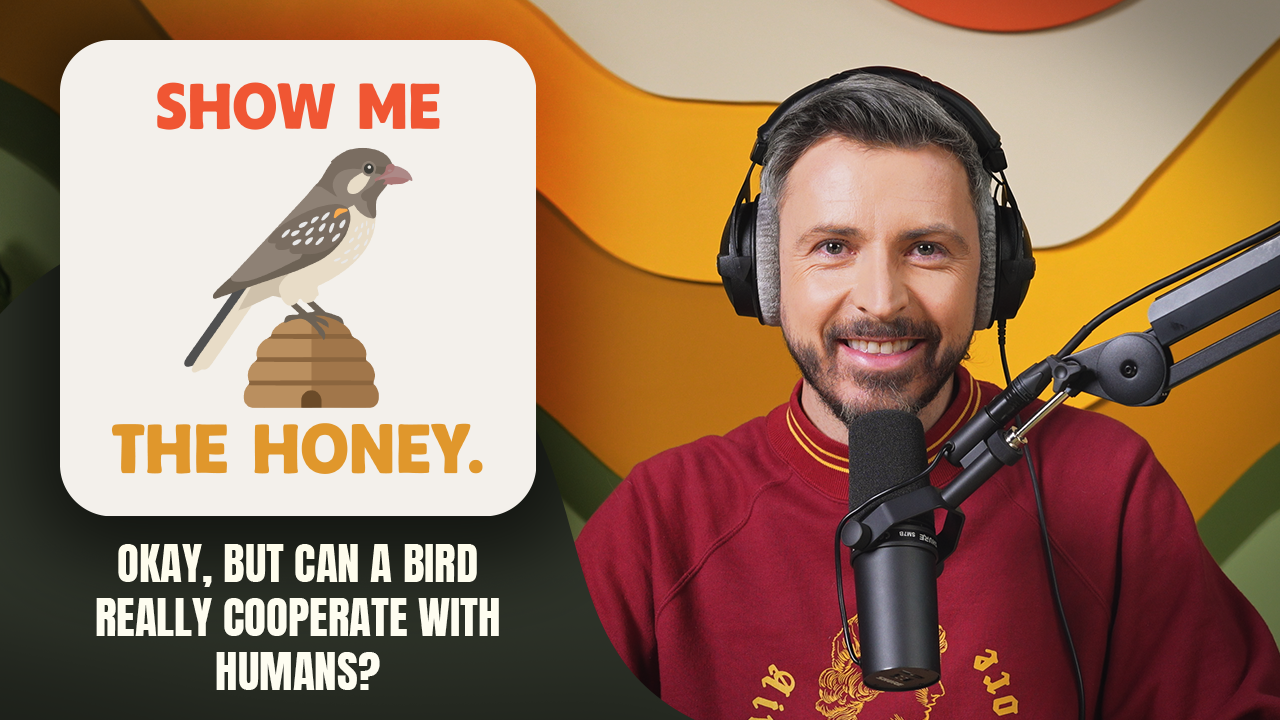
Release Date: May 21, 2026Across sub-Saharan Africa, wild birds and people work together to find honey. No taming, no breeding, no domestication… just a partnership thousands of years in the making. Behavioral ecologist Dr. Jessica van der Wal, FitzPatrick Institute of African Ornithology, joins Scott to unpack what's actually happening when a honey hunter calls and a greater honeyguide answers.
Transcript
In this episode
- What each side actually gets out of the honeyguide partnership
- Why this particular bird evolved to seek out humans rather than avoid them
- What signal a honeyguide uses to get a person's attention and keep it
- What playback experiments showed when the same calls were tested in different communities
- Why honey hunters in different regions answer the bird with completely different sounds
- What happens to a partnership built over generations once honey can be bought in a shop
Jessica van der Wal: Yeah, it is quite a rare specialization and it is very weird. I agree.
Scott Taylor: Sometimes I feel like Douglas and I are cooperating. Douglas is my dog. He's a 37 pound mini Australian labradoodle. I know, we're gay. He gets food, scritches, walks, two kinds of vegetables he demands with the enthusiasm of a two year old who like a two year old, will lose his mind if denied a carrot or a cucumber, and a level of medical attention that I am embarrassed to itemize. In return, I get companionship, joy, love, and so many low grade anxieties about whether his stomach is doing okay today. Mutualism. Both sides win, even when one side is silently catastrophizing about the other side's poop. Here's the part I think about. Douglas and a gray wolf share somewhere between 98.8 and 99.9% of their DNA functionally identical. And yet Douglas, a creature that has been bred down to the size of a footstool and answers to the command spin always to the right, thanks to my friend Jay, is genetically a hair's breadth away from an animal that pack hunts. Bison. Bison. Just what? The point being, artificial selection is a hell of a force. Over thousands of years, humans have bred wolves into dogs, aurochs into cows, wild horses into things you can saddle and ride into the next county. Cooperation, the kind we have with our pets and our livestock, is what you get on the long slow end of human driven evolutionary changes. Now imagine, you skip that part. Imagine a wild gray wolf. No domestication, no thousands of years of selective breeding, just decided one day that it wanted to work with a human on a shared project. What would that even look like? How would it know what your sounds meant? If I tried to ask a wild wolf to spin to the right, the most likely outcome is that I would end up on the news dead. Cooperation with a genuinely wild animal sounds like a fairy tale. Think those little birds carrying ribbons for Cinderella. Like the kind of thing my brain dismisses even before it finishes the sentence. But that is almost word for word a daily occurrence for honey hunters across sub Saharan Africa. Which brings us to the topic of today's episode. Okay, but can a bird really cooperate with humans? To dive into this fascinating question, we'll talk with Dr. Jessica Vanderwaal, Behavioral ecologist and researcher at the Fitzpatrick Institute of African Ornithology in South Africa, who studies the greater honey God and the people it works with. She coordinates the Honey Hunting Research Network, a collaborative of researchers across Africa documenting where, how, and how variably this partnership still happens. After the break, Jessica walks us through the actual mechanics of the relationship between humans and greater honeyguides. We get into the part where it isn't one human cultural tradition, but many. And the bird turns out to be paying attention to which one is calling. And we talk about what happens to a partnership like this in a world where the humans on one side are increasingly likely to buy honey at the store and the wild on the other side is increasingly less wild. Stay tuned. Welcome back, everyone. I'm really excited to have Jessica here today to talk all about greater honey guides. Thanks for joining us, Jessica.
Jessica van der Wal: Yeah, thanks for having me.
Scott Taylor: Of course. Yeah. I've been fascinated by these birds for a very long time. So I'm excited to talk to someone who knows a lot more about them than I do. For our listeners who might have never heard of a greater honeyguide before. If you could talk about this remarkable partnership between honeyguides and people and what each side gets out of this, that would be awesome.
Jessica van der Wal: Yes, of course. So the greater honeyguide is a wax eating bird that occurs across savannas in sub Saharan Africa. And it's well known for its behavior of guiding people to bees nests. So people who collect wild honey are also called honey hunters. And they look out for this bird and it has a chattering call. And it then flies from tree to tree until it reaches a bees nest. And then when these human honey hunters use smoke to subdue the bees and use an axe to open the bees nest, they harvest the honey and leave behind beeswax and larvae for the honey guys to feed on. So this is what we refer to as a rare case of human wildlife cooperation, where humans and a free living wild animal coordinate their behavior to mutual benefit.
Scott Taylor: It's incredible to me that this could ever have come to be. And so how do we know it's true interspecific cooperation and not just humans paying attention to a bird that happens to be nearby? Like, how do we really know it's this cooperation piece?
Jessica van der Wal: What makes it cooperation is that both sides are actively influencing each other's behavior to create that mutual benefit. So in other words, we know that both sides are playing an active role in making sure the interaction works. So the, the bird deliberately guides people to bees nest. It uses this distinctive chattering call that it only uses in the context of chatting to humans. Really?
Scott Taylor: That's so cool.
Jessica van der Wal: Yeah. So it does that to motivate humans to follow it. And it has these very distinctive flight patterns as well, to point them in the direction of a bee's nest. And then on the human side, cooperating humans are responding with these specialized signals, and that allows them to communicate with the bird while they follow it. And then afterwards, they do share the rewards of the nest.
Scott Taylor: Yeah, the sharing the rewards is such a. Like, I don't know, feels special in a. I don't know, some sort of magical. Sharing food with wildlife is. I don't know, it's a cool thing. So in terms of the. You just mentioned that humans make specific noises to communicate with the honey guides. I've heard that different groups have different honey hunting calls. And I was wondering if you could talk a little bit about that and how you've looked into, like, these dialects within a region.
Jessica van der Wal: Sure. So there's a great deal of variation in the call or sounds that honey hunters use across the different regions of Africa where people cooperate with the greater honey guide. So, for example, the Jawa honey hunters in northern Mozambique, they have a call that goes something like this,.
Scott Taylor: While in.
Jessica van der Wal: Other places, people use other calls and sounds like whistles, for example. So how these are produced varies. Sometimes it's just mouth whistles, other times it's whistling on objects like snail shells or hollow fruit, sometimes on hands or fingers. And presumably this is because it carries much further, more easily. Yeah. So as we from a playback experiment some years ago, we know that honeyguides respond more to the calls of their own culture compared to a culture a thousand kilometers away. And what this shows is that honey guys must be learning to associate to the calls of their own local human culture.
Scott Taylor: Yeah, that's incredible. I mean, I guess that, like, regional coordination just really makes it much more obvious that it is this interspecific cooperation and that it is valuable enough that it's, like, geographically repeated. Do we know how many different dialects there are across the range of the greater honeygut?
Jessica van der Wal: Yeah. So if I may. So what I talked about just now is more the same as different human languages being used, because these are different. So in my own work, following on from that, I was able to show that there's also regional variation in honeyhunter calls being used in northern Mozambique specifically. And these are similar to dialects in human language. Although we didn't directly test the response of honeyguides to these more subtle differences in honey hunter goals, we do know that human honeyguide cooperation remains successful and important to livelihoods. And from that we can infer that honeyguides are in turn, probably learning and helping reinforce these local human dialects. So my research was across certain villages and every village has like a subtle different dialect. And your question was about different languages? Well, in every culture across sub Saharan Africa, where we've conducted research on these honeyhunter calls, there is a slightly different call and sometimes completely different call. So I don't, I can't put a number on it, but there's a great deal of cultural variation.
Scott Taylor: Yeah, so lots of cultural variation. Then even within a specific geographic area, there's this like village by village dialect. That's incredible. That's like, I don't know that I would have expected that much variation, but I guess if you think about how much. Yeah, just local dialects can vary in humans, it makes some sense. But it's pretty amazing how tightly connected it is.
Jessica van der Wal: Yeah.
Scott Taylor: Yeah. Wow. What happens? So like, obviously the humans are there for the honey, and honey can be extremely important, you know, in terms of like caloric intake for these populations. And the birds are there for the larvae and the wax. But what happens if somebody cheats? Like, if humans break the deal and for whatever reason the reward's not there? Like, is there evidence that there are consequences to that? Like, do the honey guides change behavior or.
Jessica van der Wal: Yeah, interesting question. So yes, in some places people do break the deal in the sense that they don't always actively leave behind beeswax after every harvest, specifically in a few places in Eastern Africa. So what they do is they withhold wax early in the day to keep the bird motivated to continue guiding to a nearby bees nest, like throughout the day. But what's important to realize here is that there's always going to be enough like scraps of wax, residual wax left for the honeyguide to benefit from. So that's probably sufficient to maintain the interaction over time. But having said all that, there are a lot of stories across all cultures that I know about where honeyguides are misleading humans in places where rewarding honeyguides is the norm. And in fact, honeyguides do sometimes lead to other things, including to snakes. So this actually happens. So this is unlikely to be punishment, really. And it's more likely to be a spatial memory bearer in the honeyguides. But coincidentally, I think this honeygite behavior and these stories of retaliations are actually an important part of passing on the right attitude to younger generations. So in other words, what it says is that if you be nice to the honey guide and the honey guide will be nice to you.
Scott Taylor: Yeah, it's a lovely lesson. It's hilarious that they Guide people to snakes. Sometimes you think that's just errors. That's not like the honey guide somehow. It's like, well, maybe people will kill the snake.
Jessica van der Wal: Yeah, well, that's one of the hypotheses and one of the reasons that honey hunters have given for this behavior. Yeah. So there's a recent study by my colleague David Lloyd Jones that looked into the different possible explanations for this behavior.
Scott Taylor: Oh, interesting. I guess one thing people might also be wondering is the eating wax thing is weird. How many birds actually eat wax? Is this a really rare specialization or is it more common?
Jessica van der Wal: Yeah, it is quite a rare specialization and it is very weird. I agree. And as one of the questions we have is why are they interested in that specifically? So if you give them a choice, they will go for wax rather than larvae. And specifically the white new wax that bees have made.
Scott Taylor: Really?
Jessica van der Wal: Yes.
Scott Taylor: Have you guys looked at like the energy content of that wax? I wonder what their gut microbiome is like to help them digest wax.
Jessica van der Wal: Yeah. So this is part of ongoing research. Exactly. Looking into microbiomes and trying to figure out the explanation of why they might be eating wax.
Scott Taylor: Yeah. Did you ever. I don't know if you guys had these candies as kids, but we would get these little candies that were wax, like a fake wax bottle full of some flavor of juice and you could, you could bite the top off and drink the juice and then some kids would eat the wax. But you were kind of a weird kid if you ate the wax. I would usually spit it out. But in the context of these honeyguides, that's what they're going for. That's so incredible. I didn't realize they'd prefer it over the larvae either. That just is really fascinating. Wax consumption, huh? Yeah.
Jessica van der Wal: It's an intriguing bird, for sure. It's also a bird parasite. So like cuckoos, it lays its eggs in other species nests. So.
Scott Taylor: Yeah, kind of a gnarly brood parasite too. It doesn't just lay its eggs in species nests. Right. What do the babies do?
Jessica van der Wal: I know they are born with these hooks on the bills that they kill the other chicks in the nest with. They depend on other species to. To raise their young and then they depend on humans to get their food for them. Quite lazy or smart.
Scott Taylor: Yeah, yeah, One of those two. Possibly a combo.
Jessica van der Wal: Yeah, possibly. Definitely.
Scott Taylor: Yeah. So it's. This is a widespread, you said in sub Saharan Africa. It's pretty widespread that wherever these greater honeyguides occur, there's a relationship with humans. And so this is still widespread today. That it's still a widespread practice to cooperate with these birds.
Jessica van der Wal: Yeah. So I should say it's not everywhere. In some places it doesn't exist. In some places it has disappeared. So I coordinate something called the Honey Hunting Research Network. And so we are a collaborative of researchers across Africa, and we're following up on anecdotes that we've heard of honey hunting with honeyguides happening everywhere. Where we do look and follow up on these anecdotes, we do find that honey hunters do use honeyguides to different extents, more so in some places than others. But it occurs throughout pockets of sub Saharan Africa, but definitely not everywhere. And in some places, mostly changes in human culture have resulted in the practice or the interaction disappearing.
Scott Taylor: Yeah, I was wondering about how that relates to urbanization and kind of a loss of whatever other habitat, things that crater honeyguides need to survive.
Jessica van der Wal: Yeah. So there's several reasons for a decline or even loss of the interaction. And as you say, one side, sometimes it has to do with urbanization, agricultural lands being cleared, so there being less bees and less honeyguides. But I would say probably a more common theme is changing in human culture so people losing interest or more generally, alternative livelihoods being more attractive, including beekeeping. So beekeeping is a practice that has been introduced in a lot of places for development purposes. But actually we're finding that in certain places, this beekeeping is meaning that people are stepping away from collecting wild honey and working together with honey guides.
Scott Taylor: Do the honey guides feed their chicks the wax, or is it just the adults eating it? Oh, no, they don't feed their chicks because the chicks are raised by somebody else.
Jessica van der Wal: Yeah. Huh.
Scott Taylor: So as chicks, they just get fed whatever their adoptive parents? Well, I guess parasitized parents feed them.
Jessica van der Wal: Yeah. So they have quite a large range of host species. So, yeah, different adoptive parents. And that also varies by location. And yeah, they will eat insects or fruits or whatever they're offered. So.
Scott Taylor: And then they. They transition to this wax diet as adults. That's even weirder, honestly.
Jessica van der Wal: Yeah, it gets weirder and weirder.
Scott Taylor: Yeah, you'd have like a quote unquote normal, like digestive system as a chick. And then as an adult, you specialize on this really weird food resource.
Jessica van der Wal: Yeah, yeah. And I should say that it. It's not the only thing they eat. And we also don't really know how important it is in the adult's diet. And that's mostly because when you try to observe this. Observe, sorry. If you try to observe this bird in the wild, you can't really because it will start chattering at you. So it will always try to get you to follow it. So it's very hard to observe them doing anything else.
Scott Taylor: I didn't think about that. They're so clued in and keyed into people being like this helpful resource that they're. You can't just sit there and watch them. I can watch my chickadees all day. They don't care that I'm there.
Jessica van der Wal: No, no, it's. Yeah, it's cool. But also like I would love to know what else they eat and how important beeswax is and a lot of other natural history questions.
Scott Taylor: Yeah, for sure. It's interesting to not be able to kind of classically address the natural history just by observing. Yeah. I get asked all the time whether chickadees have differences in spatial memory.
Jessica van der Wal: Yeah.
Scott Taylor: Which for chickadees there's no like between the sexes but there's no reason to suspect that because they both need to find food. Whereas like in brood parasites, cowbirds for example, the males really just have to mate with females. But the females have to track like many different nests and they're laying up to 40 eggs a season. And there is evidence that they have better spatial memory than the males. Yeah. Are there differences between the sexes or what would we even expect to be in this behavior?
Jessica van der Wal: There aren't. There aren't. So we see both males, males and females to be guiding. We do see that juveniles are a little bit less good at guiding to bees nests. Although they will always try to chatter at you and try to get you all excited. They might not be as good of guides as adults.
Scott Taylor: Yeah. It's interesting to think about if they're not as good as juveniles, if they need years to improve, how long does that take? Do they get better across the season or do they have a few years to practice? I just thinking about New Caledonian crows and how they play around with sticks as young juveniles but then takes time for them to learn how to make the tools and stuff.
Jessica van der Wal: Yeah, I guess in the New Caledonian crow there is definitely a lot more time because they don't need a human to be interacting with to learn from. I guess. I guess what I'm saying is that for honey guys to learn how to guide to bees nest and to get better at it. We think there is a component of learning like in the New Caledonian crows there needs to be humans around that want to cooperate and are willing to cooperate. So yeah, it is a very good question and it's something that we think about A lot. And trying to capture as well in mathematical models of the system, trying to understand how important learning and potentially social learning is in the system. So what we think is going on is that there is a innate part as well as a learning part. So as I said, juvenile honey guys will try to guide you. They're intrinsically excited and attracted to humans. But we think that in places where there are humans and they're willing to cooperate, there that's a learning environment for them to learn how to be better guides. But that behavior might also disappear in places where there are no humans that want to cooperate. Anecdotally, we know that juveniles in places where there's no honey hunting, they will try to chatter at you. So we know the call is innate. It's more that the successful guiding to a bees nest probably has a learned component.
Scott Taylor: So the greater honeyguide gets most of the attention and has a lot of research. But are there other honeyguide species and do they all demonstrate like this similar behavior or do we know if they have honey guiding behaviors?
Jessica van der Wal: Yeah, so there's about 16 or 17 forget honeyguide species and two of them live in Asia, but the rest are all African honeyguides. And they all eat wax and they're all brood parasites as far as we know. But the greater honeyguide is the only one that guides humans. So actively has this behavior of leading people to bees nests. So for example, in northern Mozape where we work, I mentioned that there are these scroungers, greater honeyguides that rock up once the harvest has been completed and benefit from the wax rewards. I guess other honeyguide species there also will join the party.
Scott Taylor: Okay, so they're just watching for the. They're reliant on the greater honey guide. That's interesting. Why are they called honey guides if only one actually guides to honey?
Jessica van der Wal: I guess the most popular guy.
Scott Taylor: Wax eaters.
Jessica van der Wal: Yeah, yeah. I guess the most popular guy got the attention and.
Scott Taylor: Yeah, and then we used other tools to figure out the rest of the relatives and realized none of them actually guide. That's so funny. Yeah. Maybe wax eaters or something would have been a better name for the group.
Jessica van der Wal: There are a few anecdotes of several other species. Quite anecdotal. Possibly also guiding or showing some. Yes, some form of indication of bees nests. But that requires further research and field observations.
Scott Taylor: Yeah, it's super fascinating. What was it like? Do you remember the first time you saw a guiding behavior?
Jessica van der Wal: Yeah, yeah, it was late 2018, so a while ago. And it was awesome. It's so normal for these honey hunters to go out and collect wild honey and do that with the help of these birds. And they go out and they start calling honey guides. And quite quickly a honey guide rocked up and just was a matter of minutes until they found the first bees nest. Yeah.
Scott Taylor: That's awesome. Are there other examples of like humans and wild animals having this kind of cooperation? You could think about domestication and kind of horses and humans cooperating, but also artificial selection really helped with that, like creating a large mammal that isn't scared of people and won't try to kill you. Is this really one of the only examples of human wildlife cooperation?
Jessica van der Wal: So as far as the scientific community is aware, there's one other example of humans and wildlife cooperating, which is between humans and dolphins in parts of Myanmar in southern Brazil. So these fishermen, they work together with dolphins to catch more fish, essentially. And in the past there were more examples, so between humans and orcas and then probably between humans and wolves as well. But yeah, as you say, this interaction between humans and honeyguides is a rare example of human wildlife cooperation. And what it shows is that free living animals can do much more than simply tolerate humans. Right. They're capable of forming these mutual beneficial partnerships. But as I said, this is what we as scientists are aware of. And there may be more examples that we don't know of yet.
Scott Taylor: Yeah. And the orca example is gone because the culture was lost.
Jessica van der Wal: Yes. If I remember right, it was a combination of orcas being culled and because they're very cultural species and intelligent species, the others just went, okay, never mind. And also the culture on the human side also changing or disappearing.
Scott Taylor: Yeah. We had an episode some time ago about whether birds have culture and talked about. It's interesting to think about all these other animals with their own cultures and how those intersect with human culture and how over time those can change or be lost. Especially if one of the players is not great about it in the context of humans just killing whatever we want to kill.
Jessica van der Wal: But yeah, yeah.
Scott Taylor: And I guess like the cooperation with wolves eventually turned into something like my 35 pound mini labradoodle, who is very much doesn't want to cooperate all the time.
Jessica van der Wal: Yeah, yeah, yeah, yeah.
Scott Taylor: So, I mean, like honey guides are obviously teaching us about what's possible between humans and truly wild animals. We kind of touched on that there, that we probably don't know all of the ways that that occurs on the planet and some of it has been lost for sure.
Jessica van der Wal: Yeah, yeah. I guess more broadly, the honeyguides remind Us that humans are not separate from nature and that we are part of ecological partnerships as well. And in that sense we can even maybe shift how we think about humans in ecology. So we're not just observers or disruptors, but actually participants. So of mutually beneficial relationships. And I think these rare examples that we just touched upon of human wildlife cooperation, including with honey guys and a few others around the world, they both depend on and help sustain people's continued connections to nature. So they show that relationships are not. Those relationships are not only possible, but they can be meaningful and long lasting. Yeah, sorry, that wasn't very great.
Scott Taylor: No, it was great. I mean, they can last generations. And I think also I think that's why this has always captured my imagination, because it is this long standing cooperation between wildlife and humans which really does puts us into the whole mix. And we're not just observers or destroyers. And yeah, I don't know, as someone who kind of grew up in the woods and always had this sense of connection to nature, I just appreciate examples that highlight for everyone who hasn't necessarily has been as privileged as I was to grow up in the woods. That connection is real and can exist for thousands of years. It's really impressive. Obviously, you're working with a lot of different communities. You talked about having this collaborative network across much of Africa to study this widespread species of bird. And it'd be great to hear how you have approached that from a respectful collaboration perspective, especially when we're talking about this as if it's new knowledge. And when this was published in Science a few years ago, it was the first time people really realized humans and birds collaborate. But the indigenous communities that practice this have known about this for obviously a very, very, very long time.
Jessica van der Wal: Yeah, yeah, you're right that for most honey hunters who use honey guys, this is such a normal everyday phenomenon and it can be surprising for them that outsiders are even interested in it. But because it's culturally embedded in many places and often a proud part of, of human, a proud part of honey hunting practice, honey hunters are generally quite open to sharing their knowledge. That said, your question about how we ensure collaboration is respectful is a really important one. And it's something that we think a lot about within the honey hunting research network. A key part of our approach is that research is led and carried out by researchers from the countries where fieldwork takes place. So these local researchers, they understand the control context, the local protocols, the practical realities. And because of that, they're very well placed to build trust and collect data in a way that is both accurate and respectful. And I think another thing I'd like to comment on is that gaining understanding of cultural or ecological knowledge through collaboration with communities takes time. And it takes time to build trust and to gain reliable data. And in certain places, especially where honey hunting is restricted, for example, so in some places it's banned or restricted. Honey hunters are often wary of questions about their practices, and they at first refuse to talk to U. S. researchers or answer questions, depending on what they think you want to hear. And building these relationships and getting them to trust you to share their knowledge and experience definitely needs and takes time.
Scott Taylor: Yeah, for sure. Why is honey hunting banned at all?
Jessica van der Wal: So. So this is actually. Sorry, this is about what ruffles my feathers so we can talk about it. But then that comes back to kind of what. What I want to say at the end.
Scott Taylor: All right, we've reached the part of the show that we call that's BS or that's bird stuff, where we give our guests an opportunity to debunk a myth that ruffles their feathers. So, Jessica, what do you want to call BS on?
Jessica van der Wal: In a lot of places, honey hunting, including with honeyguides, has quite a bad reputation and is therefore restricted or even banned. So wild honey collection does involve damaging trees to some extent and is assumed to cause other damage to the ecosystem. My colleagues in the honeyguide research project are actually looking into this and quantifying the ecosystem effects of honey hunting and specifically northern Mozambique, and they're finding that actually the bee in tree populations are actually doing totally okay. It can't speak for every place, of course, but I do think we need to be careful about making blanket assumptions about traditional practices and that they are automatically harmful or at least do some research before making policy decisions. And what's frustrating for me is that such activities and interactions, special interactions with wildlife, can be extremely important for local livelihoods and cultural traditions. And in some cases, supporting these may actually contribute positively to forest conservation and community well being, I guess, more directly related to the interaction with the honeyguides that banning people's honey hunt is an important threat to human honeyguide cooperation, and it makes its future uncertain in some places.
Scott Taylor: That's really sad that that's what would be motivating. I mean, we were talking about how this connection with nature is such a central piece to this whole story, this whole relationship, and then to ban it in, you know, as a way to protect nature just feels so backwards in terms of. Yeah. All the things you just pointed out. So I appreciate that. Well, this has been really fascinating. I really appreciate you taking the time to join us. So thanks for coming on the podcast and talking all about Greater Honey Guides. I'm sure I just have more questions so we're going to have to have you back.
Jessica van der Wal: Yeah, thanks. Thanks for inviting me and I'm always happy to talk about honey guides.
Scott Taylor: Birds are dinosaurs and around here we like our snacks. So we end each episode with a dinosaur nugget. Today's nugget is yes, a wild bird can cooperate with humans. The Greater Honey Guide of Sub Saharan Africa actively leads honey hunters to bees nests so that the humans crack the hive, take the honey and leave behind wax and larvae for the bird. Humans never bred this bird. Nobody trained it. It's one of only few confirmed cases on Earth of a free living, undomesticated wild animal cooperating with people. And it has been working at a deal with us for a very long time without ever asking to be domesticated for the trouble. That's a wrap on this week's episode. Okay, but can a bird really cooperate with humans? Do you want to cooperate with us? Well, head over to okayabutbirds.com and pick up a sick shirt or a hoodie or a tote. She's cute. We'll catch you next time. Bye. Okay, But... Birds is hosted by Scott Taylor, with production and creative by Zach Karl.
This transcript was generated using AI-assisted transcription and may contain errors or omissions. Please refer to the audio or video episode for the most accurate representation.
Credits
All audio, video, and images in this episode are either original to Okay, But... Birds (© Okay Media, LLC) or used under license/permission from the respective rights holders. Media from the Macaulay Library is used courtesy of the Cornell Lab of Ornithology as follows:
- Greater Honeyguide audio contributed by Jennifer F. M. Horne, ML55972