
E20: Okay, but what can we learn from a drawer of birds?
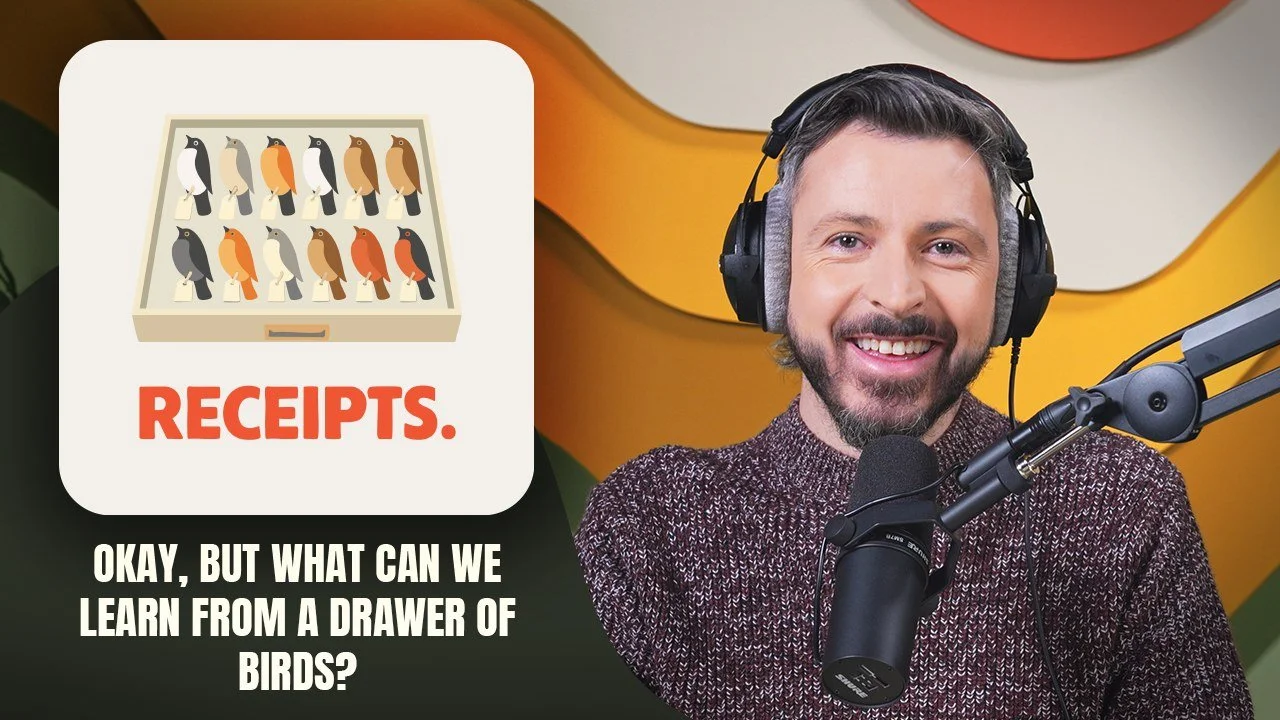
Release Date: Apr 23, 2026Less than 1% of what's in a museum is actually on display. So what's happening with the other 99%? Scott talks with Dr. Sushma Reddy, Breckenridge Chair of Ornithology at the Bell Museum and Associate Professor at the University of Minnesota, about the extraordinary scientific afterlife of a specimen in a drawer.
Transcript
In this episode
- How a bird skin collected 150 years ago becomes a record of air pollution
- What museum specimens revealed about insect decline that no field study could
- Why falcons turned out to be closer relatives of parrots than of hawks
- Which other parts of the bird family tree got rearranged once genomes were sequenced
- What a specimen tag records beyond the date and the place
- Why access to collections matters most for scientists in the countries the birds came from
Scott Taylor: The museum noise fades and you are somewhere else entirely. The floor tilts slightly under your feet and the air feels cooler. It smells faintly earthy. Or maybe that's just your imagination filling in the blanks. The cave mouth glows dimly behind you ahead, its shadow and rock and the suggestion of depth. You hear dripping water, then the high, thin chatter of bats. You look up and your eyes slowly adjust. They are everywhere, packed along the ceiling, wrapped in their wings, clustered shoulder to shoulder. Some look delicate and small. Others have fox like faces and oversized eyes that catch the low light. As a kid, it feels enormous. The ceiling seems higher than it probably is. The models are so convincing that you half expect one to shift its weight or blink. You move slowly, scanning the walls. There are crickets in the cracks, strange cave insects, details tucked into corners that reward you for paying attention. Then comes the exodus. The space opens slightly and the sound builds. A rush of wings fills the cavern. The lighting shifts towards dusk and suddenly the whole colony seems to lift off. It is immersive in a way that feels almost overwhelming. Not frightening, but powerful. You feel small standing in the middle of that moment. When you step back out into the bright hallway, the spell breaks quickly. But for a few minutes, you were underground in Jamaica rather than in Toronto, inside a living system of sound and shadow. As a kid, it feels like you discovered something secret. And that feeling sticks. The Batcave. If you've ever visited the Royal Ontario Museum, you know what I'm talking about. Not Batman's secret lair, but perhaps one of the most impactful museum exhibits in North America. As a kid on a trip with my school, I remember the first time I walked through the Batcave. It was transformative. And here's the thing. Museum exhibits like the Bat Cave, the halls of dioramas of big mammals from Africa, polar bears from the Arctic, or Emperor penguins from Antarctica, that inspired many of us to care about the natural world. That's just 1% of the specimens and artifacts that most museums have. And we learn so much from these specimens. Which brings us to the topic of today's episode. Okay, but what can we learn from a drawer of birds to get to the bottom of the valley of museums and their amazing specimen collections? We'll talk to Dr. Sush Moretti, the Breckenridge chair of Ornithology at the Bell Museum and associate professor in fisheries, wildlife, and Conservation biology at the University of Minnesota. And here's where it gets extremely birdy, extremely fast. Because a drawer of birds isn't just storage. It's a time machine with feathers. It's a record of what birds were, not just what we think they are now. A bird in the wild can surprise you for a second. A bird in a drawer can surprise you across 150 years. In this episode, Sushma walks us through the kinds of questions you can only answer with museum the receipts, the behind the scenes surprises, the way museum work can reshuffle what we thought we knew about bird family trees and hidden diversity. So if you've ever wondered whether museums are just dusty buildings with dioramas, just you wait. Stay tuned. Well, welcome back, everyone. I'm really excited to have Sushma Reddy with me today. Sushmit, thanks for joining.
Sushma Reddy: Thanks, Scott. Really happy to be here.
Scott Taylor: Yeah, I'm excited to get to talk about museums. I think museums are what inspire many of us to care about the natural world. What's the first thing you would tell anyone in the world about the importance of museum collections?
Sushma Reddy: I grew up in New York City, and museums are my temples. Right. And so I used to go to museums as a kid to do all sorts of things, from natural history to art to pretty much everything I learned from a museum. And the first time I went behind the scenes and went past the exhibits to the area where the scientists sit, it just blew my mind. There was just so much more of a museum behind the scenes. And the statistic that I really like to tell people is that less than 1% of what's in a museum is actually on display for the public to see. Which really makes you wonder, well, what's going on with the other 99%? Right. And so that's where the fun begins for me as a scientist and for a lot of researchers. Right. So everything we know about biodiversity starts with a specimen, a specimen that was described to say this is a new species and that is usually housed in a museum. And we add to that one specimen, the type specimen, by contributing other specimens that tell us more about the species. Every specimen is a record of a particular species at a particular time and place. And so you can think of them as library books. You can think of them as records of information of the natural world, but each of them tell a story. And it's really remarkable to think about. For the past more than 150 years, most of these museums have had specimens that have been collected over time. And we can use this to ask so many different questions.
Scott Taylor: Yeah, it's incredible. And that 1% thing, I remember being so inspired by the hulls, the dioramas, as kind of an art science geek I would look at and things like, oh, I want to be able to generate those. And yeah, it was similar for me that I was much, much later in my life that I finally got to see like a drawer of birds, Whether they were chickadees or coatingas. And yet the number of specimens and the amount that we can learn from them is just kind of mind blowing. In terms of specimens, then what are some of the coolest things that a specimen, so a bird in a drawer can tell us compared to a living bird? Like, are there things we can learn from these museum specimens that we can't actually learn from just watching birds out in the woods?
Sushma Reddy: Yeah, you know, so there's that old adage, a bird in the hand is worth chewing the bush.
Scott Taylor: Yeah, I was hoping you were gonna say that.
Sushma Reddy: Excellent. I love that one because it feels like a museum curator came up with that.
Scott Taylor: Yeah, it does, doesn't it?
Sushma Reddy: Being able to hold a bird. Unfortunately, they're dead. But, you know, we can do things with them. We can manipulate them in different ways to see the inside, the outside, to see where they've been, to see what they've been doing. And I think that's really remarkable. You know, we're doing things with specimens that collected 150 years ago, 180 years ago, that people didn't even imagine we could do. Right. Most of the specimens that are in museum collections were collected before we even knew what DNA molecules were. And now we're using them for genomics. And that's pretty incredible. And the people who preserved it were preserving certain features that they thought were really important for birds or to study birds, but at the same time, we can use them in ways that they couldn't even imagine. But what I find really fascinating is all of the uses of museum specimens that have gone beyond looking at evolution, looking at birds, to look at ecosystems and how that has changed over time. So my favorite examples of these, what I'm calling novel uses of museum specimens, or how we can use it to actually study insect declines. We don't actually know a lot of all the insect species that are out there, but we know that they're declining. And one of the ways we know that they're declining is actually studying birds. We can use museum specimens to look at isotopes in their feather samples and see how that has changed over time. That's a really strong indication that they're eating different insects because the availability of the diversity of insects has gone down over time. And so that's something that. Where you can use indirect methods of studying environmental change and biodiversity change. Another great example. And I was in Chicago when they started this project to look at soot levels. Birds actually trap a whole bunch of air molecules and things that are in the air. You can actually open up drawers and see some birds that are really dirty looking. And it turns out that's because during the Industrial Revolution, they were picking up all sorts of soot and other particulates in the air and it just got trapped into the barbules of the feathers. And we like to keep as much as possible when we preserve a bird for collections. And it turns out we can actually measure the amount of soot and correlate it to what the air quality was like at the time. You can actually see that these same species start getting cleaner once the Clean Air Bill got passed.
Scott Taylor: Yeah. The Clean Air act was effective too. I never thought that we could look at bird specimens and get a. Get a record of environmental air pollutants and contamination. And then also we can legislate to have cleaner air and see that reflected in the physical object, like in these birds bodies. It's just. Yeah. An unexpected thing no one was thinking when they were collecting birds a hundred years ago. Like, this will be good to understand pollution. Like.
Sushma Reddy: Yeah, yeah. And another great example is bald eagles and ddt. Right. Which is really kind of the beginning of the environmental movement and awareness of how human impacts on the environment were affecting biodiversity. And that was really also a great example of why museums are important. The reason we realized that bald eagle eggshells were getting thinner was because we had eggshells from before DDT was being used. And we could measure this and go back and say, look, they're, you know, less than half the thickness they're supposed to be, which is why they're being crushed. Yeah. And you know, and now we have bald eagles that are no longer endangered, no longer in the Endangered Species act, and they're thriving.
Scott Taylor: Yeah, I see them almost every day on my way to work. I actually didn't put together until just now that it was because we could compare DDT impacted eggs to museum specimens. That's cool. I had no idea. But of course, like, that makes total sense now that you say it. But I'm like, why didn't you ever think of that before, huh? Very cool. So there's all these amazing things that we can learn from museum specimens about ecological change, environmental change. Your research tackles, like these big bird family tree questions, including really deep relationships, specifically between old world tropic birds. Just talk to us a little bit about how you got into that and what you're, what you're finding and what you're most excited about.
Sushma Reddy: Yeah, that's great. You know, when looking at the, the bird evolutionary tree, this was a long standing mystery in, in birds for a long time, Right. How did all the modern groups of birds evolve? Because if you look at the birds that we're familiar with, they look quite different and distinct from each other. Right. Like owls all look like owls. And there's nothing that is kind of in between an owl and a parrot or a songbird or so. We didn't really have a good sense of how most birds were related to each other. And using morphology, it didn't really help because there turns out there are multiple times in birds where we have similar features evolving. We call it convergent evolution. That can be confusing when you were trying to figure out what features were in common as they evolved into these different groups. One of the reasons why it's so difficult is because dinosaurs, non avian dinosaurs, go extinct about 66 million years ago. And as soon as that asteroid impact extinction event happens, you suddenly have, within a very short period of time, all the modern forms of birds that we see today appear. So there isn't this long transition where we see birds that are in between. And so we don't have good evidence from the fossil record, from morphology. And even with DNA, which is where I came in, I was part of a study where, you know, amassed more DNA than ever to produce this phylogeny, this evolutionary tree that was just utterly surprising to almost everyone. Right. There was something in it that people picked on, people argued about. And it turns out most of what we suggested was actually followed up and corroborated with additional genomic evidence. For example, you know, hawks and falcons look almost identical.
Scott Taylor: Yeah.
Sushma Reddy: And for a while they were placed in the same order. And it turns out they're not very closely related. In fact, falcons are more closely related to parrots and songbirds than they are to hawks, which, you know, and it turns out they're very similar looking because they ecologically do very similar things.
Scott Taylor: Yeah. That close relationship between parrots and falcons I love to present to a class of new ornithology students. And it confuses them. Right. Because like you said, hawks and falcons, we Think of this united group. But yeah, it's amazing to see how convergent evolution made these other raptors. But when you really look at a falcon, you can see, I mean, parrots are in there for sure. Oh, that's really cool.
Sushma Reddy: No, for sure. And I think what, what it does is it helps you see things differently. Right. Getting information from a different perspective. The genes help us go, oh, yeah, maybe this feature that we thought was the same is actually a little bit different. And there's. And you can break it up into multiple other features.
Scott Taylor: Yeah. Where did the Watson fall out on your tree? I don't remember.
Sushma Reddy: The Watson is like the biggest mystery. I think the Huatzin is a cow that is.
Scott Taylor: Well, it smells like one, it eats like one, so why not? Right. If we use conversion evolution of, of what you digested. Yes, absolutely. Put it on the mammal, cow side of things. But it's always been this enigmatic, like, hard to place thing, right?
Sushma Reddy: Yes and no. No study has conclusively put it out there. Every study puts it in a different place.
Scott Taylor: Yeah, it's so fascinating.
Sushma Reddy: Yeah. And there are some things that, you know, don't look at all like each other, like flamingos and grebes.
Scott Taylor: Right.
Sushma Reddy: And don't have any in between looking relatives or. And are these really long evolutionary branches. But every study finds them. It's a strong relationship. So something got preserved that indicates that they were closely related, whereas with hoatzins we have nothing. Everything got changed around.
Scott Taylor: You're the curator of the Bell Museum and if you want to blow someone's mind, what drawer are you going to open?
Sushma Reddy: The one incredibly special specimen we have in the Bell Museum is a gynandromorph of Eden and Grosbeak. And so that is a specimen where one side is male and one side is female. And it is just beautiful bilateral symmetry, like, you know, just like you can slice it down and one half looks identical to males and the other side looks identical to females. So I think that's really special because you don't see a lot of these kind of representation in research. It's by chance that someone actually had a. Was able to collect it and bring it in. But it's a really great way for us to know that this, this can exist, this can happen. Right. And it leads to all sorts of questions, like how did it live, what did it reproduce? Which we don't have the internal organs, but we do have the notes that the preparator took. And so we actually have that it had ovaries and a Testes, which is kind of really fascinating. So that is a nice, dramatic specimen.
Scott Taylor: We've just, like, looked past the variation, you know, and I think we're starting to come to understand, like, we need to look at the variation because it adds to our broader understanding of biological diversity, and it's relevant for the way we think about ourselves, too. But it's funny, like, again, because of who was predominantly scientists for a very long time, we looked past the. The variation to, like, these binaries, which is frustrating.
Sushma Reddy: I think a lot of it is also that we. We want to make it clean. We want to make the divisions in nature very clean, and there's some very fuzzy boundaries. And that's actually very exciting. Right. Like, it tells us how what's possible.
Scott Taylor: The history of museums, in many ways, is problematic. I mean, and now you're a curator at a museum and you're thinking about these questions, and I'm curious to hear, like, what do you want people to know in this context?
Sushma Reddy: Yeah, I've actually been thinking a lot about this, and it's something that I'm working hard to advocate for. And I think one thing is that we think of these. You know, these are resources, but they're global resources. You know, the treasures that we have in our museums are accumulated from all over the world. And many times they were taken. You know, they might have had the right legal authority to do that at the time, but we still have to interpret that as being extracted. And so. And if you're taking things away from context and you're not giving the opportunity for the people who live in these areas to study them, I think that becomes a real problem. And so I've been advocating for museums to be a lot more open and willing to allow the use of their specimens in different ways. We should say yes more. Right. We should say yes to people who want to come from different parts of the world. We want to say yes to people who are coming from different fields, people who might be interested in a particular aspect that didn't. Is not what was traditionally done in museums, but can really add to the number of people who use museum resources. Because if we, you know, one of the problems with this idea that, like, there's so much behind the scenes and no one knows about it, is it can disappear really fast. Right? Yeah. The funding for museums, like a lot of other places that people don't know, a lot of science is really at risk right now. And so if we don't talk to people about how valuable these are and how important it is Then it's going to disappear. And so we need to also kind of build that base of people using it and people showing off how great it is. And it's only going to make your collections even better when they're used. Right. And when you have stories to tell about how they've contributed to science.
Scott Taylor: Totally. The more diversity of questions we get, the more interesting our science gets. Like, we know that. And I think, yeah, it's definitely time to be proactive about who gets access and how and all of those things. And like you say, from the funding perspective, you can't care about what you don't know exists. And there are so many more stories that museums can tell. When a museum is facing funding challenges, the public might better understand, oh, it's not just this hall of dioramas, it's this entire, like, collection from across the planet that can inform so many, so many amazing questions about the natural world.
Sushma Reddy: Yeah. And that impacts conservation in the places where this, the biodiversity still exists.
Scott Taylor: Right, right.
Sushma Reddy: So if they don't know about it, and we are studying in, in like a, you know, museum thousands of miles away, and we're removed from what the animals are like now, and they're removed from what we know about them. I mean, there's this disconnect in terms of really what we should be together focusing on for conservation of these important biodiversity resources.
Scott Taylor: Totally. What has your experience been with that? Like, trying to bring the information you're learning about new species or the way that species in the regions you're working on are connected back to the places where they actually live? There's field collections, obviously, but then you're collecting data and you're kind of. The discoveries happen a far, far distance, distance away from the communities that need to know that these are evolutionarily distinct or unique or fascinating creatures. So what's that been like for you to try to bring those messages back?
Sushma Reddy: My way of working is to work with collaborators who have that ability to make those connections. Since I live in the us I can travel to the places that I work in, but I don't spend most of my time there. So I do rely a lot on making strong collaborations who can push that through. But I have this great example of one of the first projects I did in India, where I had a now colleague who came over to spend a little bit of time doing a postdoc with me because he was really fascinated by these birds that were called short wings in the western guts. And it's something that I, I didn't know much About, I didn't know much about these little birds, these little bluish birds. And he was fascinated because he was really intrigued by their beautiful songs. They have quite a repertoire of songs. I know nothing about bird songs. I'll be hon museum biologist, what they look like and what their DNA tells me. So we, you know, we again put our different ideas together and it turns out there are only like, I want to say less than 10 specimens of these species in all of the museums in the world.
Scott Taylor: Wow.
Sushma Reddy: And he was one of the first people that were was able to get blood samples from live birds from in the wild. And so we were able to put together data, data from the field collections that he made, the museum specimens that I was able to access and all of the information we had together. And it turns out they're not short wings. And it turns out they're actually closer to Robin's, which is ironic because his name was Robin. The other part of the story is that it turns out they're quite unique, right? They're this unique new genus. And we described two new genera from the western guts that was again showing just how much more unique this Avifauna was compared to what we knew before. Because before we were only using the morphologies. And as I explained before, like convergent evolution can really lead to misleading results. So in the western gods, we describe these two new genera which just again showed just how much more distinct and how much more unique the Avifana was. And that just led to, to just even more people getting excited by the things that are found in their backyards. Right. Because all of the examples from most ecological textbooks are from the Northern hemisphere or from other parts of the world. But here was something where they could say, hey, look, this is in our backyard. We know these birds, we can go out and study these birds. Now, my colleague Robin has inspired so many people to go into birds. This kind of trickle down from the students who are interested in science to the, the local communities. So there are people who are talking about shade grown coffee and have bling that has these birds on it.
Scott Taylor: Oh, nice.
Sushma Reddy: That's awesome. And it's really nice because we also got to use some local names and so the local names get again that, that pride that people have. And so there's this little diminutive bluebird in the western guts that has gotten so many people inspired to not just do science, but also think about conservation.
Scott Taylor: I don't know. Everyone talks about science being objective. You and I both know that's not true. Scientists are people who have opinions and life experiences. And so you're saying, you know, when the. During the colonial era, people came to Madagascar and were like, oh, that looks like a warbler from Europe. We're going to say it's a warbler or whatever, but it's just not. It's like. And I'd love for you to talk more about the vengas and like, that whole radiation in Madagascar, because it's fascinating, but it was really overlooked because of convergent evolution and ignorance and just being like, well, I know what that is. I don't need to look more deeply. Which is so common and so frustrating. Right. Like, you miss so much. And then it can lead to this amazing, like, pride and conservation and all of these things when you actually understand what's. What's there in your backyard, you know?
Sushma Reddy: Yeah, yeah. The example with the Malagasy vangas and the tetracas, or barnierids, these are two of the largest families of birds that we know from Madagascar. And it turns out we didn't know either family well enough until very recently. Or no, maybe about 10 years ago. Well, no, that's not true. 20 Years ago, I would say.
Scott Taylor: Okay, time goes quickly. 20 Years old. Research for the broader context. Like, to not understand the diversity of birds in a place like Madagascar until just 20 years ago is actually crazy.
Sushma Reddy: Exactly. Because it's a place where humans go a lot.
Scott Taylor: Yeah.
Sushma Reddy: Yeah, I'll say. This century is probably like a nice guess. So with the vanguas, the. The interesting aspect about them is that all of the birds in this family look completely different from each other. Yeah. And the funny part about that is I would walk around the museum at the Field Museum with a tray of vanga specimens because I was looking for ways of imaging their bills and studying them in different ways. And so there were a number of different people in other departments that had photo setups. And so I literally walked around with this tray of specimens, and people would be like, why do you have this random group of birds?
Scott Taylor: Yeah, it does look like a random group of birds. When I first saw the file physiology you guys built, I was like, huh, interesting. Like, the morphological diversity is crazy within that group.
Sushma Reddy: Yeah. And for me, it's. It's really exciting. Again, it's very similar to how we think about Darwin's finches and Hawaiian honeycreepers. There's like, they're a great example of an adaptive radiation. A group that small population got to a new area and then just diversified in response to new opportunities. And in the case with the Malagasy Vangas. They had enough time to really diversify, diversify explosively, but in very different ways and to the point. Now we have what's the ends of those lineages that look completely different? We have one that is the sickle bill venga, that just basically has what looks like a claw for a bill, a very thin, almost two dimensional curved bill. There's the helmet venga that has this really thick blue bill.
Scott Taylor: That's the one I always think about.
Sushma Reddy: Yeah, it's amazing. And it turns out a whole bunch of them actually have very bluish bills. And so this is where museums fail. So I'll give you an example of like, you know, you'd miss a lot if you only ever see things in museum collections, which is what for me, most of my work ends up being. So when I get to go in the field, it's really exciting because I get to see things in real life and it blows my mind that they're actually way more interesting. So there's the blue venga, which I currently have as my phone screen. And it is blue in every possible way it can be. But like it's bill is blue, it's iris is blue. And so like things like that you don't get in a museum specimen. You don't see their eyes, right. You don't see the blue in their bills fades. And so you don't see that, but the brilliant blue of their feathers still comes through. And that in conjunction with all the other blue is just amazing.
Scott Taylor: Just absolutely amazing. We're blue. We're every way you can be blue. And blue is like, I mean, not a super common color in birds in general, but. Yeah, sounds awesome. All right. What's a tiny action or a large action a normal person can take to support museums and the science that they conduct?
Sushma Reddy: Great. I have two great. One is support science. Right. Please support your science, period. Right. Support the legislation that supports things like the National Science foundation, the Institute for Museum and Library Services. These are all federal agencies that contribute a tremendous amount towards the funding that we get to have as at museums that support the collections, that support exhibits, that support pretty much everything we do, all the public engagement. Right. And so without this, without, without federal support, we can't do our work and we won't be able to persist. And so I think that's really important to support your museums. You can also support your museum museums by going to museums and contributing to the visitorship as well as the donations that we get from visitors. The other thing is that you can actually support the Science that museums do. One of the programs that we have started at the Bell Museum, and this is not unlike a lot of other programs at various regional museums. If you find a specimen of something that freshly died, that can actually be really valuable to science. And so if you can bring that in, pick it up like you would pick up dog poop, right, with like, a plastic bag as a. As a glove, try not to touch it with your own hands, but make sure you give it. Give us the data of where you found it and when you found it. Those are going to be the most important things. And try to keep it frozen and bring it in. And most museums will take that. It's not legal for most people to keep specimens, but you can pick it up and bring it to a depository like the museums, like natural history museums, who will take it and turn them into scientific specimens. And we're using this to get specimens from all across Minnesota and using it to study all different aspects of how populations have changed, how the environment has changed, and how various aspects of birds can tell us about other biodiversity as well.
Scott Taylor: Yeah, that's super important and a great thing to remind people that they can do for sure. All right, we've reached the part of the show that we call that's BS or that's bird stuff, where we give our guests an opportunity to debunk a myth that ruffles their feathers. So, Sushma, what do you want to call BS On?
Sushma Reddy: Okay, so I work on birds of Madagascar, and I also work on penguins. And when I say Madagascar or penguins, most people think about the movies, and this drives me a little crazy. Crazy. Not that I want to be let's stick in the mud, but no, be the stick.
Scott Taylor: I'm fine with it.
Sushma Reddy: There are no penguins on Madagascar unless they are very, very, very lost. And that might be what the movies are. I haven't actually seen them all, but the other part about it is that I. I wish the movies would have focused a little bit more on how cool the. The actual animals in Madagascar are. Like, they focus on non Malagasy animals going into Madagascar, which is kind of like the opp. The movie should have been named. So it's. It's not many people know much about Madagascar, and so the movies end up being what they're connected to. And so I have to spend a lot of time kind of dispelling the myths that they learned there. But the penguins thing is also interesting because people think that penguins are just in every cold place, and that's not true. You know, every Time I see like a, a picture of a penguin and a, or a drawing of a penguin and a polar bear.
Scott Taylor: I know.
Sushma Reddy: Drives me crazy.
Scott Taylor: It drives me insane also. Yeah. And there are other cool birds that do live with polar bears that dive and are black and white, but they're not penguins. And they can fly. You know, like, come on people. It's not that hard to get that right. So I appreciate that bs. Why is the main character in all of these, like hymenopteran movies? So whether it's about ants or bees, it's always a guy.
Sushma Reddy: It's always that. Right.
Scott Taylor: There are almost no male male bees and wasps and ants are rare. So most ants or wasps or bees in a colony are female. The queen and the workers are all female. The drones are male. But they're really only produced when they need sexual reproduction. So they're just like a transient part of the whole life of a colony. But they're almost always like the main.
Sushma Reddy: Characters in like, you wouldn't see the males because they're usually just in the, the part close to the queen.
Scott Taylor: Yeah.
Sushma Reddy: And mating. But the, the ants that you see walking around are all female.
Scott Taylor: Yeah. And the bees you see flying around are all female. So it's, it's just a really frustrating error. And it's cooler that it's not that. Like, I just wish people understood just a little bit more. Like, and my best, my favorite example is finding Nemo. Like if Nemo's mom actually died, his dad would become his mom and the movie would be over. Right. Because this, like when you have the dominant female. I'm pretty sure in clownfish, I mean, many fish can change sexes either back and forth or directionally. But I think in clownfish, the more dominant larger individuals become female. But anyways, yeah. Would have been a shorter movie. All right, well, it's been really great to chat with you. Thanks so much for joining us today. And yeah, thanks for all the work you do for museums.
Sushma Reddy: Thanks for having me. This was really fun.
Scott Taylor: Awesome. Birds are dinosaurs. And around here we like our snacks. So we end each episode with a dinosaur nugget. Today's dinosaur nugget is that museum bird collections are nature's receipts. Not just what lived where, but how the world changed. A specimen is a time stamped record that scientists can keep revisiting as new tools show up. That's the magic. A bird collected 100 years ago can suddenly tell a brand new story through genomics, through clues about diet and range shifts, and even through measurable signals of pollution in bodies and feathers. And sometimes those drawers capture the rarest thing of all. Proof that we fixed something like the classic DDT raptor recovery comeback. And here's the equity who gets to use that? Evidence matters. Collections are only as powerful as their access, digitizing records, sharing data and building partnerships so researchers, students and communities everywhere, not just people at the biggest, best funded institutions can learn from them and benefit from what those receipts reveal. That's a wrap on this week's episode. Ok, but what can we learn from A Drawer of Birds? Have you listened to more than one episode and still haven't left a comment or rating side eye? We'll catch you next time. Byeee. Okay, But... Birds is hosted by Scott Taylor with production and creative by Zach Karl.
This transcript was generated using AI-assisted transcription and may contain errors or omissions. Please refer to the audio or video episode for the most accurate representation.
Credits
All audio, video, and images in this episode are either original to Okay, But... Birds (© Okay Media, LLC) or used under license/permission from the respective rights holders. Media from the Macaulay Library is used courtesy of the Cornell Lab of Ornithology as follows:
- Bald eagle sound contributed by Gerrit Vyn, ML 200943
- Red-tailed hawk sound contributed by David McCartt, ML 229578
- Gyrfalcon sound contributed by Lucas DeCicco, ML 516973
- Kea sound contributed by William V. Ward, ML 8523
- Small ground finch sound contributed by Robert I. Bowman, ML 86711
- Iiwi sound contributed by Doug Pratt, ML 5888
- Sickle-billed vanga sound contributed by Anonymous, ML 100013